10 Workable Alternatives for Growing Companies in MENA
10 Workable Alternatives for Growing Companies in MENA
Choosing the right hiring platform is harder than it looks, especially for growing companies in MENA navigating regional compliance, multi-currency payroll, and fast-changing headcount needs. Workable works well for many teams, but it is not the right fit for everyone. Exploring Recruitment Automation tools and Workable alternatives means weighing factors such as applicant-tracking depth, local support, and how well a platform scales with the business.
Among the strongest options available, Cercli stands out for teams building across the MENA region. Built to handle everything from onboarding to payroll in a single workflow, it removes the friction that comes with stitching together multiple tools. Teams that need both recruiting functionality and regional HR coverage will find it a practical, consolidated solution worth evaluating as a global HR system.
Table of Contents
- Why More Growing Companies Are Looking for Workable Alternatives
- Signs Your Organization May Have Outgrown Workable
- What to Look for in a Workable Alternative
- 10 Best Workable Alternatives for Growing Companies
- Considerations for Companies Hiring Across MENA
- How Cercli Helps Growing Companies Move Beyond Traditional ATS Software
- Book a Demo to Speak with Our Team about Our Global HR System
Summary
- Fragmented HR stacks are a structural problem, not a tooling gap. When recruitment, payroll, and onboarding operate in separate systems, every handoff between them creates a point where data goes stale, errors multiply, and someone manually reconciles the difference. Research from MIT CISR and Insight Partners found that top-quartile real-time businesses achieve 50% higher revenue growth and net margins compared to bottom-quartile peers, a gap driven largely by how quickly organizations act on information across functions.
- Finding skilled talent has become harder across the board, which raises the cost of process inefficiency. According to the Robert Half April 2025 Labor Market Update, 63% of employers report difficulty finding skilled talent in 2025. Every hour a recruiter spends reconciling data between disconnected systems is an hour not spent attracting and closing the right candidates.
- MENA hiring carries compliance weight that generic applicant tracking systems were not built to handle. Saudi Arabia's Nitaqat localization quotas and the UAE's Emiratisation targets (now enforced with quarterly penalties for eligible private-sector employers) have turned workforce composition into a finance risk, not just an HR metric. Analysis of over 360,000 hiring cases across 4,700 Saudi companies confirms that localization compliance is now one of the most operationally complex dimensions of regional hiring.
- Compensation pressure in MENA is compressing offer timelines and raising the stakes on every hiring decision. The MCG Talent 2025 MENA Recruitment Market Guide reports senior roles in Saudi Arabia seeing salary increases of up to 35%. When offers need to move fast, and compensation data shifts quarterly, a recruitment platform disconnected from payroll becomes a liability.
- Contractor classification is a hidden compliance risk that most HR systems leave entirely unmanaged. Growing regional teams typically rely on a mix of full-time employees, project-based contractors, and part-time consultants, each carrying different tax treatment, end-of-service entitlement calculations, and documentation requirements under GCC labor law. Platforms that track only permanent headcount leave the contractor population outside their compliance framework.
- The strongest alternatives to any point-solution ATS win not on individual features but on how much they reduce the total number of tools a team needs to operate. A LinkedIn analysis of top Workable alternatives found this pattern consistently: the platforms that create durable value are the ones that shrink a team's stack rather than expand it.
- Cercli's global HR system addresses this by connecting recruitment, onboarding, payroll, and contractor management within a single platform built specifically for teams scaling across the UAE, Saudi Arabia, and the wider MENA region.
Why More Growing Companies Are Looking for Workable Alternatives
Growing companies don't outgrow Workable because it stops working. They outgrow it because what they think "working" means changes. What once felt like a complete hiring solution starts to show its limits when recruitment needs to connect with payroll runs, contractor classifications, multi-country compliance, and onboarding workflows that span time zones and legal jurisdictions.
"What once felt like a complete hiring solution starts to show its limits when recruitment needs to connect with payroll, compliance, and onboarding workflows spanning multiple legal jurisdictions." — Key Insight
💡 Tip: If your hiring tool can't talk to your payroll system or handle multi-country compliance, you're not outgrowing a product — you're outgrowing a category.
⚠️ Warning: Many growing teams mistake a tool's early simplicity for long-term scalability. Recruitment, contractor classification, and onboarding workflows are not the same problem; a single-purpose ATS will eventually treat them that way.

How does fragmented tooling quietly become a liability?
The failure point is usually invisible at first. A team adds a spreadsheet to track offer letters, then a separate tool for onboarding documents, then another for payroll in a new country. Each addition feels reasonable, but the stack becomes a liability. According to the Robert Half April 2025 Labor Market Update, 63% of employers report difficulty finding skilled talent in 2025. Every hour your team spends matching data between disconnected systems is an hour not spent attracting and closing candidates.
Most teams handle fragmentation by manually syncing data between their ATS, HR system, and payroll platform. As headcount grows and hiring spans multiple entities or countries, this manual bridge becomes a bottleneck: errors compound, compliance gaps widen, and the person doing the syncing becomes a single point of failure. Platforms like Cercli connect recruitment, HR, and payroll in one place so a hire made in Cairo doesn't require three separate tools and a spreadsheet to become a compliant, paid employee.
Where does an ATS hand complexity back to your team at the worst moment?
This pattern appears consistently across companies expanding in regions like MENA, where employment law varies by country and worker type. An offer made to a contractor in one area may require different paperwork, tax treatment, and onboarding steps than an offer to a full-time hire in another area. An ATS that stops at the offer stage returns that complexity to your team at the worst possible moment.
What is the real cost of manual handoffs between disconnected systems?
The economics of fragmented tooling become harder to ignore. Research from the MIT CISR and Insight Partners study found that top-quartile real-time businesses achieve 50% higher revenue growth and net margins compared to bottom-quartile peers, driven largely by how quickly organizations act on information across functions. A hiring process requiring manual handoffs between systems incurs delays that carry measurable costs.
The search for a workable alternative is rarely driven by dissatisfaction with an ATS's feature list. It's about recognizing that your hiring process has become the connective tissue between HR, finance, and operations—tissue that needs to be stronger than point solutions held together by manual effort.
Signs Your Organization May Have Outgrown Workable
Most organizations don't wake up one day and decide their recruitment platform is broken. The friction builds slowly — a spreadsheet here, a manual email there, a compliance checklist managed in a shared Google Doc. Each workaround feels reasonable on its own, but together they signal something more significant: your hiring process has become a patchwork of fixes rather than a coherent system.
"Every manual workaround your team adds is a signal — not a solution. When spreadsheets, shared docs, and ad hoc emails become the glue holding your hiring process together, you've already outgrown your platform."
⚠️ Warning: If your team is relying on manual workarounds like shared Google Docs or email chains to manage hiring, these aren't minor inefficiencies — they're early warning signs that your recruitment platform can no longer support your organization's growth.
💡 Tip: Audit your hiring process for shadow systems — any spreadsheet, external checklist, or manual step that exists outside your core platform is a gap worth addressing before it becomes a critical bottleneck.
Spreadsheet overload
- Tracking candidates outside the ATS
- Platform lacks visibility features
Manual email chains
- Coordinating interviews via inbox
- Missing automation capabilities
Shared compliance docs
- Google Docs for checklists
- No built-in compliance management
Patchwork processes
- Multiple disconnected tools
- System has hit its scalability limit

When hiring crosses borders, complexity multiplies fast
When your team hires across multiple countries, requirements grow quickly. Employment contracts, tax obligations, and right-to-work documentation all differ by location. A standalone applicant tracking system built for domestic hiring cannot handle this complexity, forcing teams to manage compliance tasks through email, store country-specific documents in inconsistently updated folders, and risk gaps before a new hire's first day.
Why do so few organizations integrate their HR systems to match this complexity?
The failure point often goes unnoticed until it becomes critical. According to a 2023 Deloitte Global Human Capital Trends report, 71% of organizations cite workforce complexity as a top operational challenge, yet fewer than a third have integrated their HR systems to address it.
What happens when teams patch the problem with more tools instead?
Most teams respond by adding tools—an onboarding platform here, a payroll integration there—rather than questioning whether the underlying system still works. As contractor classifications, multi-entity payroll, and localized compliance requirements emerge, these integrations require constant maintenance. Platforms like Cercli address this turning point by connecting recruitment, HR, and payroll across multiple countries and worker types in a single framework, eliminating the compliance and data-transfer work currently scattered across spreadsheets and inboxes.
When administration grows faster than your headcount
A more subtle sign is when recruiters spend more time managing the process than working with candidates. Scheduling interviews, requesting feedback, preparing offer letters, and entering data into payroll systems might seem minor individually. But when a recruiter spends 40% of their week on coordination instead of finding new candidates, recruitment becomes a data-entry job with a talent acquisition title.
That's not a problem with one specific platform; it's what happens when any single solution reaches the limits of its design. The real question isn't whether your current platform is missing features, but whether your HR stack's architecture helps or hinders your team.
Knowing the signs is one thing; knowing what to look for in a replacement is where most teams get stuck.
Related Reading
- Candidate Screening Questions
- Candidate Screening Process
- Automated Candidate Screening
- Steps in the Recruitment Process
- End to End Recruitment Process
- Recruiting Funnel Metrics
- AI in Recruitment Examples
- Recruitment Lifecycle
- Best Recruitment Strategies
What to Look for in a Workable Alternative
Choosing a replacement platform is a big decision about how your entire hiring and workforce operation should work — getting it wrong means you'll have to rebuild again in two years.
"The cost of switching HR platforms goes beyond licensing fees — it includes lost productivity, retraining time, and data migration risk." — HR Technology Analysts
🚨 Warning: Don't rush this decision. A poor platform choice today locks your team into another painful migration cycle within 24 months.
💡 Tip: Evaluate every candidate platform against your long-term workforce goals, not just your immediate pain points — the right fit should scale with your operation for years to come.
Evaluation Criteria
- Scalability
- Supports growth without requiring a platform switch
- Integration compatibility
- Connects with your existing HR and payroll tools
- Implementation timeline
- Minimizes disruption to active hiring workflows
- Vendor support quality
- Ensures fast resolution when critical issues arise
- Total cost of ownership
- Reveals hidden fees beyond the base subscription

Recruitment and applicant tracking that actually collaborate
A modern ATS should let hiring managers leave feedback without logging into a separate system, let recruiters change pipelines for different roles without calling IT, and eliminate copy-paste work between your hiring tool and everything downstream. Most ATS setups fail not because of the software itself, but because they stop at the offer letter, leaving everything after that disconnected.
Where most platforms stop short
The pattern repeats in growing HR teams: recruitment in one tool, payroll in another, contractor records in a spreadsheet, and compliance documentation in an email thread. Each data transfer between systems introduces delays, errors, and manual reconciliation work. According to the Search Solution Group Q2 2025 Jobs Report, wage growth reached 3.8% year-over-year in Q2 2025, making delayed hires and payroll errors more costly than ever. Teams using Cercli avoid this problem because our global HR system integrates recruitment, payroll, and HR records in one place—new hire data moves forward automatically rather than being manually entered.
Multi-country hiring and compliance aren't add-ons
If your organization hires across borders, country-specific employment contracts, right-to-work checks, localization requirements, and payroll jurisdictions must be built into the hiring workflow from day one, not handled through integrations and workarounds. During any demo, ask not "do you support X country?" but "how does the platform handle the employment requirements specific to that country without us building a separate process for each one?"
Contractor visibility and workforce completeness
The workforce most organizations manage looks nothing like the one their HR system tracks. Full-time employees, contractors, freelancers, and remote specialists often exist in separate tools or spreadsheets. When your platform sees only part of your workforce, your reporting becomes incomplete, your compliance exposure is higher, and your HR team spends time reconciling data instead of making decisions. A credible alternative should give you a single view of every person doing work for your organization, regardless of classification.
Scalability is a design question, not a pricing tier
The right platform should handle your hiring volume today and your workforce complexity in three years without requiring a full migration. According to the Search Solution Group Q2 2025 Jobs Report, the labor market added 177,000 jobs in April 2025 alone, signaling sustained hiring pressure for growing organizations. Scalability reflects platform architecture, not a premium feature. Ask directly: what breaks, slows, or requires outside help when hiring volume doubles or a new country is added?
The harder question becomes which platforms deliver scalability in practice.
10 Best Workable Alternatives for Growing Companies
Ten platforms are worth thinking about as serious choices instead of Workable for companies that are growing. The right choice depends on your specific hiring needs: recruiting funnel optimization, cross-border payroll, contractor classification, or combinations of these.
"The right hiring platform isn't the most popular one — it's the one built for your specific growth stage, compliance needs, and team structure." — Industry Best Practice
💡 Tip: Before evaluating any Workable alternative, map out your exact pain points — whether that's recruiting funnel gaps, multi-country payroll, or contractor misclassification risk — so you can match the platform to the problem.
Hiring Need
- Recruiting funnel optimization
- ATS with pipeline analytics & automation
Hiring Need
- Cross-border payroll
- Multi-currency, tax-compliant global payroll
Hiring Need
- Contractor classification
- Built-in compliance & misclassification safeguards
Hiring Need
- All of the above
- Unified HR platform with end-to-end coverage
🎯 Key Point: No single platform wins for every company — the best Workable alternative is the one that solves your most critical bottleneck first.

1. Cercli
Cercli is built for companies managing workforces across the UAE, Saudi Arabia, and the wider MENA region. Unlike most competitors, our platform integrates recruitment, onboarding, payroll, contractor management, and Employer of Record services into one system rather than connecting them through third-party integrations.
How does Cercli handle multi-country hiring without tool sprawl?
Most HR teams handle hiring across multiple countries by adding tools as problems arise: one for tracking applicants, another for payroll, a third for EOR services, with spreadsheets filling gaps. Each time information moves between tools, data can be lost, compliance can slip, or a new hire's start date delayed. Cercli connects the full employee lifecycle from application to payroll run, so the platform that tracks a candidate also manages their contract, onboarding documents, and monthly pay.
For teams hiring across multiple GCC markets simultaneously, that continuity matters more than any single feature.
2. Bayzat
Bayzat is a well-known UAE HR technology platform that focuses on payroll, employee benefits, and insurance administration. It functions best as a post-hire operations tool for businesses using a separate ATS, rather than as a standalone recruitment solution.
3. ZenHR
Regional compliance requirements change faster than most HR teams anticipate as companies expand across GCC markets. ZenHR, headquartered in Jordan, was built to address this challenge, supporting payroll, attendance, and HR workflows across Middle Eastern markets with localized logic built in rather than bolted on.
4. Palm.hr
Palm.hr is designed for startups and growing businesses in the GCC. It replaces spreadsheets with an easy-to-use HR platform focused on employee records, leave management, onboarding, and payroll support. Unlike larger enterprise platforms, it requires minimal setup and configuration.
5. Greenhouse
Greenhouse earns its reputation among mid-sized and enterprise organizations with mature talent acquisition teams. Its structured interview frameworks, hiring manager collaboration tools, and recruitment analytics are strong. However, once a candidate accepts an offer, Greenhouse hands off to the downstream payroll or HR system—a gap that growing companies often feel acutely.
6. Lever
Lever combines applicant tracking with candidate relationship management, making it ideal for organizations investing in proactive sourcing and employer branding. The ability to nurture passive candidates over months rather than simply managing active applicants is a meaningful differentiator in competitive talent markets.
Lever solves pipeline bottlenecks directly, but not post-offer challenges.
7. Ashby
Ashby has grown quickly among scaling technology companies because it treats recruitment analytics as a first-class feature rather than a reporting afterthought. Teams measuring time-to-hire, funnel conversion, and interviewer performance find Ashby's reporting more flexible than most ATS platforms at its price point.
According to the CVViZ Blog's roundup of top Workable alternatives, Workable starts at $149 per month for small teams. Ashby positions itself as a premium, analytics-forward ATS, so its value depends on whether your team actively uses recruitment data to inform decisions.
8. BambooHR
BambooHR is the most common starting point for small and medium-sized businesses building their first integrated HR stack. It combines employee records, onboarding, leave management, and performance management with lightweight recruiting tools, making it suitable for teams that need HR essentials without enterprise complexity.
As hiring volume grows and roles become more specialized, BambooHR's recruitment capabilities feel thin compared to dedicated ATS platforms.
9. Rippling
Rippling extends HR software to include payroll, identity management, device provisioning, and workflow automation alongside employee records and hiring tools, making it attractive for organizations consolidating HR and IT operations.
This breadth works well for distributed, tech-forward teams but can feel wasteful for organizations whose main complexity stems from regional compliance rather than IT infrastructure.
10. Deel
Deel has become the go-to choice for companies hiring employees and contractors across more than 150 countries. Its Employer of Record infrastructure, global payroll engine, and contractor management tools are mature and well-documented. For organizations expanding into markets where they lack a legal entity, Deel removes significant friction from international hiring compliance.
Which Workable alternatives actually reduce your tool count?
LinkedIn Pulse contributor Hardik Vishwakarma tested and compared 7 Workable alternatives and found that the strongest alternatives win not on any single feature but on how well they reduce the total number of tools a team needs to operate. The platforms that create the most durable value shrink your stack rather than expand it.
Which platform prevents the creation of new problems as hiring complexity grows?
Each of the ten platforms solves a real problem with a natural ceiling: recruitment-only platforms stop at the offer, HR platforms stop at headcount management, global payroll platforms stop at payment. The question isn't which platform has the best feature on paper, but which one stops creating new problems as your hiring complexity grows.
Where you hire changes everything about what compliance demands.
Considerations for Companies Hiring Across MENA
Hiring across MENA involves distinct compliance challenges shaped by country, worker type, and industry localization obligations.
"Hiring across MENA is never a one-size-fits-all exercise — country, worker type, and industry localization obligations each introduce a unique layer of compliance complexity."
⚠️ Warning: Treating MENA as a single, uniform hiring market is one of the most costly mistakes a company can make — compliance requirements vary dramatically from one country to the next.
💡 Tip: Before expanding into any MENA market, conduct a country-specific compliance audit covering worker classification, localization quotas, and industry-specific obligations to avoid expensive regulatory missteps.
Key Hiring Factor
- Country
- Laws, labor codes, and visa rules differ significantly across the region
- Worker Type
- Local vs. expatriate classifications carry distinct legal obligations
- Industry Localization
- Sectors like energy, finance, and tech face strict nationalization quotas

Where geography reshapes the rules
The same role in two different GCC countries requires completely different paperwork, payroll systems, and legal requirements. Saudi Arabia's Nitaqat system sets hiring quotas for local workers that vary by company size and industry, meaning your hiring plan directly affects compliance. The UAE's Emiratisation targets, now enforced with quarterly penalties for eligible private-sector employers, have turned workforce composition into a financial risk. According to the Jisr State of Hiring Report in Saudi Arabia 2025-2026, which analyzed over 360,000 hiring cases across 4,700+ Saudi companies, following local hiring rules is now one of the most operationally complex aspects of regional hiring.
What does salary pressure actually signal?
Compensation benchmarking in MENA is unstable. The MCG Talent 2025 MENA Recruitment Market Guide reports that senior roles in Saudi Arabia are seeing salary increases of up to 35%, shortening offer timelines and raising the stakes for every hiring decision.
Why does disconnected compensation data become a liability?
When compensation data changes every three months, a recruitment platform disconnected from payroll and compensation planning becomes problematic. The gap between an accepted offer and an accurate payroll record should span hours, not a week of manual data entry across three systems.
How does a unified system reduce errors across multi-country hiring?
Most teams handle hiring across multiple countries using separate spreadsheets, contacts, and approval chains for each country. Errors accumulate when employee data moves between disconnected tools. An AI-native global HR system like Cercli connects recruitment, onboarding, and payroll into a single workflow, so a hire in Riyadh and a hire in Dubai follow the same process structure, with country-specific rules applied automatically.
The contractor classification problem
Regional teams that are growing rely on full-time employees, project-based contractors, and part-time consultants. Each type of worker has different tax treatment, end-of-service entitlements, and documentation requirements under GCC labor law. The failure point typically occurs six months in, when a contractor's role has shifted, and the original classification no longer fits the actual arrangement. Platforms that track only permanent headcount leave this risk unmanaged.
Cross-border onboarding as a hiring bottleneck
When a candidate accepts a cross-border offer, visa sponsorship, employment contract localization, identity verification, and benefits registration require coordination among HR, legal, finance, and government portals. Without connected systems, coordination defaults to email chains and shared folders, creating delays. The fastest organizations combine these steps into a single workflow rather than treating onboarding as separate from recruitment.
The right platform removes the distance between a signed offer and a compliant, productive employee, regardless of the employee's location.
Related Reading
- Recruitment Analytics Software
- How Can I Use Ai To Improve My Job Descriptions
- Hr Automation Tools
- How To Write A Job Description
- Automate Interview Scheduling
- How To Use Ai In Recruitment
- Candidate Screening Tools
- Best Tools For Remote Recruitment
- Companies Using Ai For Recruitment
How Cercli Helps Growing Companies Move Beyond Traditional ATS Software
For many organizations, replacing Workable isn't about finding a better applicant tracking system—it's about finding a platform that supports how the business operates today. The shift reflects a deeper need: tools that align with real operational complexity, not just hiring workflows.
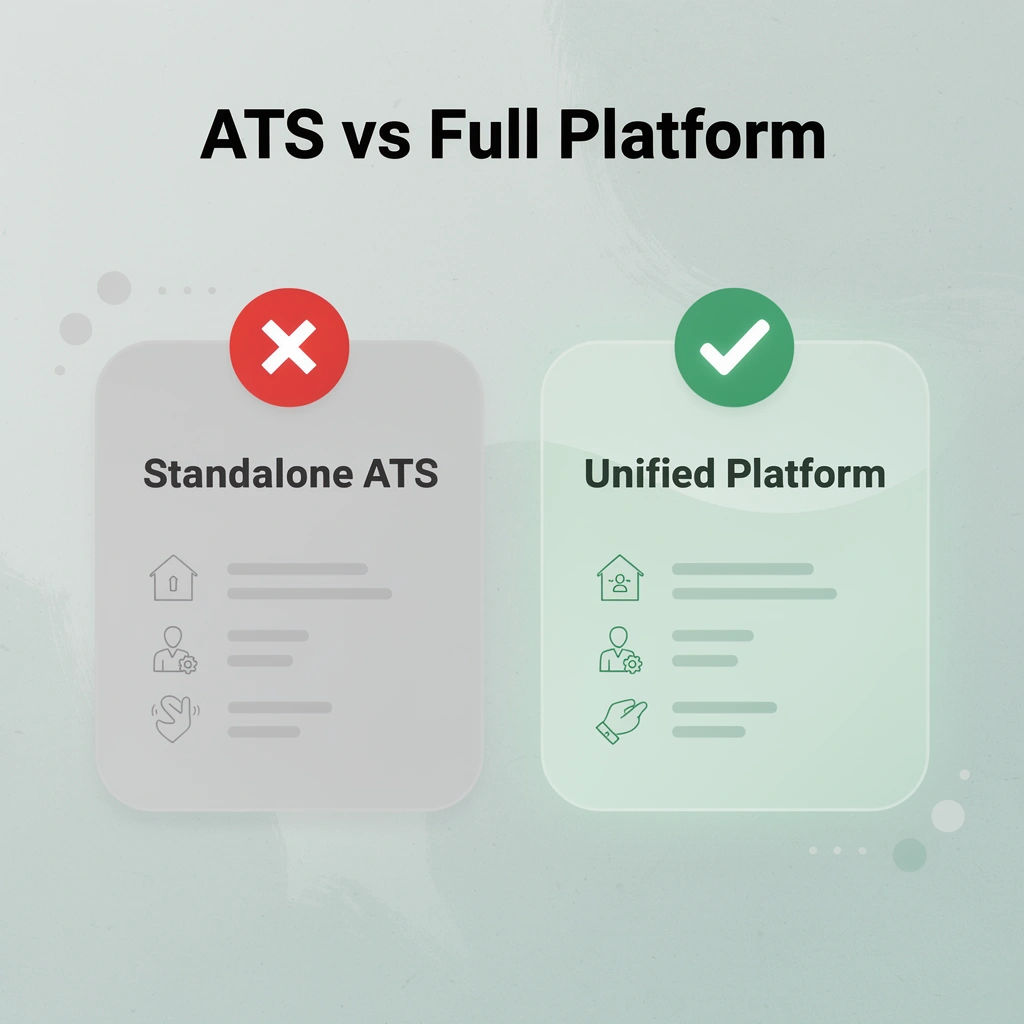
"As companies grow, recruitment becomes increasingly connected to onboarding, payroll, compliance, contractor management, and workforce planning—making a standalone ATS a liability, not an asset."
As companies grow, recruitment becomes increasingly connected to onboarding, payroll, compliance, contractor management, and workforce planning. Many HR teams manage these activities across separate platforms, creating duplicate work, fragmented data, and unnecessary administrative overhead.
⚠️ Warning: Managing recruitment in isolation from the rest of your HR stack doesn't just slow teams down—it creates data gaps and compliance risks that compound as headcount scales.
Challenge
Duplicate data entry
- Wasted time, human error
Fragmented platforms
- No single source of truth
Disconnected onboarding
- Slower time-to-productivity
Siloed compliance tracking
- Increased regulatory risk
Cercli addresses these challenges by directly connecting recruitment with the rest of the employee lifecycle. Rather than functioning as a standalone ATS, our integrated workforce platform serves organizations hiring across the UAE, Saudi Arabia, and the wider MENA region.
🎯 Key Point: Cercli isn't a replacement ATS—it's a unified workforce platform that eliminates silos between hiring, onboarding, payroll, and compliance.
💡 Tip: If your HR team is manually syncing data between your ATS and payroll or compliance tools, your stack needs deeper integration, not more point solutions.
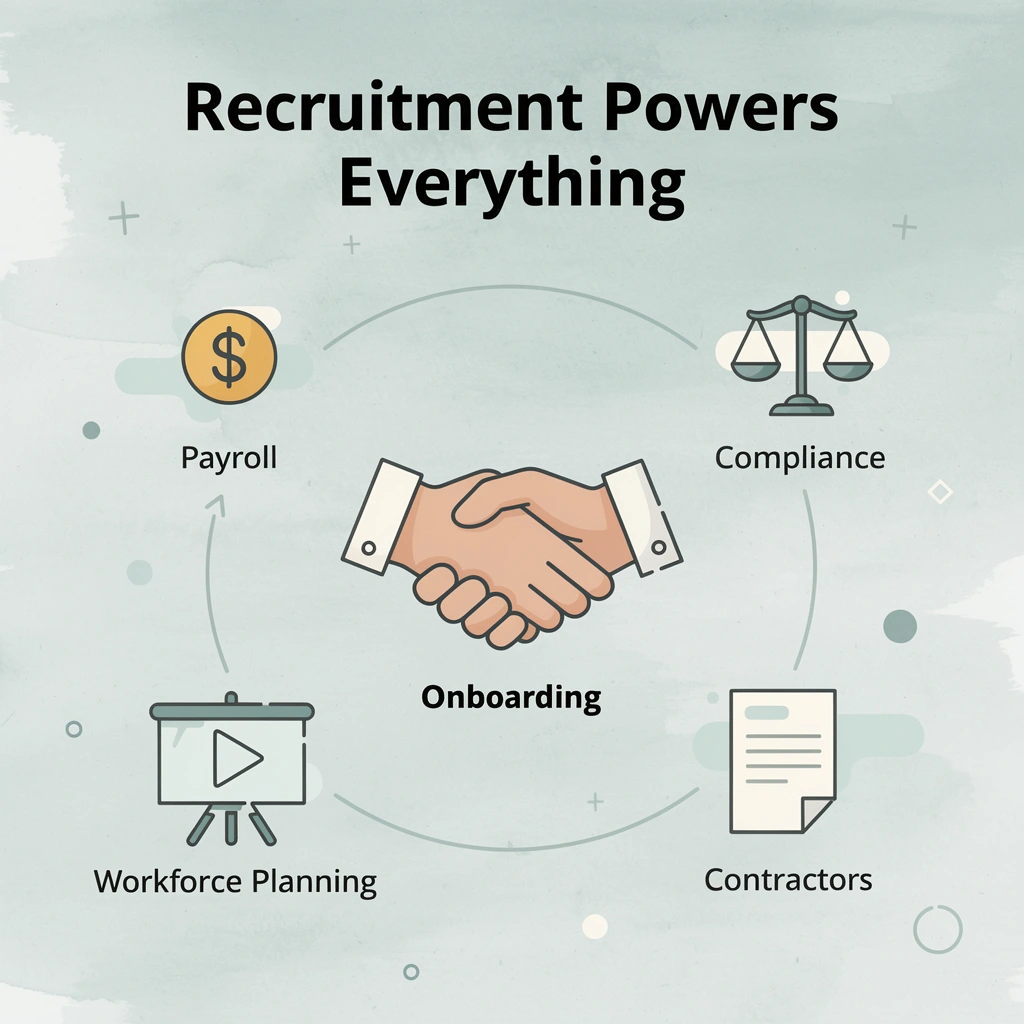
What happens when recruitment is disconnected from HR?
Challenge: Recruitment Is Disconnected From HR
Recruitment often ends when a candidate accepts an offer. HR teams then manually recreate employee records, collect onboarding documents, and transfer information into separate HR systems. This disconnect slows onboarding, increases administrative burden, and creates opportunities for errors.
How Cercli helps: Cercli connects recruitment directly with onboarding and HR management. Candidate information captured during hiring automatically flows into employee records, enabling HR teams to onboard new hires efficiently without duplicate data entry.
How does managing payroll separately affect growing organizations?
Challenge: Payroll Lives in a Separate Platform
Many organizations manage payroll separately from recruitment. Once an offer is accepted, employee details are manually transferred into payroll software, increasing the risk of inconsistent records and delayed onboarding. As organizations expand across multiple countries, these manual handoffs become harder to manage.
How Cercli helps: Cercli integrates recruitment with payroll, enabling organizations to manage hiring and workforce administration from a single platform. Our global HR system helps HR teams transition new hires into payroll while supporting multi-country operations across the MENA region.
Why does managing contractors separately create operational complexity?
Challenge: Managing Contractors Separately Creates Operational Complexity
Growing companies increasingly rely on a combination of full-time employees, contractors, freelancers, and international workers. Managing each workforce type through different systems creates fragmented records, inconsistent onboarding experiences, and additional administrative burden.
How Cercli helps: Cercli enables organizations to manage employees, contractors, and Employer of Record (EOR) hires from one platform, giving HR teams greater visibility across their entire workforce while simplifying onboarding and ongoing management regardless of engagement type.
How does regional compliance become harder to manage at scale?
Challenge: Regional Compliance Becomes Harder to Manage at Scale
Hiring across the UAE, Saudi Arabia, and other MENA markets introduces additional employment requirements, localization initiatives, payroll regulations, and country-specific HR processes. Managing these obligations manually or through disconnected systems increases operational risk as hiring volumes grow.
How Cercli helps: Cercli is built specifically for organizations operating across the MENA region. Our platform supports compliant hiring and workforce management by connecting recruitment with onboarding, payroll, contractor management, and Employer of Record services in a unified workflow.
What does one connected hiring workflow look like in practice?
Instead of treating recruitment as a separate function, Cercli connects every stage of the employee lifecycle within a single platform. Candidates can be sourced through job boards, employee referrals, recruitment agencies, or social media campaigns. Applications are automatically captured in Cercli's Applicant Tracking System, where recruiters organize candidates, manage pipelines, and collaborate with hiring managers.
Interview scheduling, feedback, evaluations, and hiring decisions are managed in one central location, allowing all recruitment stakeholders to work from the same information. Once a candidate accepts an offer, the recruitment process flows directly into onboarding without requiring HR teams to recreate employee records or move data between systems.
From there, Cercli supports the employee lifecycle through HR records, multi-country payroll, contractor management, compliance, and Employer of Record services. Organizations can manage their workforce from recruitment through ongoing employment within one connected system.
For businesses operating across the UAE, Saudi Arabia, and the wider MENA region, this integrated approach reduces administrative overhead, improves collaboration, and creates a consistent experience for both employees and HR teams.
Workable remains an excellent applicant tracking system for many organizations. However, businesses expanding across MENA often need more than just recruitment software. They need a platform that connects hiring with the operational realities of managing a modern workforce: onboarding, payroll, compliance, and cross-border employment.
Book a Demo to Speak with Our Team about Our Global HR System
If your current setup treats recruitment, onboarding, payroll, and compliance as separate problems requiring separate tools, the friction you feel is structural. A free demo with Cercli shows how our integrated workforce platform handles that complexity, built specifically for teams operating across the UAE, Saudi Arabia, and the wider MENA region.
"If your tools don't talk to each other, your team pays the price — in time, compliance risk, and operational drag." — Cercli
🎯 Key Point: Disconnected HR tools create structural friction that compounds across every hire, payroll run, and compliance deadline.
💡 Tip: A single integrated platform for recruitment, onboarding, payroll, and compliance eliminates workarounds that drain your team's time and confidence.
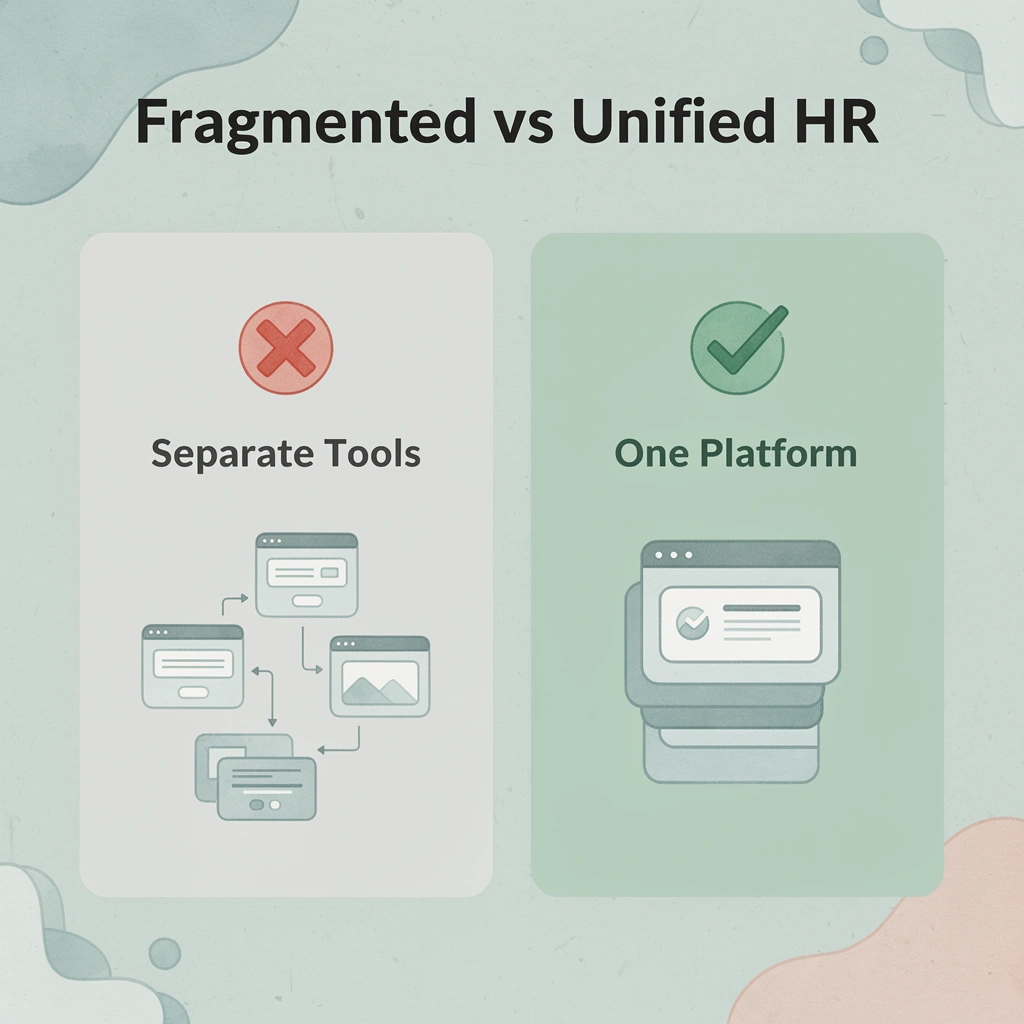
During the session, the Cercli team will map your current hiring workflow against a connected alternative, identify bottlenecks costing you time and compliance confidence, and show you what recruitment and payroll look like sharing the same system of record. Book your demo at a global HR system and see your process without the workarounds.
What Cercli Reviews
- Current hiring workflow
- Compliance bottlenecks
- Payroll & recruitment alignment
- Onboarding process
What You Gain
- A mapped view of gaps and inefficiencies
- Reduced risk across UAE & KSA regulations
- One shared system of record
- Faster, connected employee starts
✅ Best Practice: Come to your demo with a specific bottleneck in mind — whether it's payroll delays, compliance gaps, or onboarding friction — so the Cercli team can show you a direct solution.
⚠️ Warning: Every month spent managing disconnected HR tools is a month of compounding inefficiency. The real cost isn't the software — it's the time and compliance risk your team absorbs to make it work.
Related Reading
- Social Media Recruitment Strategies
- Corporate Recruitment Strategies
- Recruitment Process Outsourcing
- Top Recruitment Process Outsourcing Companies
- How To Improve The Recruitment Process
- Manatal Alternatives
- Braintrust Alternatives
- Workable Vs Greenhouse


