15 Companies Using AI for Recruitment (Benefits & Best Practices)
15 Companies Using AI for Recruitment (Benefits & Best Practices)
Companies using AI for recruitment are pulling ahead by screening candidates faster, reducing bias, and improving hire quality, while others remain buried in manual processes. Recruitment automation tools have become a genuine competitive advantage, and understanding how leading organizations deploy them, what results they drive, and which practices deliver the most value helps HR teams make smarter decisions.
For teams managing hiring across borders, the challenge goes beyond finding the right tools. It also means keeping compliance, onboarding, and workforce data aligned in one place, which is exactly what Cercli offers through its global HR system.
Summary
- AI adoption in recruitment has accelerated sharply, with over 75% of large companies now using AI-powered recruitment tools, according to Universum Global. A separate finding from HeroHunt.ai shows that 65% of companies use AI at least at one stage of their hiring process, though results vary considerably depending on how well the technology is embedded in existing workflows rather than added as a standalone layer.
- The time savings from AI are measurable and significant. Organizations using AI report up to a 40% reduction in time-to-hire, according to SHRM research, and Chipotle's deployment of an AI recruiting assistant cut the time from application to start date from 12 days to 4. These gains come primarily from removing repetitive coordination tasks from recruiters, not from replacing the human judgment involved in final hiring decisions.
- Candidate trust in AI-assisted hiring depends on maintaining a clear boundary between automation and human accountability. Research cited by Truffle found that 67% of candidates accept AI screening as long as a human makes the final hiring decision. Companies that blur or remove that boundary do not just create ethical risk; they damage candidate experience and employer reputation in ways that affect future hiring outcomes.
- Bias auditing remains a significant gap in how most organizations deploy AI for recruitment. Only 22% of companies conduct bias audits on their AI recruitment tools before deployment, according to HootRecruit. Since AI systems learn from historical hiring data, unaudited tools can reproduce and accelerate the same narrow hiring patterns that existed before the technology was introduced.
- Training and system integration are the two most common failure points when AI recruitment tools underperform. HootRecruit reports that 67% of HR professionals cite lack of proper training as the top barrier to successful AI implementation, and companies that fail to integrate AI with existing HR systems see up to 40% lower efficiency gains. Faster candidate screening produces little value if shortlisted profiles then sit in spreadsheets waiting to be manually transferred into payroll or onboarding systems.
- The employee experience connected to hiring begins well before the first day of work, and its business impact is substantial. Companies with strong onboarding improve new hire retention by 82%, according to HRMorning, and Quantum Workplace's HR Trends 2025 research found that organizations investing in employee experience are four times more profitable than those that do not. The quality of what happens between offer acceptance and the first payslip is part of the hiring outcome, not separate from it.
- Cercli's global HR system addresses the integration gap directly by consolidating recruitment, onboarding, payroll, and compliance into a single AI-native platform, so candidate data flows automatically rather than being re-entered at each stage across disconnected tools.
Why More Companies Are Using AI for Recruitment
Recruitment has changed faster in the last three years than in the previous thirty. The scale of modern hiring — more roles, more markets, more candidates — has made manual processes unsustainable. AI adoption in recruitment is a practical response to a workload problem that human effort alone cannot solve at speed.
💡 Tip: If your hiring team relies on manual screening, you're falling behind the majority of large employers who have adopted AI-assisted workflows.
"Over 75% of large companies now use AI-powered recruitment tools, and 67% of HR professionals say AI has improved their hiring process." — Universum Global
According to Universum Global's analysis of AI in recruitment, over 75% of large companies now use AI-powered recruitment tools, and 67% of HR professionals say AI has improved their hiring process. Recruiters face hundreds of applications per role, compressed hiring timelines, and candidates who expect fast, personalized communication from application onwards.
🔑 Takeaway: With two-thirds of HR professionals reporting measurable improvement, AI in recruitment is no longer experimental — it's a proven operational upgrade that directly addresses the pressure of high-volume, high-speed hiring.
Hiring Challenge
- Hundreds of applications per role
- Compressed hiring timelines
- Candidate communication expectations
Why AI Addresses It
- Automated screening filters candidates at scale
- AI accelerates shortlisting and scheduling
- Instant, personalized responses at every stage
⚠️ Warning: Companies that delay AI adoption in recruitment risk longer time-to-hire, higher drop-off rates, and losing top candidates to faster-moving competitors.
Why does volume meeting velocity create the real bottleneck?
The failure point is usually volume meeting velocity. When a company opens ten roles simultaneously across three countries, the bottleneck is not finding candidates but processing them quickly enough to act before competitors do. AI helps recruiters score applicants, flag relevant profiles, and move qualified candidates through early stages without manual input at each step. The result is faster shortlists and fewer good candidates lost to slow follow-up.
What happens when AI tools are fragmented across separate systems?
Most teams add AI tools on top of existing systems: a screening tool here, an interview scheduler there, a separate ATS elsewhere. The hidden cost is fragmented data. A candidate who progresses through three hiring stages doesn't automatically appear in the HR system, and payroll setup requires starting from scratch. When AI hiring agents are built into the same platform managing HR records and payroll, that friction disappears. Cercli operates on this principle, integrating candidate tracking, onboarding, and workforce management into a single system rather than stitching them together after the fact.
Is this actually improving outcomes?
HeroHunt.ai's 2025 review of AI adoption in recruiting found that 65% of companies use AI in at least one stage of their hiring process, though results vary significantly by implementation. Teams using AI as a standalone add-on see modest gains. Teams embedding it into structured, end-to-end hiring processes achieve meaningful improvements in both speed and quality of hire. The technology itself is consistent; the surrounding system determines outcomes.
Much of the value from AI in recruitment comes not from screening itself, but from what happens after a candidate is selected.
How Companies Use AI Throughout the Recruitment Process
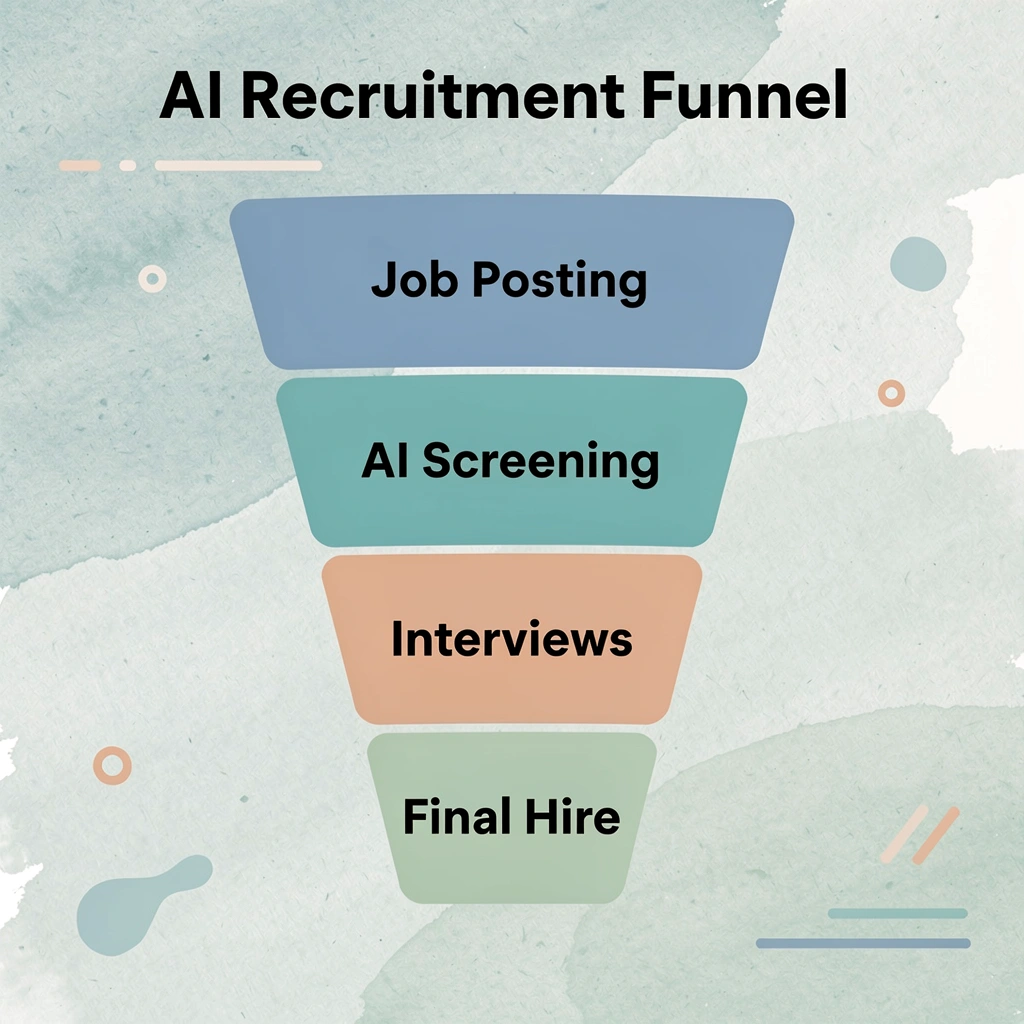
AI now touches nearly every stage of hiring, with screening creating the most leverage. According to SHRM's research on the evolving role of AI in recruitment, organizations using AI report up to a 40% reduction in time-to-hire. But time saved at the top of the funnel matters only if the rest of the process keeps pace.
"Organizations using AI report up to a 40% reduction in time-to-hire, but speed at the screening stage only delivers value when the entire hiring pipeline moves with it." — SHRM
🔑 Takeaway: A 40% reduction in time-to-hire is a significant operational win, but it's meaningful only when downstream hiring stages like interviews, assessments, and offers are equally optimized.
💡 Tip: If your organization uses AI for screening, audit whether your interview scheduling, candidate communication, and offer workflows create bottlenecks that erase those time-to-hire gains.
Sourcing and screening, where AI earns its place
Candidate sourcing is where AI does its most consistent work. AI-powered tools scan talent databases, match profiles against role requirements, and surface candidates who fit the brief without manual sifting. Resume screening follows the same logic: AI extracts qualifications, identifies relevant experience, and organizes applications by fit, freeing recruiters to focus on evaluation rather than administration. The critical discipline is using AI to prioritize, not eliminate. Candidates with non-linear career paths or unconventional formatting can be filtered out by systems that only recognize familiar patterns—a quality problem masquerading as an efficiency gain.
How do scheduling and communication tools reduce the hidden time drain?
Scheduling interviews by hand requires extensive back-and-forth messaging. AI scheduling tools suggest available times by reviewing multiple calendars, send confirmations, and automatically dispatch reminders. Automated messages keep candidates informed at each stage, without recruiters having to write individual responses. Together, these tools reduce administrative burden and frustration for candidates juggling multiple interviews.
How does consolidating recruitment and HR data eliminate re-entry work?
Most teams manually copy candidate details into separate HR systems, then update payroll records once someone is hired—a process that breaks down as volume increases. Cercli brings together recruitment, HR, and payroll in one AI-native platform, so information gathered during hiring moves forward automatically rather than being re-entered at each stage. The result is less time on platform administration and more time on people.
Skills assessments and what they actually reveal
Skills-based hiring has transformed how AI functions in the hiring process. Rather than relying on job titles and degrees, AI-supported assessments evaluate what candidates can do through technical exercises, role-specific scenarios, or structured competency evaluations. AI surfaces patterns across candidates that individual reviewers might miss, particularly when hiring at volume. Recruiters and hiring managers make final decisions with stronger evidence.
Recruitment analytics the layer most teams underuse
Over 50% of HR teams now use AI tools to improve talent acquisition and retention strategies, yet analytics remains the least-used AI capability in most recruitment functions. AI can identify where candidates drop off in the funnel, which sourcing channels produce the strongest hires, and how each stage's duration compares to benchmarks. Teams using recruitment analytics make fewer reactive decisions and more deliberate ones.
The companies getting the most from AI in recruitment are not necessarily those with the most sophisticated tools, but rather those where AI is embedded in a system that connects hiring to everything that follows.
Related Reading
- Candidate Screening Questions
- Candidate Screening Process
- Automated Candidate Screening
- Steps in the Recruitment Process
- End to End Recruitment Process
- Recruiting Funnel Metrics
- AI in Recruitment Examples
- Recruitment Lifecycle
- Best Recruitment Strategies
15 Companies Using AI for Recruitment
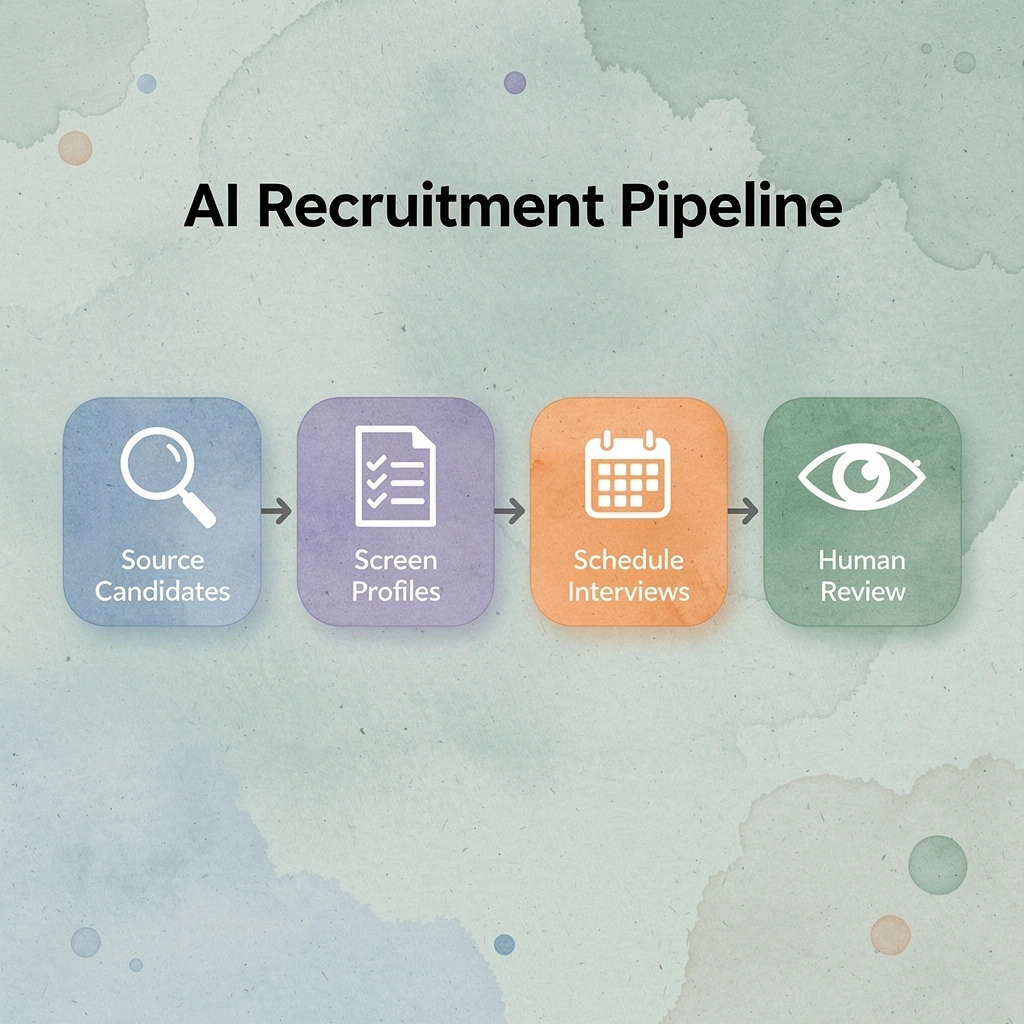
Organizations across industries use AI to automate repetitive recruitment tasks—from candidate sourcing and screening to interview scheduling—while keeping hiring decisions under human oversight.
"AI is transforming recruitment by automating repetitive tasks—from candidate sourcing and screening to interview scheduling—so human teams can focus on what matters most: making the right hire." — Industry Insight
💡 Tip: Companies that leverage AI-powered recruitment tools free up their hiring teams to focus on high-value decisions rather than manual, time-consuming tasks.
🎯 Key Point: The most effective AI recruitment strategies strike a balance—letting automation handle repetitive workflows while keeping humans firmly in control of final hiring decisions.
Recruitment Task
- AI Role: Automated search & matching
- Human Role: Final candidate approval
Resume Screening
- AI Role: Filters & ranks applicants
- Human Role: Reviews shortlisted profiles
Interview Scheduling
- AI Role: Automates coordination
- Human Role: Confirms and conducts interviews
Hiring Decision
- AI Role: Provides data-driven insights
- Human Role: Final decision authority
1. Cercli (HR Technology, MENA)
View AI as a tool that enhances work within connected recruitment workflows rather than as a standalone hiring solution. Its platform combines AI-supported recruitment with an ATS, candidate pipeline management, recruitment analytics, hiring manager collaboration, onboarding, payroll, compliance, contractor management, and Employer of Record (EOR) services.
2. Unilever (Consumer Goods)
Was an early adopter of AI, using AI-powered game-based assessments to evaluate cognitive and behavioral traits alongside AI-assisted video interviews to standardize early-stage evaluations during high-volume graduate recruitment.
3. Chipotle (Restaurants)
Uses an AI recruiting assistant called Ava Cado, built with Paradox, to answer candidate questions, collect applicant information, schedule interviews, and automate communication. This reduced the average time from application to start date from 12 days to four days while increasing application completion rates.
4. Mastercard (Financial Services)
Uses AI to personalize candidate engagement, automate interview scheduling, improve talent pipeline management, and support recruiter productivity through AI-powered recruitment marketing and talent community management.
5. Bridgestone (Manufacturing)
Uses conversational AI to engage applicants, answer questions, screen candidates, and schedule interviews immediately after application submission, accelerating hiring while maintaining recruiter oversight.
6. Electrolux Group (Manufacturing)
Modernized recruitment using AI-powered candidate matching, recruitment marketing, automated interview scheduling, and talent CRM capabilities, reporting improvements in application conversion rates and reductions in time-to-hire.
7. GE Appliances (Manufacturing)
Uses AI-powered recruitment technology to automate candidate communication and improve recruiter responsiveness, helping engage applicants more quickly.
8. ServiceNow (Enterprise Software)
Uses AI to improve candidate sourcing and build stronger talent pipelines by identifying relevant candidates and supporting sourcing activities across large hiring programs.
9. Siemens (Industrial Technology)
Is an early customer of LinkedIn's AI-powered Hiring Assistant, which supports talent sourcing, candidate identification, and recruiter collaboration while recruiters retain final hiring authority.
10. AMD (Semiconductors)
Uses LinkedIn's Hiring Assistant to identify qualified talent, reducing the number of profiles recruiters must review and improving sourcing productivity.
11. Microsoft (Technology)
Uses LinkedIn's Hiring Assistant to improve candidate sourcing, recruiter collaboration, and talent discovery. AI recommends suitable candidates and streamlines sourcing activities while maintaining human oversight.
12. Compass Group (Hospitality & Food Services)
Uses conversational AI to automate candidate communication, answer questions, schedule interviews, and engage applicants outside business hours, enabling a small recruitment team to manage high hiring volumes
13. Land O'Lakes (Agriculture)
Uses AI to personalize candidate engagement throughout the recruitment process, delivering more relevant communication and helping recruiters build stronger relationships with prospective candidates.
14. Medtronic (Healthcare Technology)
Uses AI-powered recruitment technology to improve candidate sourcing, automate candidate engagement, and increase recruiter productivity while managing hiring at scale.
15. Hilton (Hospitality)
Uses AI-powered recruitment technology to automate candidate communication, answer applicant questions, support interview scheduling, and improve the candidate experience during high-volume hiring. This approach reduces friction in the application process while helping recruiters respond more quickly to candidates.
Related Reading
- Recruitment Analytics Software
- How Can I Use Ai To Improve My Job Descriptions
- Hr Automation Tools
- Best Job Descriptions
- How To Write A Job Description
- Automate Interview Scheduling
- How To Use Ai In Recruitment
- Candidate Screening Tools
- Best Tools For Remote Recruitment
- Best Recruitment Crm
What Can HR Teams Learn from These Companies?
The most effective HR teams thought carefully about where human judgment ends and where automation should begin, then deliberately built their entire processes around that critical line.
"The most effective HR teams didn't automate everything — they identified the exact boundary between human judgement and automation, and engineered their workflows around it." — Key Industry Insight
🎯 Key Point: The single most important decision an HR team can make is identifying precisely where human judgment is irreplaceable — and protecting that space from over-automation.
💡 Tip: Map your hiring and people-management workflows step by step, then mark each stage as either "human-led" or "automation-ready" — this exercise alone can transform your HR strategy.
Workflow Stage
- Resume screening & filtering
- Best Handled By: Automation
- Why: High volume, rule-based criteria
- Cultural fit assessment
- Best Handled By: Human judgement
- Why: Nuance, empathy, context
- Scheduling & logistics
- Best Handled By: Automation
- Why: Repetitive, time-consuming tasks
- Final hiring decisions
- Best Handled By: Human judgement
- Why: Accountability and relationship
- Onboarding communications
- Best Handled By: Automation
- Why: Consistency and scale

Where does AI fit, and where do people still need to lead?
Looking across companies like Unilever, Chipotle, and Siemens, the pattern is clear: AI handles work that doesn't require a person, and people handle work that does. Resume screening, interview scheduling, and application acknowledgments are administrative tasks that consume recruiter time without improving hiring quality. Automating them frees recruiters to focus on higher-value work.
Recruiters spend most of their working hours on coordination rather than evaluation. When AI takes on that coordination layer, recruiters have more time to prepare for interviews, build relationships with hiring managers, and assess candidate fit. According to HRMorning, companies with strong onboarding improve new hire retention by 82%, meaning the recruiter's role extends beyond the offer letter. The quality of post-hire experience requires human attention.
Why does system integration determine whether AI delivers real value?
Most teams handle recruitment and HR administration in separate systems, creating delays, duplicate data entry, and visibility gaps at each handoff. Teams using Cercli find that running recruitment, HR, and payroll in a single AI-native platform eliminates that friction, enabling a seamless transition from candidate to employee.
The critical difference between companies that gain real value from AI and those that do not comes down to integration. AI operating within a connected system can flag a candidate, schedule their interview, and feed their accepted offer directly into onboarding and payroll workflows without manual data entry. Quantum Workplace's HR Trends 2025 research found that organizations investing in employee experience are four times more profitable than those that do not, and the employee experience begins the moment a candidate hears back from you.
What these companies figured out is that AI is not a hiring strategy—it is an infrastructure decision. Build it into a fragmented stack, and it optimizes one step while friction absorbs the gains elsewhere. Build it into a connected system, and it changes the pace and quality of the entire hiring lifecycle.
Common Mistakes Companies Make When Implementing AI in Recruitment
AI recruitment projects fail not because of the technology itself, but because of the assumptions teams bring to the decision — before they even pick any tool.
"The root cause of most AI recruitment failures isn't the algorithm — it's the unchecked assumptions baked in before implementation even begins." — Industry Insight
⚠️ Warning: The most costly mistakes in AI-driven hiring happen before a single line of code is deployed — they start with flawed thinking, not flawed software.
💡 Tip: Before committing to any AI recruitment tool, your team must audit its own assumptions about bias, data quality, and process readiness — these are the real make-or-break factors.
Common Assumption
- AI will fix a broken process
- The tool handles everything
- Data is always neutral
The Reality
- AI amplifies existing flaws; it doesn't correct them
- Human oversight remains critical at every stage
- Biased training data produces biased outcomes

When training is treated as optional
The failure point is usually not the software. HootRecruit reports that 67% of HR professionals cite lack of proper training as the top barrier to successful AI implementation in recruitment. Teams adopt AI tools, hand them to recruiters without instruction, and blame the technology when results disappoint. AI in recruitment requires a shift in how recruiters think about their role, not a new browser tab.
What happens when AI runs on a broken stack?
When AI is added to disconnected systems, it reduces efficiency in moving information between steps. According to HootRecruit, companies that don't integrate AI with their existing HR systems see up to 40% lower efficiency gains. Scoring candidates faster provides little benefit if shortlisted profiles remain in a spreadsheet, awaiting manual transfer to payroll or onboarding systems.
How do disconnected point solutions create bottlenecks as hiring scales?
Most teams use point solutions: an AI screener here, an ATS there, payroll elsewhere. As hiring volume grows, gaps between systems become the problem. Platforms like Cercli put AI hiring agents inside the same system that manages HR and payroll, so candidates move from screening through offer, onboarding, and payroll without re-entering data or seeking approvals across different tools.
The bias problem nobody audits
Only 22% of companies conduct bias audits on their AI recruitment tools before deployment, according to HootRecruit. This means most organizations that use AI to screen candidates lack a verified understanding of the patterns their systems reward. AI learns from historical hiring data, and if that data reflects a narrow profile of past hires, the system reproduces that pattern at scale, faster than any human reviewer could catch it.
Measuring the wrong thing
Measuring AI success only by hiring speed misses critical problems: a person hired quickly who leaves after 90 days, or a strong candidate screened out who was the best fit, does not appear in speed metrics. Recruitment quality, candidate experience, and diversity outcomes are harder to measure but more important. Organizations that maximize AI recruitment tools define success across the entire hiring process, not just the initial stage.
The gap between what AI recruitment promises and what most teams experience comes down to infrastructure: whether the foundation underneath can handle the weight.
How Cercli Helps Companies Implement AI Across the Recruitment Lifecycle
Many organizations discover that AI technology alone doesn't solve their biggest hiring challenges. High application volumes, manual administrative work, disconnected systems, and limited visibility across the hiring process create bottlenecks. To realize the full value of AI, organizations need a platform that connects recruitment with the employee lifecycle.
"AI technology alone doesn't solve hiring challenges — organizations need a platform that connects recruitment with the entire employee lifecycle to unlock real value." — Key Insight
🎯 Key Point: The barrier to AI-driven hiring isn't the technology itself — it's the lack of integration between recruitment tools and workforce systems.
⚠️ Warning: Deploying AI in isolation leaves teams buried in manual work, disconnected data, and process bottlenecks, defeating the purpose of automation.
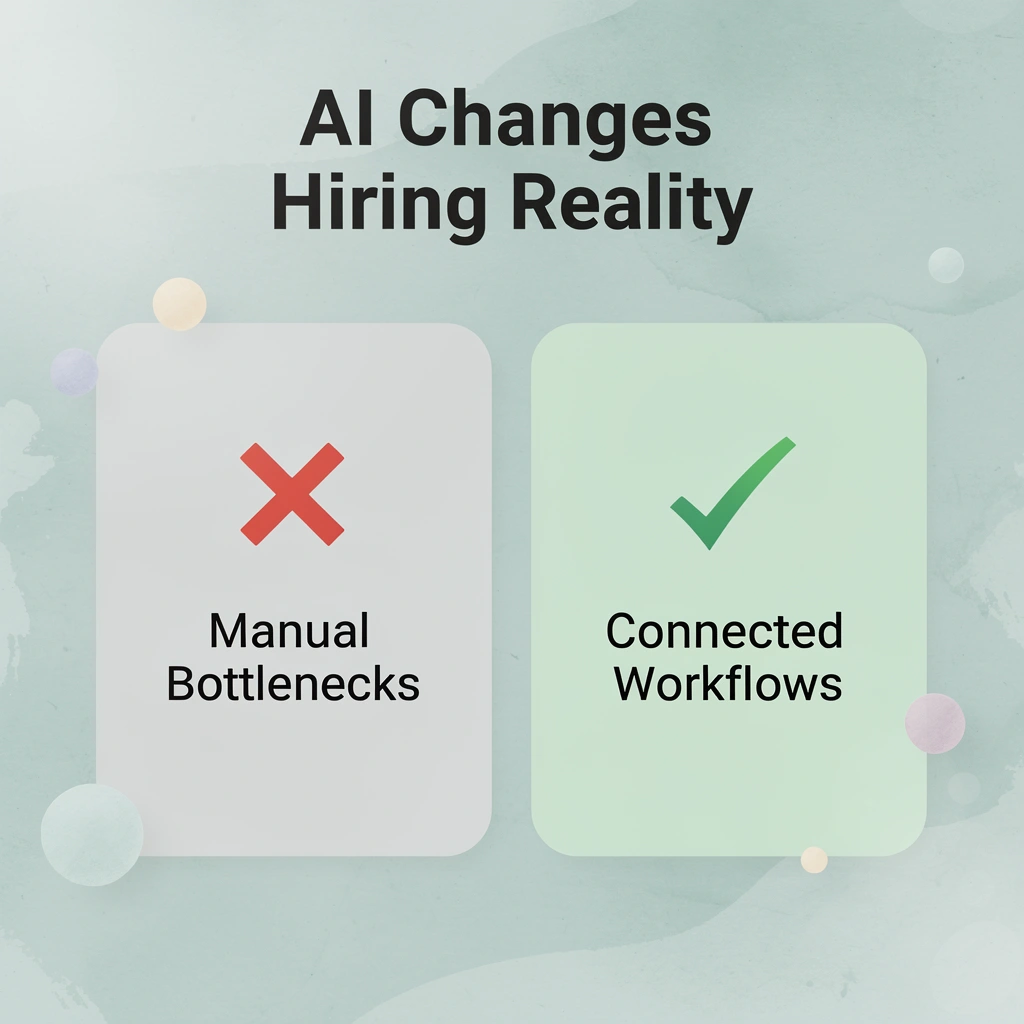
Cercli enables organizations to incorporate AI into connected recruitment workflows that support hiring teams from candidate sourcing through onboarding and ongoing workforce management.
Recruitment Stage
- Candidate Sourcing
- Hiring Workflows
- Onboarding
- Workforce Management
Cercli AI Capability
- AI-powered talent discovery and matching
- Automated, connected process management
- Seamless transition from hire to employee
- Ongoing visibility across the employee lifecycle
✅ Best Practice: Choose a platform like Cercli that supports the entire hiring journey — from first touchpoint to fully onboarded employee — rather than patching together disconnected point solutions.
💡 Tip: Connected recruitment workflows don't just save time — they give hiring teams real-time visibility and meaningful control at every stage of the employee lifecycle.
How does Cercli bring AI into everyday recruitment workflows?
Recruiters spend considerable time on administrative tasks such as reviewing applications, advancing candidates through hiring stages, coordinating interviews, and updating recruitment records. Cercli's AI-supported workflows accelerate these repetitive activities while keeping recruiters and hiring managers in control of candidate evaluation and final hiring decisions. Rather than replacing human judgment, AI helps recruitment teams work more efficiently and focus on building relationships with qualified candidates.
How does managing recruitment from a single platform improve hiring?
Recruitment becomes fragmented when applicant tracking, hiring collaboration, onboarding, and workforce administration are handled in separate systems. Cercli's integrated Applicant Tracking System (ATS) enables organizations to manage candidate pipelines, track recruitment progress, collaborate with hiring managers, and monitor hiring performance from a single platform. Centralized recruitment analytics and pipeline visibility allow hiring teams to identify bottlenecks, make informed decisions, and improve recruitment efficiency as hiring demands grow.
How does Cercli connect hiring with onboarding and workforce management?
Once a candidate accepts an offer, organizations must complete onboarding, prepare payroll, manage employment documentation, and ensure compliance with local labor regulations. Cercli connects recruitment directly with onboarding, payroll, compliance management, contractor management, and Employer of Record (EOR) services. This reduces duplicate administrative work and creates a smoother transition from candidate to employee while giving HR teams greater visibility across the entire workforce lifecycle.
How does Cercli help organizations build a scalable recruitment process?
As organizations grow, larger applicant pools, multiple hiring managers, international hiring, and changing compliance requirements overwhelm manual processes. Cercli provides a connected platform that helps organizations scale recruitment without losing visibility or control. By combining AI-supported recruitment workflows with applicant tracking, recruitment analytics, onboarding, payroll, compliance, contractor management, and EOR capabilities, our global HR system enables companies to build efficient hiring processes while maintaining the human oversight needed for confident hiring decisions.
Book a Demo to Speak with Our Team about Our Global HR System
If your recruitment workflow still depends on separate tools for sourcing, screening, onboarding, and payroll, you are not running AI recruitment — you are running manual coordination with an AI layer on top, and the gap between the two is where time and quality quietly disappear.
"The gap between true AI recruitment and manual coordination with an AI layer is exactly where time and quality quietly disappear." — Cercli
🎯 Key Point: A fragmented tech stack isn't an AI strategy — it's a liability. Every disconnected tool erodes hiring quality and operational efficiency.
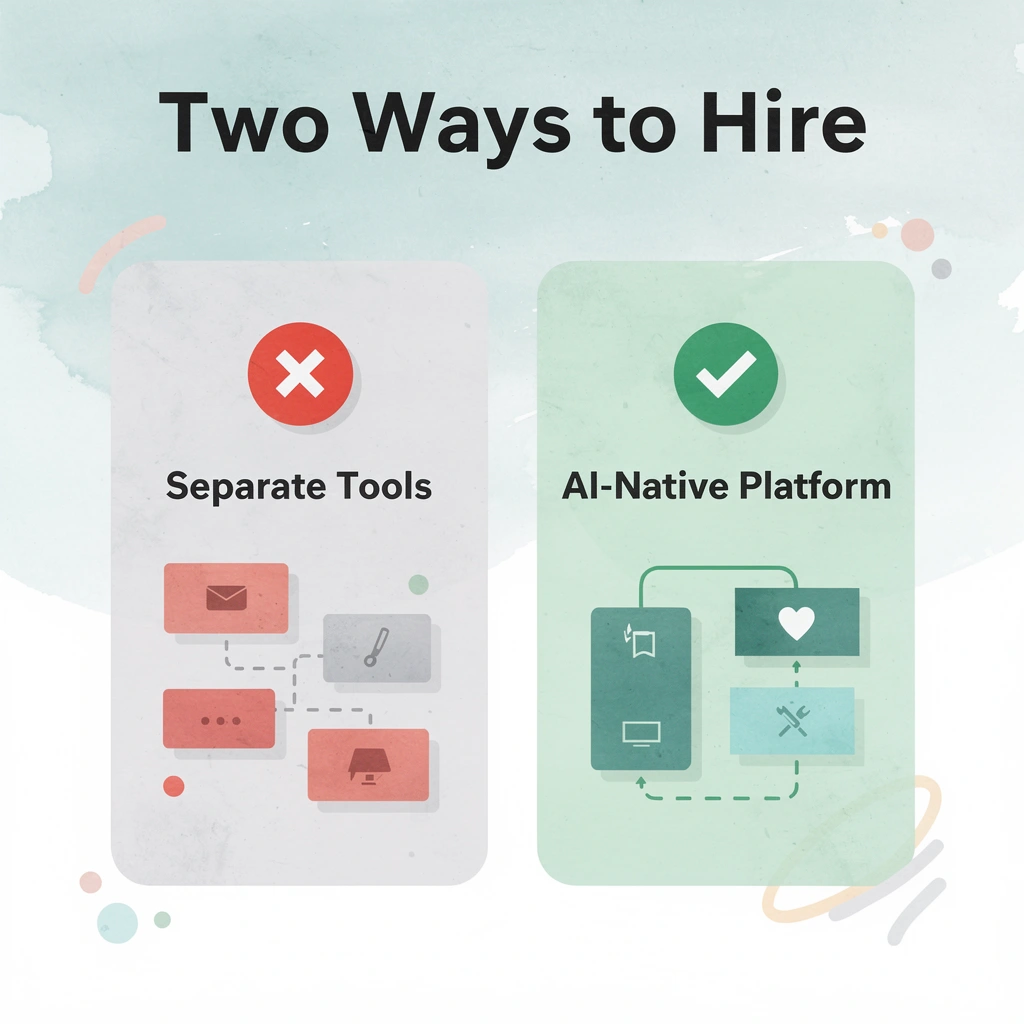
Cercli is built as an AI-native platform where recruitment, HR, payroll, compliance, contractor management, and EOR services sit in the same system. Book a demo with the Cercli team to see how connected hiring workflows reduce friction and free up time for your people, not your platforms.
Fragmented Stack
- Separate sourcing, screening & payroll tools
- Manual data transfers between platforms
- Compliance gaps across borders
- Slow, error-prone onboarding
Cercli AI-Native Platform
- All-in-one connected system
- Seamless, automated data flow
- Built-in global compliance
- Streamlined EOR & contractor management
💡 Tip: Booking a demo takes minutes — and seeing Cercli's unified workflow in action is the fastest way to understand how much time your team is losing to platform-switching.
✅ Best Practice: Look for an HR and recruitment platform that handles every stage — from sourcing to global payroll — in one place. That's the real definition of AI-native hiring.
Related Reading
- Social Media Recruitment Strategies
- Corporate Recruitment Strategies
- Recruitment Process Outsourcing
- Top Recruitment Process Outsourcing Companies
- How To Improve The Recruitment Process
- Workable Alternatives
- Manatal Alternatives
- Braintrust Alternatives
- Workable Vs Greenhouse


