Steps in Recruitment Process: A Guide to Hiring the Right People
.jpg)
Steps in the Recruitment Process: A Guide to Hiring the Right People
Finding the right person for your team shouldn't feel like searching for a needle in a haystack, yet many companies struggle with lengthy hiring cycles, missed opportunities, and candidates who slip through the cracks. The recruitment process involves multiple stages, from identifying talent needs and posting job descriptions to screening candidates, conducting interviews, and making final offers. Understanding each step in the recruitment process helps you build a structured hiring approach, reduce time-to-hire, and ultimately bring the best people on board. Whether you're a small business owner handling your first hire or an HR professional looking to refine your candidate selection strategy, mastering these essential recruitment stages will help you execute each one effectively.
Modern recruitment automation tools can transform how you manage these hiring stages, taking repetitive tasks off your plate so you can focus on what matters most: connecting with great candidates. Instead of juggling spreadsheets and email threads, companies need a clear view of where each candidate stands in their pipeline, making it easier to move qualified people forward quickly and keep the hiring process organized from start to finish. Streamlining your entire recruitment workflow becomes much simpler with the right technological foundation, such as a comprehensive global HR system.
Summary
- Recruitment delays often stem from problems that exist before job postings go live. Weak workforce planning, unclear role definitions, and misaligned stakeholders create hiring failures that no amount of candidate sourcing can fix. When responsibilities and success criteria remain vague, job descriptions attract unsuitable applicants while qualified candidates ignore the posting. LinkedIn's Future of Recruiting 2025 report found that 37% of talent acquisition professionals say administrative tasks prevent them from focusing on strategic recruiting activities, revealing how operational inefficiencies consume hours that could be spent evaluating talent.
- Candidate experience directly influences whether qualified people accept your offer or walk away. CareerPlug's 2025 Candidate Experience Report revealed that 66% of candidates accepted a job offer because of a positive hiring experience, while 26% declined due to a negative one. Delays and unclear communication, often rooted in poor planning and disconnected systems, signal how an organization operates. Research from the CoRecruit Blog reports that 47% of candidates withdraw their applications due to poor communication, reflecting broader concerns about whether the organization can coordinate internally and respect candidates' time.
- Most recruitment delays happen during screening, not because screening is inherently slow but because it's done manually at scale. SHRM's 2025 Recruiting Benchmarking Report shows the average cost per hire reaches $4,700, much of which stems from time spent on administrative screening tasks that could be automated. When recruiters spend hours reviewing hundreds of applications to find a handful worth interviewing, the process becomes a bottleneck that slows every subsequent stage and increases the likelihood that strong candidates will accept competing offers.
- Technology reduces time spent on administrative tasks by automating candidate routing, interview scheduling, and approval processes. According to Insight Global, AI reduces time-to-hire by an average of 40%, allowing recruiters to move candidates through the pipeline faster without sacrificing quality. The goal is not to remove human judgment but to eliminate repetitive work that prevents recruiters from building stronger talent pipelines, engaging passive candidates, and supporting hiring managers more effectively.
- Structured evaluation frameworks improve hiring consistency and reduce bias in candidate selection. Criteria's 2024 Candidate Experience Report found that more than 25% of candidates reported experiencing bias during interviews, highlighting the importance of standardized screening criteria, candidate scorecards, and shared evaluation frameworks. When every interviewer evaluates candidates using the same criteria rather than personal preferences, hiring decisions become faster, more defensible, and more reliable across different roles and departments.
- Cercli's global HR system integrates recruitment, onboarding, employee records, payroll, and compliance documentation into a single workflow, reducing duplicate data entry and accelerating the transition from candidate to employee.
Why Recruitment Problems Often Start Before Hiring Begins
Most organizations think hiring begins when they post a job advertisement. The biggest hiring failures are already locked in by that point. Weak workforce planning, unclear role definitions, and misaligned stakeholders create problems that candidate sourcing cannot fix.

🎯 Key Point: The foundation of successful hiring is built long before you ever meet a candidate. Strategic preparation determines whether your recruitment efforts will succeed or fail.
"Poor workforce planning and unclear role definitions are responsible for most hiring failures, creating problems that cannot be solved through better candidate sourcing alone."

⚠️ Warning: Organizations that skip the pre-hiring planning phase often find themselves in a cycle of bad hires, regardless of how many qualified candidates they interview.
The Foundation Cracks Before the First Application
Unclear responsibilities and success criteria attract unsuitable applicants and slow down the screening process. Recruiters struggle to find qualified candidates because the target keeps shifting—not from a shortage of talent, but from failing to define what success looks like before the search begins.
People not agreeing on goals compounds the issue. Recruiters, hiring managers, finance teams, and leadership often have conflicting views on pay, required experience, and role priorities. These disagreements surface during interviews or in approval processes, causing delays that frustrate candidates and waste weeks of effort. The problem originates long before anyone reviews a resume.
Where Time Gets Lost
The administrative burden of hiring often bears little relation to candidate quality. LinkedIn's Future of Recruiting 2025 report found that 37% of talent acquisition professionals say administrative tasks prevent them from focusing on strategic recruiting activities.
Scheduling conflicts, feedback collection, and process coordination consume hours that could be spent evaluating talent or building relationships with promising candidates.
How do recruitment delays impact candidate decisions?
CareerPlug's 2025 Candidate Experience Report found that 66% of candidates accepted a job offer because of a positive hiring experience, while 26% turned it down due to a negative one. Delays and unclear communication determine whether qualified candidates join your team or decline the offer.
Building Better Foundations
Good recruitment depends on preparation before a job is advertised. Clear workforce planning sets hiring priorities that match business needs. Team members should agree on candidate evaluation criteria, pay ranges, and decision-making authority before applications arrive.
How do structured workflows improve hiring efficiency?
Structured workflows define who reviews applications, how feedback is collected, and when decisions are made.
Cercli's global HR system connects recruitment directly to workforce planning and approval workflows. Rather than managing hiring through spreadsheets and email threads, our platform helps teams align stakeholders, define role requirements, and structure their hiring process within the same system that handles HR and payroll. This integration reduces administrative friction and accelerates movement from approved headcount to qualified candidates.
Why do hiring processes feel harder than they should?
Understanding what happens during recruitment and where each stage breaks down reveals why so many hiring processes feel harder than they should be.
What Is the Recruitment Process?
The recruitment process is the organized sequence that companies follow from identifying a hiring need through bringing a new employee into the team. It includes defining role requirements, finding candidates, screening applications, conducting interviews, managing offers, and onboarding. The process helps companies find qualified people efficiently while creating an experience that reflects how they treat their people.

🎯 Key Point: A well-structured recruitment process serves as both a talent acquisition tool and a brand ambassador for your company culture.
"The recruitment process is not just about filling positions—it's about creating the first impression that determines whether top talent wants to join your organization." — HR Industry Best Practices, 2024

💡 Example: A tech startup might follow this sequence: identify skill gaps → post on job boards → screen resumes → conduct technical interviews → check references → extend offers → complete onboarding—each step designed to find the right fit while showcasing company values.
Why does the recruitment process matter for organizations?
The framework is straightforward: identify the need, attract candidates, evaluate fit, make a selection, and integrate the hire. But execution is where most organizations struggle. According to CareerBuilder, 78% of candidates say the overall candidate experience reflects how a company values its people. The process signals culture, priorities, and respect for candidates' time.
Why the process matters beyond filling seats
A well-structured recruitment process reduces time-to-hire, improves quality of hire, and protects the organization's reputation in talent markets. A broken process frustrates hiring managers, wastes recruiter time, and drives qualified candidates to competitors who move faster and communicate better.
CoRecruit Blog reports that 47% of candidates withdraw their application due to poor communication. Candidates assess whether the organization can coordinate internally, respect their time, and follow through on commitments. A disorganized hiring process signals a disorganized work environment.
What causes recruitment process fragmentation?
Most organizations run hiring across fragmented systems: job descriptions in documents, applications via email or an applicant tracking system, interview feedback in spreadsheets or Slack threads, offer approvals via email chains, and onboarding on separate platforms.
This fragmentation creates delays, miscommunication, and administrative overhead. Recruiters spend hours chasing feedback and coordinating schedules, while hiring managers lose track of candidates in the pipeline. Candidates face long silences, unclear next steps, and inconsistent communication.
How do integrated platforms solve these breakdowns?
Platforms like a global HR system solve this problem by integrating recruitment, HR, and payroll into one workflow. Our Cercli platform helps teams define roles, track candidates, collect feedback, and move new hires into onboarding without switching between systems or re-entering data.
Understanding how each stage works and where problems most often occur is important for improving the process.
Related Reading
- Recruitment Automation Tools
- Candidate Screening Questions
- Candidate Screening Process
- Automated Candidate Screening
- End-to-End Recruitment Process
- Recruiting Funnel Metrics
- AI in Recruitment Examples
- Recruitment Lifecycle
- Best Recruitment Strategies
The 8 Key Steps in the Recruitment Process
Understanding recruitment means examining each stage as a checkpoint where quality, speed, and candidate experience improve or decline. What follows is the practical sequence most organizations use to move from headcount approval to productive employees.
🎯 Key Point: Every recruitment stage is a quality gate that either enhances or diminishes your hiring outcomes. Missing steps or rushing through checkpoints leads to poor hires and candidate drop-off.

"Organizations with a structured recruitment process are 67% more likely to make successful hires and reduce time-to-fill by 25% compared to ad-hoc hiring approaches." — Society for Human Resource Management, 2023
💡 Tip: Treat each recruitment step as an opportunity to both evaluate candidates and sell your organization. The best talent has options, so the quality of your process directly impacts whether top candidates accept your offers.
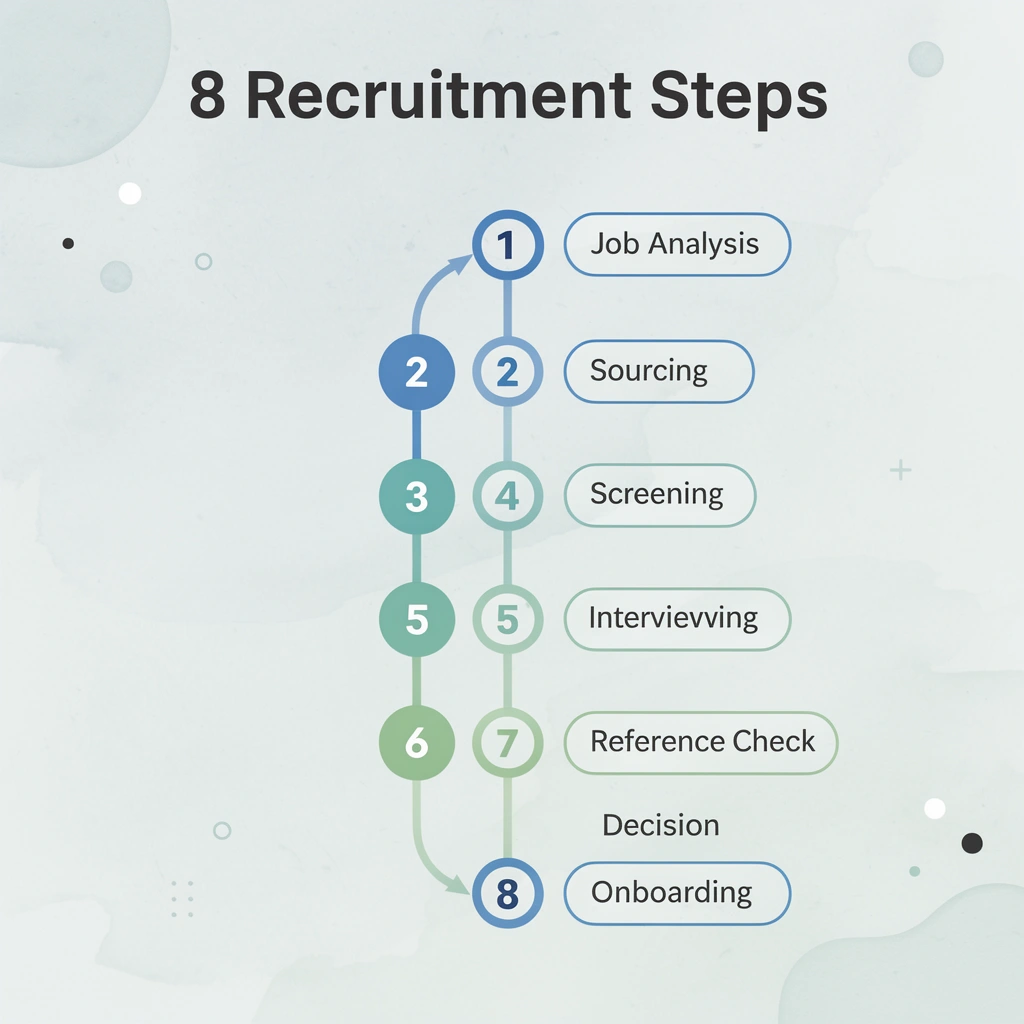
Recruitment Stage
Job Analysis
- Define requirements
- Clear role specifications
Sourcing
- Find candidates
- Quality applicant pool
Screening
- Initial evaluation
- Qualified candidate shortlist
Interviewing
- Deep assessment
- Best-fit identification
Selection
- Final decision
- Chosen candidate
Offer Management
- Negotiation
- Accepted offer
Onboarding
- Integration
- Productive employee
Evaluation
- Process review
- Continuous improvement
Step 1: Workforce Planning and Role Definition
The strongest hiring outcomes begin before anyone writes a job description. Workforce planning identifies which roles matter most, when they need to be filled, and what success looks like for each position.
How does proper workforce planning prevent hiring misalignments?
This requires the finance department, department heads, and HR to agree on headcount, budget limits, reporting structures, and performance expectations. When rushed, hiring managers request candidates without defining "qualified," recruiters source mismatched profiles, and interview panels discover they're evaluating against different criteria.
Clear role definition prevents these misalignments by establishing scope, seniority, and success metrics before sourcing begins.
Step 2: Job Description Creation
A well-written job description outlines what the role involves, the required skills and experience, and why candidates would want the position. Strong descriptions distinguish must-have requirements from nice-to-have ones, include realistic pay ranges when possible, and avoid confusing language that deters capable candidates.
Poorly written job descriptions attract the wrong applicants and push away the right ones. Unclear requirements ("must be a team player") or unrealistic ones ("10 years of experience in a technology released three years ago") cause qualified candidates to skip the posting, while unqualified ones apply in large numbers, increasing screening burden.
Step 3: Candidate Sourcing
Sourcing identifies where qualified candidates are and how to reach them through job boards, employee referral networks, professional platforms, or direct outreach to passive candidates. Senior positions typically require direct outreach, while high-volume roles benefit from broad advertising.
Most organizations treat sourcing as a single action rather than an ongoing effort. Strong talent pipelines are built through consistent engagement over time. Teams that maintain relationships with potential candidates, even when not actively hiring, reduce time-to-fill when urgent needs arise.
Step 4: Candidate Screening
Screening separates applicants who merit interviews from those who don't meet basic requirements. This stage typically involves reviewing resumes, analyzing application questions, assessing skills, and conducting initial phone screenings. The goal is to identify candidates with sufficient relevant experience, qualifications, and interest for further evaluation.
Why does structured screening matter more than gut feel?
Unstructured screening creates inconsistency. When recruiters apply varying standards or evaluate applications based on gut feeling rather than defined criteria, qualified candidates are rejected while unsuitable ones advance. Structured screening uses consistent rubrics, knockout questions for essential requirements, and blind review processes to reduce bias and improve decision quality.
Where do most recruitment delays actually happen?
Most recruitment delays occur during manual screening of high application volumes. According to SHRM's 2025 Recruiting Benchmarking Report, the average cost per hire reaches $4,700, much of which stems from administrative screening tasks that could be automated. When recruiters spend hours reviewing hundreds of applications to identify candidates for interviews, the process becomes a bottleneck.
Step 5: Interviews and Candidate Evaluation
Interviews reveal how candidates think, communicate, and solve problems—details a resume cannot provide. Structured formats with identical questions for all candidates, clear evaluation criteria, and multiple interviewers reduce personal bias. Behavioral questions ("Tell me about a time when...") and practical assessments (case studies, technical tests, work samples) predict job performance better than hypothetical scenarios.
What causes interview inconsistency and bias?
Inconsistency is the main problem. When interviewers ask different questions or judge based on personal preference rather than job requirements, decisions become subjective and unreliable. Candidate scorecards, standard question sets, and calibration meetings keep hiring fair and decisions sound.
How does interview scheduling create friction?
Scheduling interviews creates unnecessary friction. Coordinating availability across multiple interviewers and candidates, collecting feedback, and consolidating evaluations consume time without improving hiring quality; they only delay decisions and frustrate participants.
Step 6: Selection and Offer Management
After interviews conclude, organizations must decide which candidate to hire, secure internal approvals, negotiate compensation, and extend a formal offer. This stage involves multiple stakeholders, legal review of employment contracts, and compensation discussions that balance candidate expectations with internal equity and budget constraints.
Why is speed critical in the offer process?
Speed is critical. Strong candidates interview with multiple employers simultaneously, and each day between the final interview and offer increases the risk that your preferred candidate accepts a position elsewhere. Research from JobScore indicates that 78% of candidates say the overall candidate experience reflects how a company values its people. Slow, disorganized offer processes signal operational dysfunction before employment begins.
How can automation streamline approval workflows?
Internal approval workflows often create the longest delays. When offer approvals pass through multiple layers of management, finance, and HR with different priorities and response times, the process stalls. Platforms like a global HR system address this by centralizing approvals with automated routing and status tracking, compressing review cycles from days to hours while maintaining audit trails and compliance documentation.
Step 7: Pre-Employment Checks and Compliance
Before onboarding begins, employers must complete required verification and compliance steps: reference checks, employment eligibility verification, documentation collection, and work authorization confirmation. Requirements vary significantly by jurisdiction, particularly across the UAE, Saudi Arabia, and wider MENA region.
Compliance checks often reveal discrepancies or incomplete documentation, delaying start dates and increasing candidate frustration. Organizations operating across multiple jurisdictions face additional complexity, as each location may require different documentation, verification processes, and regulatory submissions.
Step 8: Onboarding and Workforce Integration
Recruitment doesn't end when a candidate accepts an offer. New hires must be integrated through employee record creation, equipment allocation, payroll setup, benefits enrollment, and team introductions. The quality of this transition determines how quickly employees become productive and how they perceive the organization in their critical first weeks.
How do disconnected onboarding processes impact new employees?
When onboarding processes aren't connected, new employees have a poor experience. If new hires re-enter information from recruitment, wait days for system access, or follow unclear setup steps, they won't engage early on. Smooth onboarding connects recruitment data directly to HR systems, payroll, and IT provisioning, allowing employees to focus on learning their roles rather than handling administrative tasks.
What elements make onboarding effective for new hires?
Good onboarding includes structured training, clear performance expectations, and regular check-ins during the first 90 days. Employees who understand what success looks like and receive consistent support reach full productivity more quickly than those left to figure things out on their own.
Recruitment as a Connected System
Each of these eight steps affects the others. Poor workforce planning leads to unclear job descriptions, attracts unsuitable candidates, increases the screening burden, delays interviews, and frustrates hiring managers and candidates alike.
How does connected workflow design improve recruitment outcomes?
When each stage is well-designed and connected to the next, the entire process becomes faster, more consistent, and more likely to result in successful hires.
The organizations that hire most effectively treat recruitment as a connected workflow where information flows smoothly from one stage to the next. When candidate data, interview feedback, compliance documentation, and onboarding details are stored in separate systems or spreadsheets, every handoff creates friction and the potential for error.
Why do recruitment processes break down despite good planning?
Yet even when organizations understand this process intellectually, execution often breaks down in predictable ways.
Related Reading
- Recruitment Analytics Software
- How Can I Use Ai To Improve My Job Descriptions
- Hr Automation Tools
- Best Job Descriptions
- How To Write A Job Description
- Automate Interview Scheduling
- How To Use Ai In Recruitment
- Candidate Screening Tools
- Best Tools For Remote Recruitment
- Companies Using Ai For Recruitment
- Best Recruitment Crm
Common Recruitment Process Mistakes That Slow Hiring
While talent shortages and competitive job markets slow hiring, many problems stem from inside the company. Inefficient workflows, unclear requirements, and poor coordination often impede hiring before candidate availability becomes the primary issue.

🎯 Key Point: Internal process breakdowns are frequently the real culprit behind slow hiring, not external market conditions.
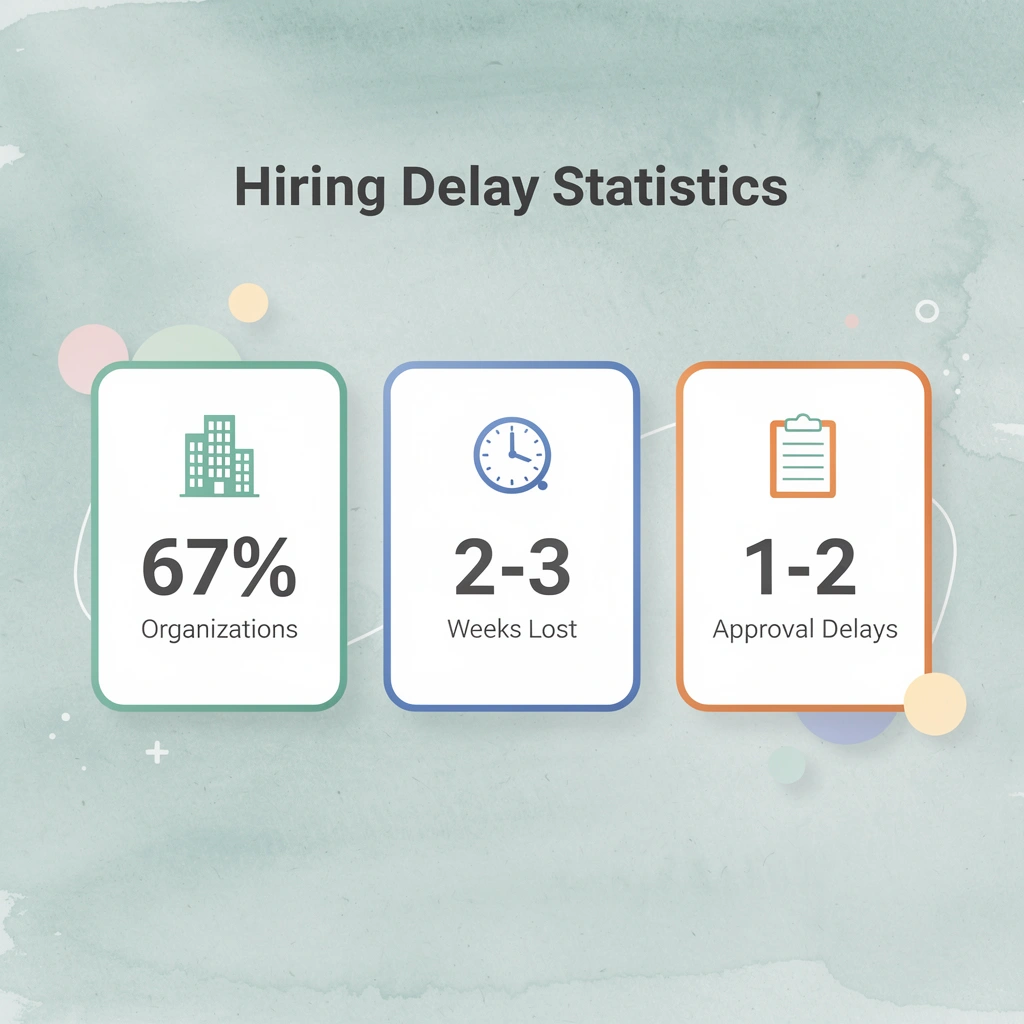
"Poor internal coordination and unclear job requirements cause more hiring delays than talent shortages in 67% of organizations." — HR Process Optimization Study, 2024

Internal Hiring Bottlenecks
Unclear job requirements
- Impact on Timeline: 2-3 week delay
- Common Cause: Poor stakeholder alignment
Inefficient approval workflows
- Impact on Timeline: 1-2 week delay
- Common Cause: Too many decision makers
Poor coordination between teams
- Impact on Timeline: 1-4 week delay
- Common Cause: Lack of process documentation
⚠️ Warning: Companies often blame external factors like talent shortages when the real problem lies in their internal processes and communication breakdowns.
Poor Workforce Planning
Reactive hiring makes recruitment harder. Without good workforce planning, hiring teams fill open roles under tight deadlines, leaving little time to define requirements, align stakeholders, or build talent pipelines. This urgency leads to rushed decisions, inconsistent evaluations, and longer hiring cycles.
Unclear Job Requirements
A recruitment process works well only when the job description is clear. Unclear responsibilities, qualifications, and expectations attract unsuitable applicants, forcing recruiters to spend extra time screening poor fits. Clear requirements attract better candidates and streamline the entire recruitment process.
Inconsistent Screening and Evaluation
Hiring slows when recruiters and hiring managers use different evaluation methods. Without organized screening processes, standard interview frameworks, or agreed-upon evaluation standards, teams review candidates multiple times, debate decisions unnecessarily, and struggle to compare applicants fairly. Consistency improves decision-making and reduces delays.
Why do organizations lose strong candidates to slow decisions?
Many organizations lose strong candidates because they make decisions too slowly, not because of screening problems. Delays occur during the collection of interview feedback, the obtaining of offer approvals, the review of compensation, and the communication with candidates. Each extra day increases the likelihood that candidates will lose interest or accept other offers. According to Cisive, 60% of job seekers abandon applications that take longer than 15 minutes to complete.
How can automated approval systems compress review cycles?
Managing approvals through email threads and spreadsheet trackers breaks down as the number of stakeholders multiply. Feedback gets buried in reply chains, and approval cycles stretch from hours to days. Our global HR system at Cercli centralizes approvals with automated routing and status tracking, compressing review cycles while maintaining full audit trails across recruitment, HR, and payroll workflows.
Disconnected Recruitment and Onboarding Systems
For many organizations, hiring delays extend beyond the offer stage. Candidate information must be manually transferred between applicant tracking systems, HR platforms, payroll systems, and onboarding tools. These handoffs create administrative work, increase the risk of errors, and delay the candidate-to-employee transition. When recruitment and onboarding operate separately, efficiency gains made during hiring disappear.
But fixing process problems addresses only half the challenge.
How Technology Improves the Recruitment Process
Technology streamlines hiring by removing bottlenecks that slow hiring teams. Rather than automating everything, it equips recruiters and hiring managers with tools for faster, more consistent decisions. When systems handle scheduling, routing, and status updates, teams can focus on evaluating candidates and building relationships that matter.

🎯 Key Point: The real value of recruitment technology isn't in replacing human judgment—it's in eliminating time-consuming tasks so hiring teams can focus on what they do best: connecting with talent and making strategic hiring decisions.
"Technology in recruitment should amplify human capabilities, not replace them. The best hiring outcomes happen when automated efficiency meets human insight." — Modern Recruitment Strategy, 2024

💡 Tip: Look for recruitment tools that integrate seamlessly with your existing workflow rather than forcing you to learn entirely new processes. The most effective technology feels like a natural extension of your current hiring approach.
How does workflow automation reduce administrative burden?
Recruitment teams lose hours each week organizing applications, scheduling interviews, gathering feedback, and updating records across disconnected systems. Workflow automation handles candidate routing, interview scheduling, hiring stage updates, communication workflows, and approval processes.
According to Insight Global, AI reduces time-to-hire by an average of 40%, enabling recruiters to move candidates through the pipeline faster without sacrificing quality.
What can recruiters focus on when administrative tasks are automated?
When administrative tasks no longer consume recruiter time, teams can build stronger talent pipelines, engage passive candidates, and support hiring managers more effectively. The goal is not to remove human judgment, but to eliminate the repetitive work that prevents recruiters from using it.
Centralized Recruitment Data Improves Hiring Visibility
Recruitment delays often occur when candidate information is scattered across email, spreadsheets, shared drives, and multiple platforms. Centralized recruitment systems consolidate applications, interview feedback, hiring activity, team collaboration, and status updates in a single platform. This shared visibility helps recruiters and hiring managers identify delays sooner and make faster decisions.
Centralized visibility becomes important as organizations grow their hiring across departments, countries, and different types of workers. When teams use the same information, miscommunication decreases and coordination improves. Teams shift from asking "where are we with this candidate?" to "should we move forward?"
How does structured evaluation improve hiring consistency?
Technology makes candidate evaluation more consistent through scorecards, structured interview feedback, standardized screening criteria, and shared frameworks, reducing differences between interviewers and making comparisons more reliable. Research from Criteria's 2024 Candidate Experience Report found that more than 25% of candidates reported experiencing bias during interviews, highlighting how structured evaluation frameworks reduce subjective decision-making.
Structured evaluation makes judgment more consistent across interviewers and roles without entirely removing it. When everyone uses the same framework, hiring decisions become faster and more defensible.
Why is system integration important for recruitment efficiency?
Most organizations manage recruitment, onboarding, HR, and payroll in separate systems, requiring manual data transfers between platforms. Platforms like Cercli connect recruitment with onboarding, employee record creation, payroll readiness, compliance documentation, and benefits administration, reducing duplicate data entry and improving operational continuity. This proves especially valuable for teams operating across borders, where fragmented systems create compliance risks and delay new hire productivity.
Centralized Hiring and Shared Visibility
Cercli brings recruitment activity into a single platform, making candidate applications, interview feedback, and hiring pipeline status visible to all stakeholders. When recruiters and hiring managers share the same view, decisions happen faster, eliminating time wasted asking "Where did we land on that candidate?" or hunting through email threads for feedback. Recruitment becomes a shared process rather than a series of disconnected handoffs.
How do standardized workflows prevent hiring fragmentation?
Without standard workflows, hiring processes break apart across teams. Some managers screen candidates using spreadsheets, others rely on email, and a few keep notes in shared documents. As hiring volumes grow, this inconsistency creates confusion: candidates receive different experiences depending on which team interviews them, and recruiters spend hours developing different tracking methods.
Platforms like Cercli allow organizations to define structured workflows that every team follows, creating consistency in screening, evaluation, and decision-making without imposing rigid processes that ignore team needs.
How does pipeline visibility help identify bottlenecks?
Seeing how your hiring pipeline is working helps teams identify bottlenecks. If candidates get stuck during interview scheduling or offer approvals take longer than expected, the data reveals it.
According to research on ATS integration, 73% of recruiters report that integrating their ATS with other HR tools significantly improves hiring efficiency. Tracking these patterns enables organizations to address delays before they become chronic.
Why doesn't recruitment end with offer acceptance?
Recruitment does not end when a candidate accepts an offer. Information gathered during hiring—personal details, tax forms, bank account information, role specifications, start dates—must be captured in employee records, payroll systems, and compliance documentation. When recruitment operates in isolation, teams manually re-enter data across multiple systems, introducing errors, delaying onboarding, and frustrating new hires.
How does integrated recruitment streamline the hiring process?
Cercli connects hiring directly to onboarding, payroll, and HR operations. Once a hiring decision is made, candidate information flows into employee workflows without manual re-entry. New hires move from offer acceptance to payroll readiness, compliance documentation, and benefits enrollment within a connected system. For organizations across the UAE, Saudi Arabia, and the wider MENA region, this approach simplifies the candidate-to-employee transition while supporting local compliance requirements and payroll operations.
Collaboration Without Fragmentation
Recruiters and hiring managers often work in separate tools, creating friction. Feedback gets lost in email threads, interview notes are scattered across documents, and evaluations are fragmented across platforms. Cercli consolidates recruitment activity, feedback, and decision-making in one place, enabling natural collaboration. Teams spend less time coordinating and more time evaluating candidates, shortening hiring cycles and improving decision quality.
The real question is whether your recruitment process competes effectively for talent in a market where speed, clarity, and candidate experience determine whether candidates accept your offer.
Book a Demo to Speak with Our Team about Our Global HR System
If your recruitment process feels fragmented, book a Cercli demo to identify inefficiencies across your hiring workflow. Our connected ATS and HR platform streamlines everything from workforce planning through onboarding, with recruitment data flowing into payroll and employee records without manual handoffs or duplicate entry.

🎯 Key Point: Most organizations discover their biggest friction points aren't where they expected during the demo process.
"Our connected ATS and HR platform eliminates manual handoffs and duplicate entry, streamlining the entire hiring workflow from planning to onboarding." — Cercli Platform Overview

Our team walks through your current process, identifies bottlenecks like delayed approvals or scattered feedback, and maps how automation could compress timelines. Most organizations discover their biggest friction points aren't where they expected. Schedule a demo at cercli.com to understand what's slowing your hiring down.
💡 Tip: Come prepared with your current hiring timeline and pain points to get the most targeted insights during your demo session.
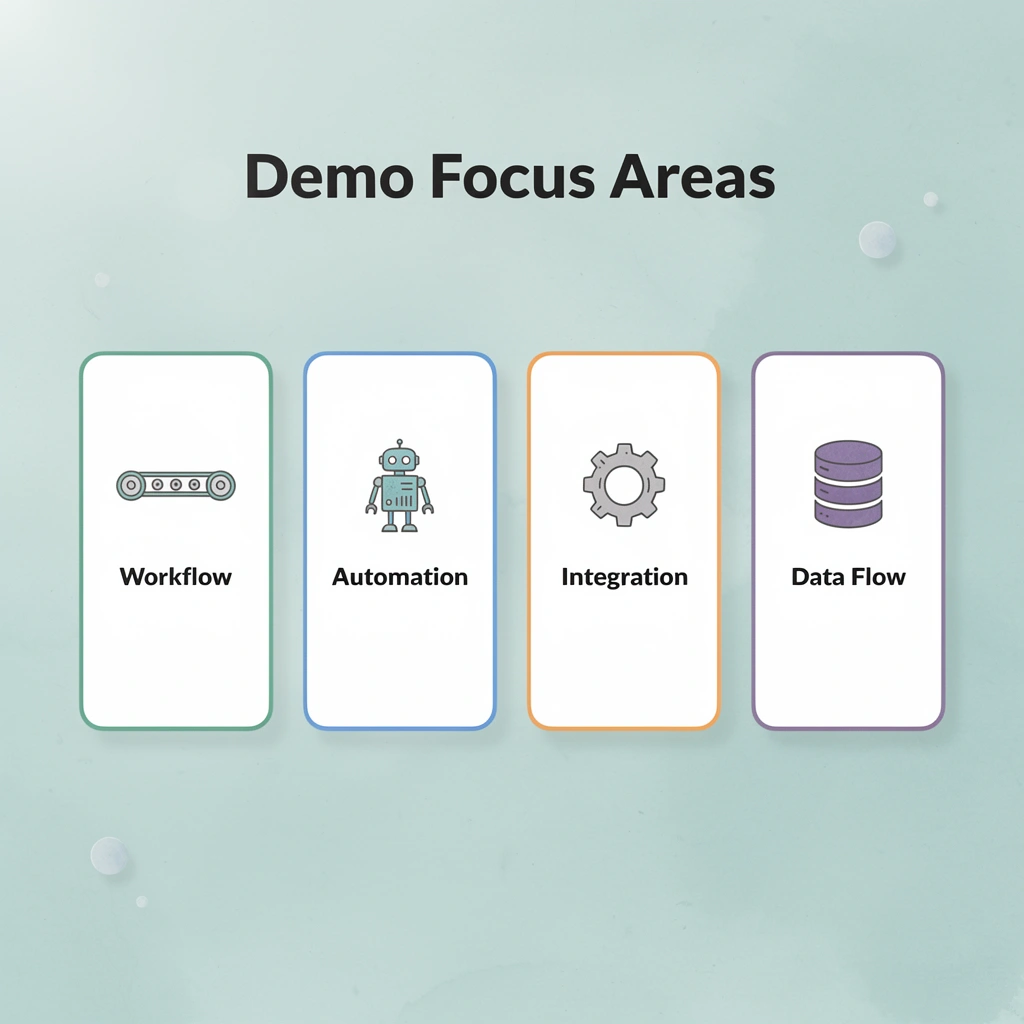
Workflow Analysis
- Hidden inefficiencies in your current process
Automation Opportunities
- Where technology can compress timelines
Integration Benefits
- How connected systems eliminate manual work
Data Flow Mapping
- Seamless recruitment-to-payroll transitions
Related Reading
- Social Media Recruitment Strategies
- Corporate Recruitment Strategies
- Recruitment Process Outsourcing
- Top Recruitment Process Outsourcing Companies
- How To Improve The Recruitment Process
- Workable Alternatives
- Manatal Alternatives
- Braintrust Alternatives
- Workable Vs Greenhouse


