21 Best Tools for Remote Recruitment: Hire Distributed Teams Fast
21 Best Tools for Remote Recruitment: Hire Distributed Teams Fast
Hiring remote talent across multiple countries means navigating time zones, local compliance requirements, and a fragmented set of tools that slow decisions down. Recruitment automation tools have reshaped how companies handle this challenge, allowing teams to screen candidates, schedule interviews, and manage offers without the usual delays. The best tools for remote recruitment do more than save time; they give hiring teams a reliable, repeatable process that scales across borders.
Where most companies run into trouble is what happens after a candidate accepts an offer. Contracts, payroll setup, and onboarding often fall to separate systems that do not communicate, creating gaps that waste time and introduce compliance risks. Cercli addresses this directly as a global HR system built for distributed teams, consolidating the post-hire process into a single platform so momentum does not stall at the finish line.
Summary
- Remote job postings attract up to 300% more applicants than in-office roles, which means sourcing is rarely the problem. The real friction appears after a candidate accepts an offer, when document collection, payroll setup, contract generation, and compliance verification must all occur across systems that were never designed to communicate with each other. That gap between "accepted" and "ready to work" is where most distributed hiring processes quietly break down.
- Fragmented tool stacks create structural delays that compound as hiring scales. When an applicant tracking system, a contract tool, a payroll platform, and an onboarding workflow all operate independently, each handoff between them becomes a potential failure point. Research from HireTruffle found that 44% of new hires wait a week or more for basic tools when starting remotely, a delay that reflects process fragmentation more than any single technology failure.
- Cross-border hiring adds compliance complexity that does not announce itself upfront. Employment classifications, payroll obligations, and labor law requirements vary by country and change over time. When those requirements live in spreadsheets or inboxes rather than a connected system, the risk of error accumulates hire by hire, country by country, until the weight of disconnected processes becomes a legal and operational liability rather than just an administrative inconvenience.
- Inconsistent evaluation frameworks are among the most common and least visible problems in remote hiring. Robert Half research found that 57% of hiring managers say it is more difficult to assess candidate skills during remote interviews. The difficulty is rarely the video call itself. It comes from the absence of shared scoring criteria and structured feedback workflows that keep distributed hiring teams aligned across time zones and roles.
- The financial cost of poor remote hiring decisions is significant. TestGorilla research found that a bad hire can cost a company up to 30% of the employee's first-year earnings, a figure that includes re-screening, re-interviewing, and re-onboarding, all of which multiply when warning signs are harder to catch in a fragmented process. Structured assessments and consistent evaluation workflows reduce the likelihood of those errors reaching the offer stage.
- AI tools have meaningfully shifted what recruitment teams can accomplish at volume. Oleeo's 2025 research found that 75% of recruiters say AI tools have improved their ability to find qualified candidates faster, and 86% say AI has improved the candidate experience during remote hiring. The practical benefit is that repetitive screening and scoring tasks are handled by automated systems, freeing recruiters to focus on decisions that require human judgment rather than on administrative coordination.
- Cercli's global HR system addresses this by connecting recruitment, onboarding, and payroll in a single platform, so the information that matters follows a candidate through every stage rather than sitting in whichever inbox or tool last touched it.
Why Remote Recruitment Is More Complex Than Many Employers Expect
Remote recruitment looks straightforward until you're doing it at scale. Video interviews replace in-person ones, and applications come online, but the operational complexity underneath catches most employers off guard.
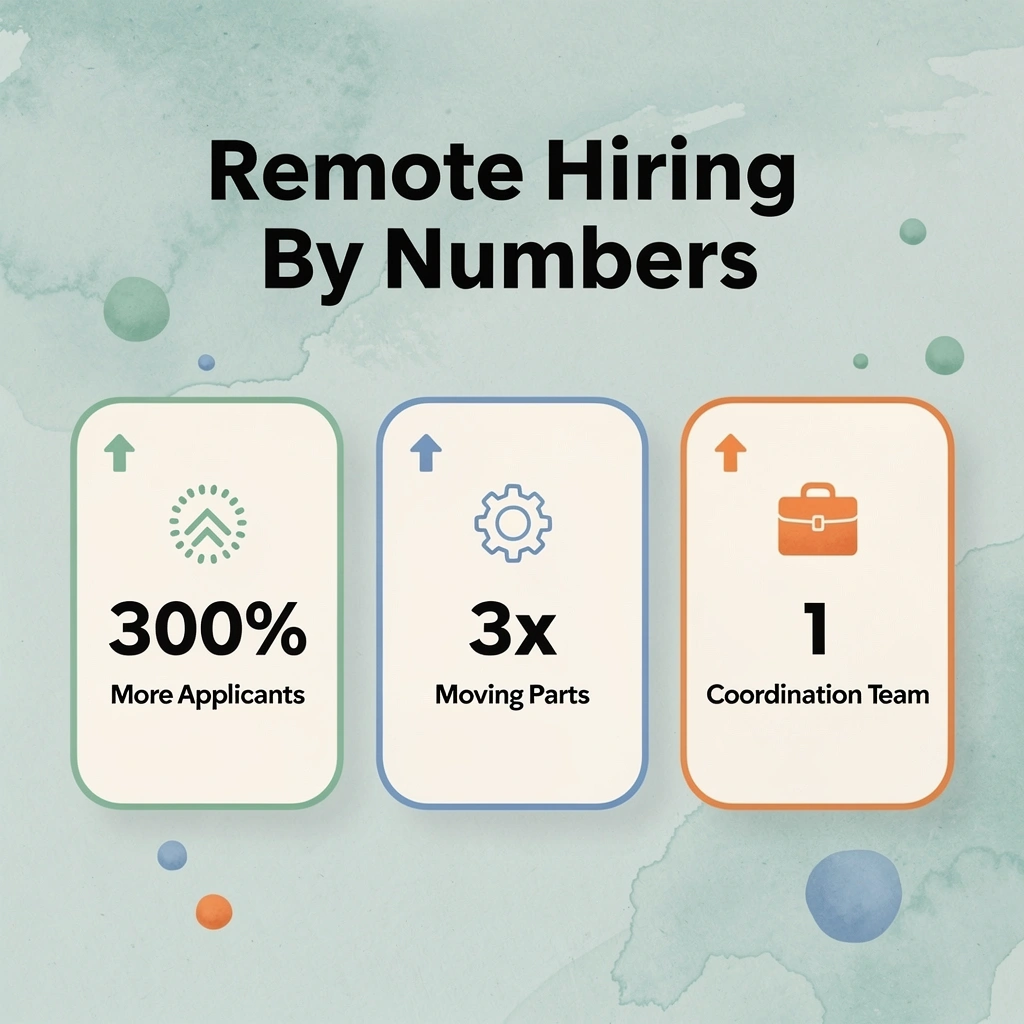
Remote hiring multiplies moving parts without multiplying coordination capacity. According to WorkTime's Remote Work Statistics, remote job postings attract up to 300% more applicants than in-office roles. This volume becomes problematic when screening spans three platforms, HR chases documents in a separate system, and hiring managers await compliance checks before sending offers. The pipeline fills faster than the infrastructure can process it.
Where does the real friction in remote hiring live?
The failure point is usually the lack of candidates. The breakdown happens in the gap between "candidate accepted" and "employee ready to work." Document collection, payroll setup, contract generation, and compliance verification require coordination across functions that rarely share a system. According to the Truffle / HireTruffle Blog's 100 Remote Hiring Statistics, 44% of new hires wait a week or more for basic tools when starting remotely. That delay is a fragmentation problem, not a process one.
Why do disconnected tools slow remote hiring down?
Most teams connect separate tools: one for tracking applicants, another for contracts, another for payroll, and another for compliance. As hiring grows across time zones and regions, gaps between those tools create slowdowns. A global HR system like Cercli fixes this by consolidating recruitment, onboarding, and payroll into a single platform, eliminating duplicate data entry and teams chasing each other for answers.
Why compliance turns a hiring delay into a business risk
Cross-border hiring adds layers that local recruitment does not: employment classifications, payroll obligations, and labor law requirements vary significantly by country and change regularly. When those requirements live in someone's inbox or a shared spreadsheet rather than a connected system, the risk of error grows with each new hire. Remote recruitment becomes a legal and operational challenge, not merely a talent acquisition one.
Complexity builds quietly, hire by hire, country by country, until disconnected systems slow everything down. This is why the tools your team uses to hire remotely matter far more than most people assume.
Related Reading
- Candidate Screening Questions
- Candidate Screening Process
- Automated Candidate Screening
- Steps in the Recruitment Process
- End to End Recruitment Process
- Recruiting Funnel Metrics
- AI in Recruitment Examples
- Recruitment Lifecycle
- Best Recruitment Strategies
What Are Remote Recruitment Tools?
Remote recruitment tools are software programs that help organizations find, screen, interview, hire, and onboard candidates remotely. They range from tools that handle just one hiring stage to larger platforms that connect every aspect of recruitment with HR, payroll, and compliance operations.
💡 Definition: Remote recruitment tools are not a single product — they exist on a spectrum, from single-stage solutions to end-to-end hiring platforms that unify the entire talent acquisition lifecycle.
Single-stage tools
- What It Handles: One phase (e.g., screening only)
- Limitation: No visibility into other stages
Applicant Tracking Systems (ATS)
- What It Handles: Application organization & tracking
- Limitation: Lacks contract, payroll, and compliance data
End-to-end platforms
- What It Handles: Recruitment + HR + payroll + compliance
- Limitation: Higher complexity, higher cost
"Over 60% of hiring managers use applicant tracking systems for remote hiring workflows." — Robert Half
A standalone applicant tracking system keeps applications organized but lacks visibility into contract signing, payroll setup, or compliance obligations in different countries. According to Robert Half, over 60% of hiring managers use applicant tracking systems for remote hiring workflows. Many of those teams simultaneously run separate tools for contracts, onboarding, and payroll — each operating without visibility into the others.
⚠️ Warning: Running disconnected tools across hiring stages creates dangerous blind spots — your team may close a role without confirming compliance obligations or payroll readiness in the candidate's country.
🔑 Takeaway: The real gap in most remote hiring stacks isn't a missing tool — it's the lack of integration between the tools already in use.
What these tools actually cover
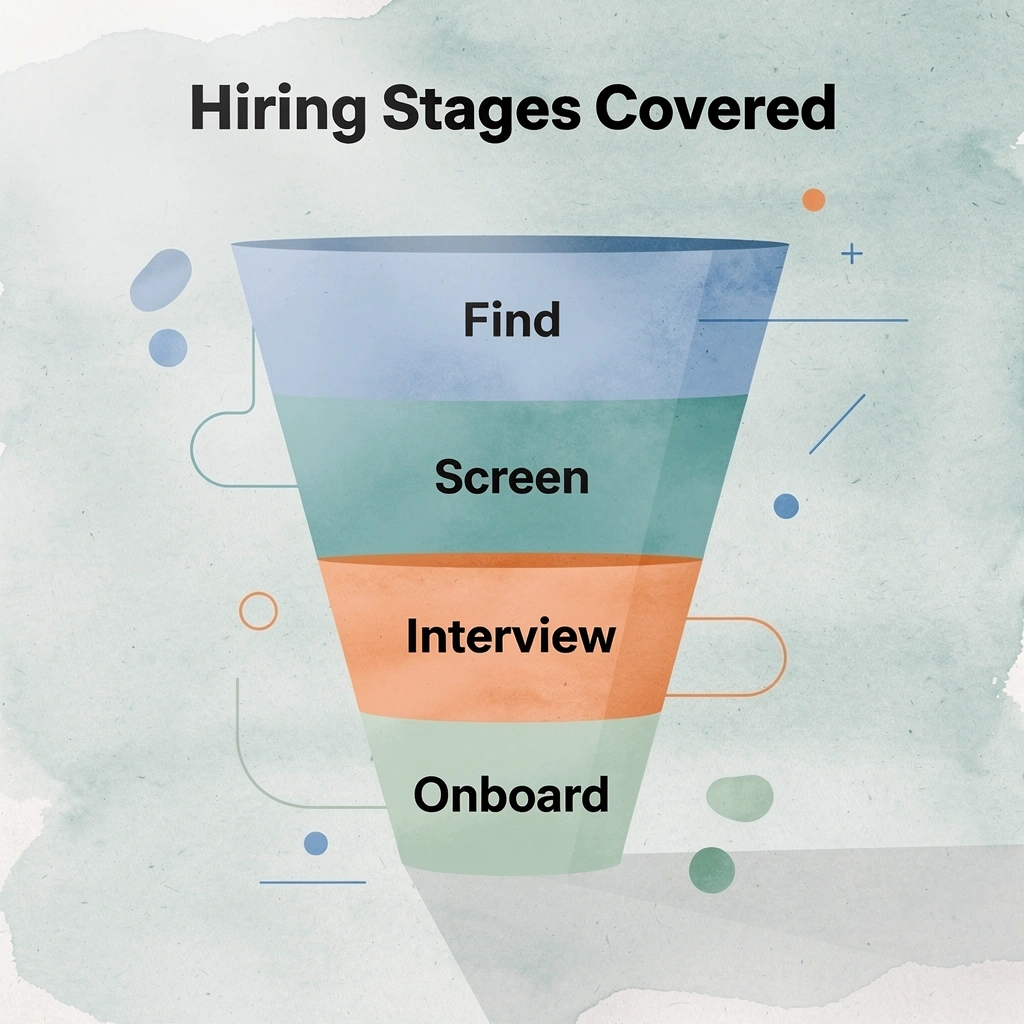
Core capabilities include finding candidates, managing applications, screening and assessing candidates, scheduling interviews, conducting video interviews, and handling onboarding workflows. Zoom's Remote Work Statistics report that 85% of hiring managers say remote recruitment tools have improved their ability to find qualified candidates. The problem emerges after candidates are found: when they move through the pipeline and land in a system never designed to hand them off smoothly to the next stage.
Why do handoffs between tools become failure points?
Most teams connect disparate tools: an ATS for tracking, a video platform for interviews, a document tool for contracts, a separate system for onboarding. As teams grow and hiring spans more countries, each handoff becomes a failure point. Data gets entered manually repeatedly, timelines slip, and candidate experience suffers in ways that are difficult to trace.
How do integrated platforms remove the overhead of tool-switching?
Platforms like Cercli solve this problem by connecting recruitment with HR records, payroll, and compliance in a single platform. Our global HR system eliminates the need for separate payment and onboarding processes when you hire someone in any country. AI agents handle screening and scoring work that previously required manual review across multiple platforms. This frees recruitment teams from constantly switching between tools, allowing them to focus on decisions requiring human judgment.
The tools you pick early on set the limit for how efficiently you can grow later—a harder constraint to change than most hiring teams realize.
21 Best Tools for Remote Recruitment
Choosing the right remote recruitment tools means picking platforms that handle the volume, speed, and compliance complexity that distributed hiring demands across regions like the UAE, Saudi Arabia, and the wider MENA market.
"The test of any remote recruitment platform isn't how it performs at average volume: it's how it holds up when demand spikes across multiple regions simultaneously." — Remote Hiring Best Practices
🎯 Key Point: Compliance complexity in regions like the UAE and Saudi Arabia is critical when evaluating any remote recruitment platform.

According to the HireTruffle Blog's 2025 remote hiring research, remote jobs get four to five times as many applications as non-remote jobs. A platform that handles 200 applicants easily can struggle with 1,000, with problems typically showing up in screening delays rather than system crashes.
Applicant Volume: Up to 200
- Common Bottleneck: Minimal friction
- Risk Level: 🟢 Low
Applicant Volume: 200–500
- Common Bottleneck: Minor screening lag
- Risk Level: 🟡 Medium
Applicant Volume: 500–1,000+
- Common Bottleneck: Significant screening delays
- Risk Level: 🔴 High
💡 Tip: When evaluating tools, always stress-test for high-volume scenarios — a platform's true limitations show up at scale, not during a standard demo.
🔑 Takeaway: A 4–5x surge in applications isn't a rare edge case — it's the new normal for remote roles. Choosing a platform built for high-volume screening is essential to avoiding costly hiring delays.
1. Cercli
Best for
Organizations in the UAE, Saudi Arabia, and the MENA region are hiring remote employees, contractors, and international talent.
Most recruitment teams manage applicant tracking, contracts, and payroll using separate systems, creating visibility gaps when new hires fall between offer acceptance and their first paycheck.
Cercli integrates hiring collaboration, onboarding, payroll connectivity, compliance management, contractor administration, and Employer of Record services. This unified approach maintains visibility across recruitment and employment operations, where fragmented stacks typically fail.
2. Qureos
Best for
MENA organizations seeking AI-powered candidate sourcing and screening.
Qureos is a UAE-based recruitment platform built around AI-driven candidate matching and automated shortlisting. Its regional focus provides a distinct advantage for employers hiring across the Middle East, where local market knowledge matters as much as technical skill.
3. Bayt.com
Best for
Organizations recruiting remote talent across the Middle East and North Africa.
Bayt.com remains one of the largest job platforms in the region, providing employers access to large talent pools across multiple MENA markets.
4. Naukrigulf
Best for
GCC employers seeking experienced professionals across UAE, Saudi Arabia, Qatar, Kuwait, Bahrain, and Oman. Naukrigulf's candidate database specializes in cross-border recruitment within the region, making it ideal for finding professionals with GCC work experience.
5. GulfTalent
Best for
Professional and managerial hiring across the GCC. GulfTalent serves employers seeking experienced professionals with sector-specific expertise across the Gulf region.
6. Deel
Best for
Hiring workers worldwide and managing teams across different countries.
Deel helps organizations manage contractors, pay workers globally, comply with local laws, and provide employer-of-record services. It simplifies building distributed teams and handling the complexities of international hiring.
7. Remote
Best for
Hiring employees from other countries and EOR services.
Remote helps organizations hire employees worldwide while managing employment rules, onboarding, payroll, and workforce operations across different locations. It's ideal for teams needing legal employment support in countries where they lack a local office.
8. Darwinbox
Best for
Large organizations managing remote hiring and HR operations.
Widely adopted across the Middle East, Darwinbox combines recruitment, onboarding, employee management, and workforce administration into a unified platform, making it more relevant to enterprise organizations than to growing teams.
9. Workable
Best for
Distributed recruitment teams seeking sourcing and hiring workflows.
Workable offers candidate sourcing, applicant tracking, recruitment collaboration tools, and hiring workflow management: a practical choice for teams needing organized hiring processes without building them from scratch.
10. Greenhouse
Best for
Structured remote hiring processes.
Remote hiring often fails due to inconsistency: different interviewers evaluate candidates using different criteria, making decisions subjective and difficult to audit. Greenhouse solves this through interview workflows, scorecards, recruitment analytics, and hiring visibility tools that standardize candidate assessment across distributed teams.
11. Lever
Best for
Finding and hiring remote workers and managing candidate relationships.
Lever combines applicant tracking with candidate relationship management. When hiring remote workers across different time zones, keeping candidates engaged between conversations often determines whether you successfully hire them or lose them from the process.
12. Ashby
Best for
Data-driven remote recruiting teams.
Ashby provides recruitment analytics, candidate tracking, pipeline visibility, and hiring performance reporting, offering diagnostic clarity on candidate drop-off points that most ATS platforms don't prioritize.
13. HireVue
Best for
Remote interviews and candidate assessments.
Robert Half's 2024 research reports that 41% of hiring managers use video interviews as a permanent part of their hiring process. HireVue supports video interviewing, skills assessments, screening workflows, and candidate evaluation for remote and high-volume hiring.
14. Spark Hire
Best for
Virtual interviewing and interview scheduling.
Spark Hire offers one-way video interviews, live interviews, interview coordination, and candidate evaluation. The one-way format works well when candidates are in different time zones.
15. TestGorilla
Best for
Skills-based remote candidate screening.
CVs show what candidates have done, not what they can do. TestGorilla uses technical assessments and skills testing to evaluate candidate capabilities before interviews, reducing the number of interviews needed to build a qualified shortlist.
16. VidCruiter
Best for
Structured virtual recruitment processes.
VidCruiter offers video interviewing, interview scheduling, recruitment workflow management, and candidate evaluation tools. Organizations seeking consistent, repeatable interview processes across multiple hiring managers will find it easier to maintain standards with this platform.
17. BambooHR
Best for
Small and mid-sized organizations are hiring remote employees.
BambooHR combines recruitment workflows, onboarding, employee records, and HR administration into a single platform. For smaller teams, this reduces the administrative burden that slows remote hiring.
18. Manatal
Best for
AI-assisted remote recruitment and candidate management.
Manatal combines applicant tracking, AI-powered candidate scoring, recruitment automation, and candidate relationship management. Automated scoring reduces manual review work while preserving recruiter judgment in final hiring decisions.
19. Zoho Recruit
Best for
Growing organizations seeking flexible remote hiring workflows.
Zoho Recruit supports candidate sourcing, applicant tracking, screening automation, interview management, and recruitment reporting. It suits organizations with evolving hiring processes that require an adaptable platform.
20. Mercer | Mettl
Best for
Remote candidate assessments and skills evaluation.
Mercer | Mettl provides psychometric testing, cognitive assessments, technical evaluations, and competency-based screening. It helps organizations connect hiring and workforce planning by using assessment data to make hiring decisions, organize teams, and support employee development.
21. HireZapp
Best for
UAE and GCC organizations seeking to automate recruitment.
HireZapp automates candidate screening, shortlisting, interview scheduling, and hiring workflows. For organizations managing large remote applicant pools in the GCC, this reduces time-to-first-contact, which is critical as candidate drop-off rates increase with every day of silence.
22. OVI
Best for
Recruitment teams looking to automate sourcing and candidate engagement.
OVI supports candidate sourcing, screening, communication workflows, and recruitment automation. It proves particularly useful for teams managing high volumes of remote applicants without expanding headcount.
Choosing the right remote recruitment tool
The right tool depends on your biggest constraint. If finding candidates is the bottleneck, regional platforms such as Bayt.com, Naukrigulf, or GulfTalent offer broad reach. If screening volume is the problem, tools like Manatal, TestGorilla, or HireZapp reduce manual work. If compliance and workforce management are the challenges, platforms extending into onboarding and payroll become more relevant.
What happens when your tool can't scale with your hiring volume?
Most teams underestimate the cost of switching tools when they grow. A sourcing platform that works well at 50 hires per year becomes problematic at 200 hires per year. Your decision now about specialized point solutions versus connected platforms shapes how much friction you will face later: friction that rarely announces itself until it has already slowed you down.
Most teams discover feature gaps only after committing to a stack.
What Features Should You Look for in Remote Recruitment Tools?
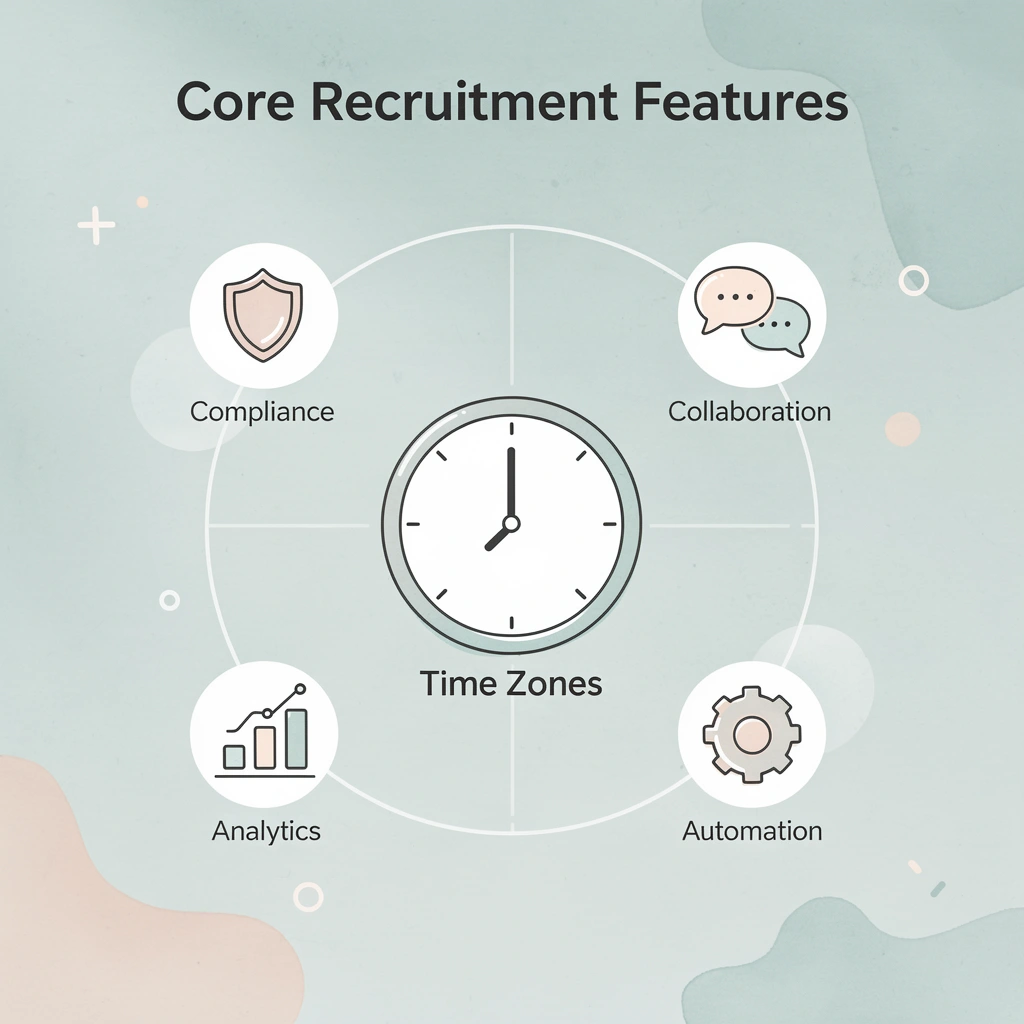
The right remote recruitment tool reduces operational drag as your team grows across locations, time zones, and employment types—not just helping you hire faster, but determining how efficiently you scale.
"The right remote recruitment tool doesn't just fill roles faster—it determines how sustainably and efficiently your organization can scale across distributed teams." — Remote Hiring Best Practices
🎯 Key Point: When evaluating remote recruitment tools, prioritize features that address your specific scaling challenges—including multi-timezone coordination, employment type flexibility, and cross-location collaboration.
Multi-timezone Scheduling
- Why It Matters: Eliminates coordination bottlenecks
- Impact on Scaling: High — affects every hire
Employment Type Support
- Why It Matters: Handles contractors, FTEs, and freelancers
- Impact on Scaling: High — critical for distributed teams
Async Collaboration Tools
- Why It Matters: Keeps hiring moving across time gaps
- Impact on Scaling: Medium-High — reduces delays
Automated Workflows
- Why It Matters: Cuts manual operational drag
- Impact on Scaling: High — scales with team growth
💡 Tip: Don't just evaluate tools on speed of hire—measure how well they reduce operational drag as your headcount and geographic complexity increase.
Candidate Sourcing and Pipeline Visibility
Sourcing is where most teams feel the pressure first. Remote roles attract candidates from wider geographies, but this creates pipeline tracking challenges across spreadsheets and disconnected inboxes. The most effective tools combine talent discovery with candidate relationship management, keeping prospects engaged across longer hiring cycles. According to Oleeo's 2025 research on AI in recruitment, 75% of recruiters say AI tools have improved their ability to find qualified candidates faster, reflecting the shift from manual searching to intelligent filtering.
Why does consistency break down in virtual hiring?
Without a physical office, consistency becomes your biggest risk. Two candidates interviewed by different hiring managers in different time zones can be evaluated on completely different criteria unless the platform enforces structured scoring. The failure point is usually not the technology itself but the absence of a shared framework: structured evaluation forms, shared scorecards, and clear handoffs between interviewer feedback and hiring decisions that keep distributed teams aligned.
What happens when hiring scales across multiple roles and regions?
Most teams use a video conferencing tool, shared documents for notes, and email threads for feedback. This works for small hiring volumes. As hiring scales across multiple jobs and regions, information scatters across inboxes, feedback arrives at different times, and decisions slow as they wait for responses. Platforms like Cercli connect recruitment workflows with HR and payroll operations in a single platform, eliminating the need for separate systems when moving candidates to employees.
Why does remote onboarding need a centralized digital process?
The critical difference between a good hire and a productive one is what happens in the first two weeks. Remote onboarding without a structured digital process creates gaps: new hires end up emailing about contracts or payroll contacts. Document collection, equipment setup, and compliance requirements for different countries all need centralized management. If onboarding lives in a separate tool from your recruitment platform, you've created a handoff problem by design. According to Oleeo, 86% of recruiters say AI has improved the candidate experience during remote hiring by reducing the dead time between offer acceptance and day-one readiness.
How does global hiring change what your recruitment tool needs to handle?
Hiring people around the world adds complexity. Contractor management, employer-of-record services, and country-specific compliance requirements are core operational needs for distributed teams, not edge cases. A recruitment tool that handles sourcing and interviewing but stops at the offer letter forces you to manage the rest through separate systems, creating the fragmentation that slows operations.
The features that matter most eliminate manual handoffs, close gaps between stages, and provide clear visibility into hiring progress for all involved.
But choosing the right features is only part of the equation. The harder problem is something most teams never anticipate.
Related Reading
- Recruitment Analytics Software
- How Can I Use Ai To Improve My Job Descriptions
- Hr Automation Tools
- Best Job Descriptions
- How To Write A Job Description
- Automate Interview Scheduling
- How To Use Ai In Recruitment
- Candidate Screening Tools
- Companies Using Ai For Recruitment
- Best Recruitment Crm
Common Remote Recruitment Mistakes
The harder problem is not finding the right tools. It assumes that once you have them, the process will hold together on its own.
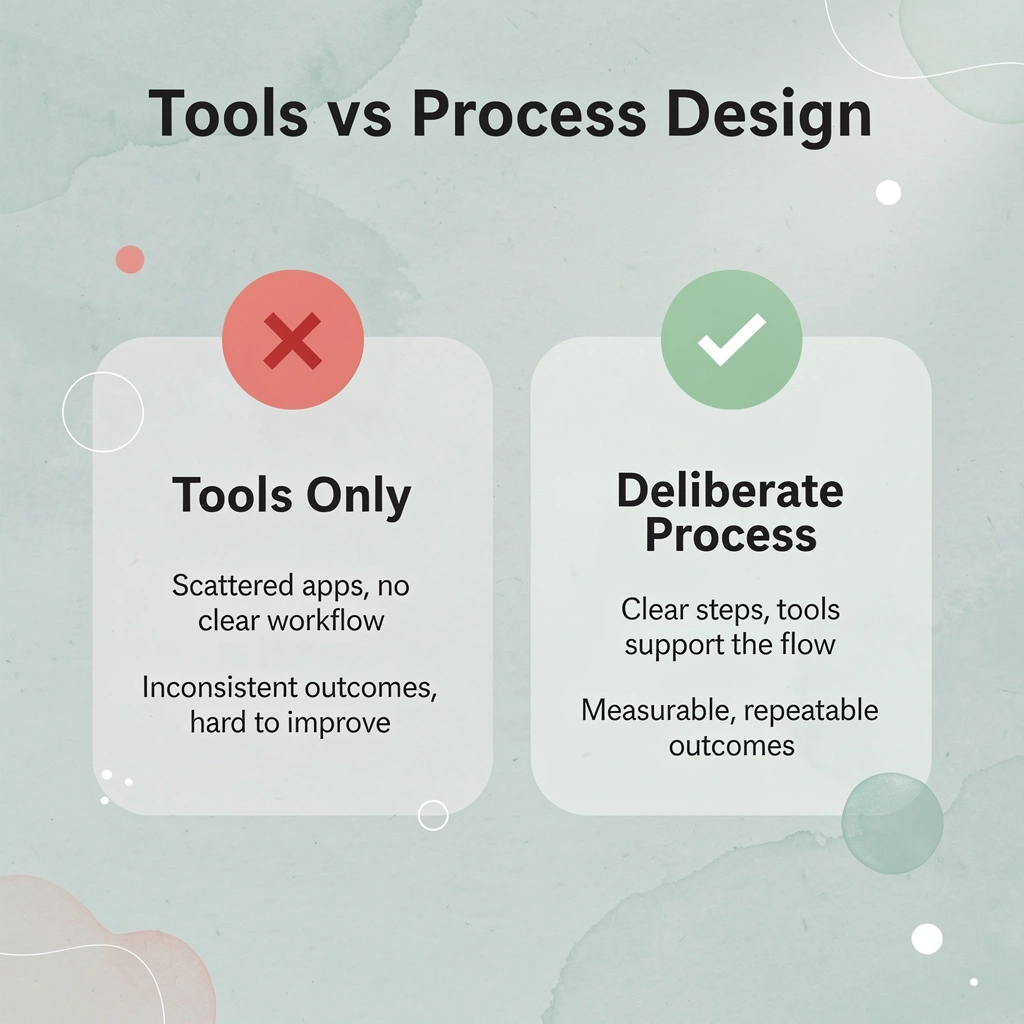
"The biggest mistake in remote recruitment isn't a bad tool choice — it's the belief that tools alone replace deliberate process design." — Remote Work Insight
⚠️ Warning: Never assume that adopting a new platform or system will automatically fix broken recruitment workflows — tools enable processes; they never replace them.
💡 Tip: Audit your remote recruitment process independently of your tools. Ask whether each step would hold up if the tool disappeared tomorrow — if the answer is no, you have a process gap, not a tool gap.
Common Assumption
- Tools will organize the process
- New software fixes team misalignment
- Automation handles candidate experience
The Reality
- Tools only support an already-defined process
- Alignment requires deliberate communication, not software
- Human touchpoints are still critical at every stage
Where do remote recruitment processes break down between stages?
Remote recruitment fails most often in the gaps between stages. A candidate moves from application to interview to offer, and at each handoff, something slips: a hiring manager lacks evaluation notes, payroll setup waits on a contract in a separate system, onboarding tasks sit in an unchecked inbox until day three. These fragmentation failures compound quietly until a strong candidate stops responding.
According to Robert Half, 57% of hiring managers say it is more difficult to assess candidates' skills during remote interviews. The difficulty stems not from the video call itself, but from the absence of shared structure, consistent scoring frameworks, and documented criteria that accompany a candidate across all interviews. When each interviewer works from a different mental checklist, the evaluation process produces noise, not signal.
Why do small fixes make fragmented hiring processes worse over time?
Most teams respond by adding another tool: a shared spreadsheet, a Slack thread, a follow-up email. Each addition feels like a small fix, but as hiring volume grows and candidates span multiple time zones, those fixes become the process itself, and nobody fully owns it. Cercli addresses this by connecting recruitment, HR, and payroll within a single platform, so information moves with the candidate rather than sitting in whichever inbox received it last.
TestGorilla's research on remote hiring found that a bad hire can cost a company up to 30% of the employee's first-year earnings. This accounts for re-screening, re-interviewing, and re-onboarding costs, which multiply when disconnected hiring systems obscure early warning signs.
How does automating repetitive work shift recruiters into an advisory role?
The shift is not about hiring faster but about building a process in which AI handles repetitive screening and scoring, freeing your team to focus on decisions that require human judgment. When busywork is automated and systems are connected, recruiters become advisors rather than administrators. That is where hiring quality improves.
How Cercli Helps Companies Recruit and Manage Remote Talent
Remote recruitment reaches more job candidates but creates operational challenges that traditional hiring processes struggle to manage. As companies expand remote hiring across multiple locations, recruiters work across fragmented systems to find candidates, track applications, coordinate decisions, onboard employees, and manage administration—reducing visibility, increasing workload, and creating inefficiencies throughout the employee lifecycle.
"As companies scale remote hiring, fragmented tools reduce visibility, increase workload, and create inefficiencies throughout the entire employee lifecycle." — Remote Workforce Operations
💡 Tip: If your team is juggling multiple disconnected platforms for recruitment, onboarding, and payroll, you're already losing time and risking compliance gaps.
Challenge
- Fragmented recruitment systems – Reduced candidate visibility
- Manual application tracking – Increased recruiter workload
- Disconnected onboarding tools – Slower time-to-productivity
- Siloed compliance management – Higher risk of errors
- Scattered workforce administration – Inefficiencies across the employee lifecycle

Cercli addresses these challenges by connecting recruitment, onboarding, payroll, compliance, and workforce management within a single, unified platform, eliminating fragmented tools and giving teams end-to-end visibility across the entire employee lifecycle.
🎯 Key Point: By consolidating every stage of the employee lifecycle into one platform, Cercli helps companies reduce operational overhead, improve hiring efficiency, and scale their remote workforce with confidence.
✅ Best Practice: Companies expanding into multi-location remote hiring should prioritize platforms like Cercli that unify recruitment and workforce management, reducing tool sprawl and keeping compliance built in from day one.
How does Cercli centralize remote hiring and pipeline management?
Cercli's ATS provides a central platform for managing applications, candidate information, and recruitment activities. Instead of using disconnected spreadsheets, emails, and separate tools, teams can view the entire hiring process in a single system. This creates consistent workflows while reducing administrative work.
Remote roles attract larger applicant pools than location-based positions. Without clear pipeline visibility, recruiters struggle to prioritize candidates and move qualified applicants through the process efficiently. Cercli helps teams manage pipelines by providing visibility into every hiring stage, tracking candidate progression, monitoring activity, and identifying bottlenecks, which proves particularly valuable when managing multiple roles or recruiting across different locations.
How does Cercli improve recruitment visibility and hiring manager collaboration?
When candidate information is spread across multiple systems, evaluating recruitment performance becomes difficult. Cercli provides recruitment analytics that monitor hiring activity, assess pipeline performance, and show recruitment effectiveness, supporting better decision-making and improved hiring efficiency.
Remote recruitment requires effective collaboration between recruiters, hiring managers, and interviewers. Without structured communication, feedback delays and inconsistent evaluations slow hiring decisions and damage candidate experience. Cercli supports collaboration by providing shared visibility into candidate information, workflows, and evaluation processes, enabling teams to work together throughout the hiring lifecycle.
How does Cercli connect recruitment with onboarding, payroll, and compliance?
Many organizations experience disconnects between recruitment and onboarding, which require manual data transfers between separate systems and lead to delays and errors. Cercli connects recruitment workflows directly to onboarding, allowing candidate information to flow seamlessly into employee setup activities.
Managing remote employees across different locations involves additional payroll and compliance responsibilities. As organizations expand into new markets, maintaining compliance with local employment requirements becomes critical. Cercli connects recruitment with payroll and compliance operations, maintaining workforce visibility while supporting smoother employee administration.
How does Cercli support contractors, international hiring, and connected workforce management?
Organizations increasingly use combinations of employees, contractors, and international talent. Managing these workforce models through separate platforms increases complexity and reduces visibility. Cercli supports contractor management and Employer of Record (EOR) services, enabling organizations to manage different worker types through a connected platform.
Remote recruitment extends beyond attracting candidates to managing onboarding, compliance, payroll, and employee activation across distributed teams. Cercli connects recruitment with onboarding, payroll, compliance, contractor management, EOR services, and HR operations, enabling organizations to manage remote recruitment as part of a connected workforce strategy. This improves hiring visibility, reduces administrative complexity, strengthens collaboration, and creates a seamless experience from application through workforce activation.
Book a Demo to Speak with Our Team about Our Global HR System
If your organization is hiring remote employees across multiple countries but still managing recruitment, onboarding, and payroll through disconnected tools, a single demo with the Cercli team can show you exactly where your hiring pipeline loses momentum — from candidate screening through workforce activation — and show what a connected platform looks like in practice. Book a global HR system demo to see how our platform replaces fragmented stacks with one unified system that handles hiring, HR, and payroll together.
"A single demo can reveal exactly where your hiring pipeline loses momentum — from candidate screening through workforce activation." — Cercli
🎯 Key Point: Managing multi-country hiring through disconnected tools doesn't just slow your team down — it creates invisible gaps in your workforce activation process that cost you top talent.
Fragmented Stack
- Separate recruitment tools
- Manual onboarding workflows
- Disconnected payroll systems
- Recruiters stuck administrating
Cercli Connected Platform
- Unified hiring pipeline
- Automated workforce activation
- Integrated multi-country payroll
- Recruiters focused on people decisions
💡 Tip: Book a Cercli demo to see firsthand how a single connected system eliminates the friction between your hiring, HR, and payroll workflows — no lengthy sales process required.

The shift from patchwork to connected lets your recruiters stop being administrators and start making better, more strategic decisions about people.
✅ Best Practice: When evaluating a global HR system, look for a platform that unifies hiring, HR, and payroll in one place, not a set of loosely integrated tools marketed as a single solution.
Related Reading
- Social Media Recruitment Strategies
- Corporate Recruitment Strategies
- Recruitment Process Outsourcing
- Top Recruitment Process Outsourcing Companies
- How To Improve The Recruitment Process
- Workable Alternatives
- Manatal Alternatives
- Braintrust Alternatives
- Workable Vs Greenhouse


