12 Candidate Screening Tools to Identify Suitable Applicants
12 Candidate Screening Tools to Identify Suitable Applicants
Hiring teams regularly face hundreds of applications for a single position, spending weeks manually sorting through resumes and potentially missing top talent. Candidate screening tools within recruitment automation tools transform this chaotic process into a strategic advantage. These systems work by automatically filtering applications, assessing qualifications, and identifying the most suitable candidates based on predetermined criteria. Companies using automated screening technology can evaluate applicants faster while improving hire quality.
Modern screening platforms offer intelligent filtering and assessment capabilities that help organizations spot qualified talent without sacrificing thoroughness. Features like side-by-side candidate comparisons, automated scoring, and customizable evaluation criteria enable data-driven hiring decisions. Whether building small teams or scaling across borders, companies need comprehensive solutions to streamline their entire candidate evaluation process through a global HR system.
Summary
- Recruitment teams now handle 2.7 times more applications per recruiter than three years ago, while managing 56% more open positions simultaneously, according to Gem's 2025 Recruiting Benchmarks Report. This surge in volume makes manual screening methods structurally unsustainable, forcing organizations to rethink how they identify qualified candidates before interviews even begin.
- Bad hires cost companies up to 30% of an employee's first-year salary when factoring in onboarding expenses, lost productivity, and restarting the search process. This figure excludes harder-to-measure damage, such as diminished team morale, wasted manager coaching time, and the opportunity cost of rejecting strong candidates because screening criteria prioritized credentials over actual job capabilities.
- Organizations using AI-powered candidate screening experience a 67% reduction in time-to-hire, but this improvement only materializes when screening removes friction from the entire hiring workflow rather than adding another isolated process step. The reduction comes from eliminating manual sorting, standardizing evaluation criteria, and connecting screening decisions directly to downstream hiring activities like interview scheduling and offer management.
- Resume parsing, which converts unstructured documents into searchable data, enables a 75% reduction in time-to-hire when implemented effectively. Strong parsing engines recognize international qualifications, handle multiple resume formats, and identify skills even when candidates describe them in different terms, which is critical when evaluating applicants across geographic markets with varied credential systems.
- Seventy-eight percent of candidates view their recruitment experience as a direct indicator of how companies value their people, yet most screening tools create friction through lengthy applications, unclear timelines, and disconnected handoffs between evaluation stages. Candidate drop-off begins during the screening and scheduling phases, when delays and inefficiencies make qualified candidates question whether roles are worth pursuing, long before formal interviews occur.
- Cercli's global HR system addresses this by connecting candidate screening directly to onboarding, payroll setup, and compliance documentation across MENA jurisdictions, eliminating the manual data transfers that typically delay start dates and cause qualified applicants to disengage between shortlisting and offer acceptance.
Why Candidate Screening Matters More Than Most Employers Realize
Most employers treat screening like a hurdle to clear before interviews and assessments. Screening determines which candidates reach those stages. If your screening process is broken, everything downstream suffers, regardless of how polished your interview techniques or evaluation rubrics.

According to Gem's 2025 Recruiting Benchmarks Report, the average recruiter now manages more than 2,500 applications—2.7 times more than three years ago—while handling 56% more open requisitions. Manual screening methods don't work at this scale. Recruiters spending hours sorting mismatched applications aren't being thorough; they're drowning.
💡 Tip: When screening volume increases by 270%, traditional methods become a bottleneck, creating poor candidate experiences and missed talent opportunities.
"The average recruiter now manages more than 2,500 applications—2.7 times more than three years ago—while handling 56% more open requisitions." — Gem's 2025 Recruiting Benchmarks Report
🔑 Takeaway: Effective screening isn't about being more selective—it's about being more strategic with limited recruiter bandwidth to identify top talent faster.
What are the financial impacts of poor screening decisions?
Poor screening hurts hiring quality and team stability. ZRG Partners reports that bad hires cost companies up to 30% of the employee's first-year salary, including onboarding expenses, lost productivity, and search restart costs.
Beyond these direct costs, team morale suffers when weak hires drag performance down, managers spend time coaching misaligned hires, and strong candidates are rejected due to misaligned screening criteria.
How does poor screening create hidden bottlenecks?
Poor screening creates bottlenecks that hiring managers attribute to candidate scarcity. Teams claim there aren't enough qualified candidates when qualified candidates were filtered out because job descriptions emphasized credentials over capabilities, or screening questions tested for the wrong skills.
Long time-to-hire and interview no-shows mask the underlying issue: how applications were evaluated before contact.
When screening becomes strategic
Good screening accurately identifies qualified candidates, allowing recruiters to focus on strong prospects. When screening criteria align with job success predictors, recruiters spend less time on irrelevant applications and more time engaging qualified candidates. Interview schedules fill with genuinely qualified people, hiring managers encounter fewer mismatches, and time-to-hire decreases without sacrificing quality.
How do intelligent screening systems learn your requirements?
Cercli's global HR system functions as an intelligent agent that identifies qualified candidates faster. The system learns what success looks like in your specific roles and across your company, eliminating the manual sorting that slows hiring teams working in multiple countries. It removes the friction that keeps recruiters trapped on platforms rather than engaging with candidates.
What challenges remain beyond technology?
Even the smartest screening tools cannot fix unclear hiring criteria or inconsistent evaluation standards across your team. That's where the real work begins, and where most organizations discover their screening problems run deeper than technology can solve.
Related Reading
- Candidate Screening Questions
- Candidate Screening Process
- Automated Candidate Screening
- Steps in the Recruitment Process
- End to End Recruitment Process
- Recruiting Funnel Metrics
- AI in Recruitment Examples
- Recruitment Lifecycle
- Best Recruitment Strategies
What Are Candidate Screening Tools?
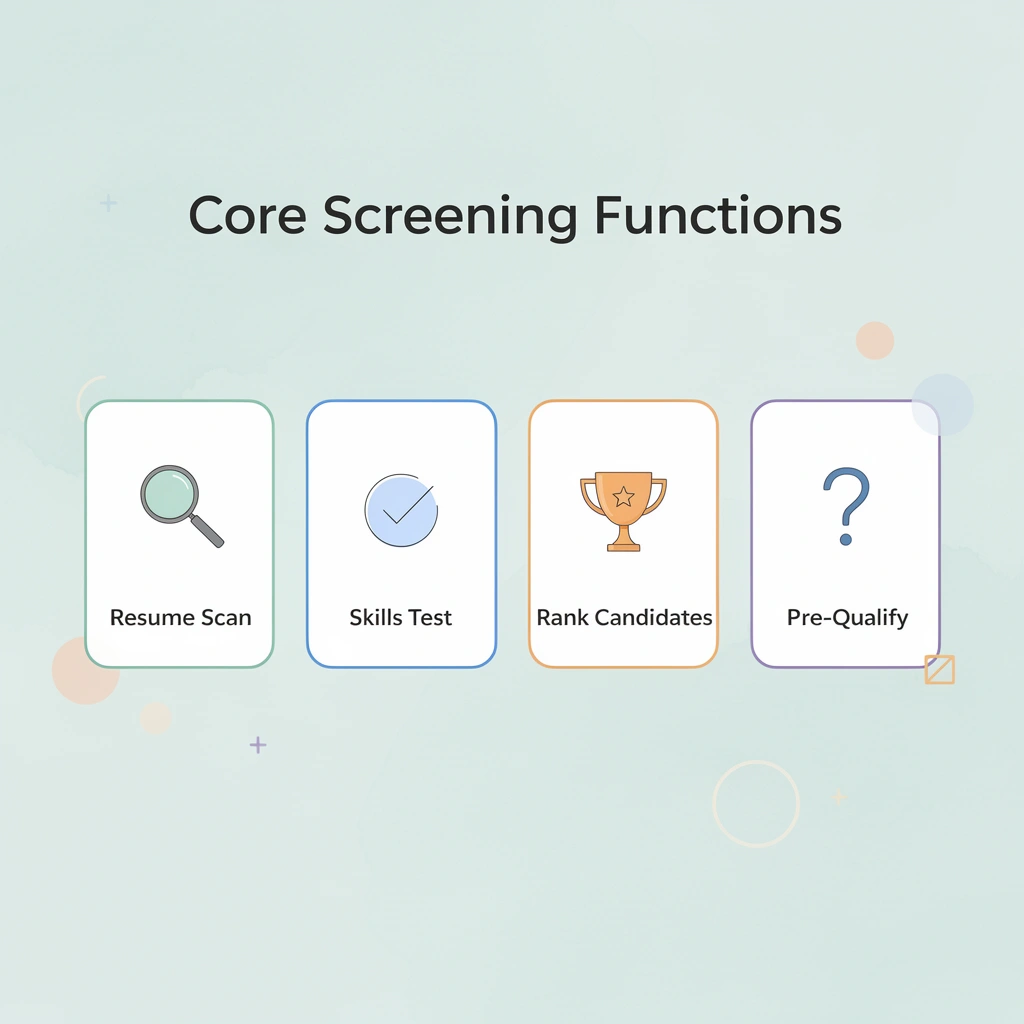
Candidate screening tools are software platforms that help you evaluate, filter, and prioritize applicants before the interview stage. They scan resumes, assess skills, rank candidates, and collect pre-qualifying answers, allowing recruiters to focus on conversations rather than sorting spreadsheets.

💡 Key Point: The goal is to eliminate hours wasted on non-viable applications, not replace human judgment.
🎯 Best Practice: Screening tools work most effectively when they handle the initial filtering while preserving human decision-making for final candidate selection.
"Screening tools transform the recruitment process by automating time-consuming tasks and allowing recruiters to focus on high-value interactions with qualified candidates."
Core Function: Resume scanning
Benefit: Faster filtering
Core Function: Skills assessment
Benefit: Objective evaluation
Core Function: Candidate ranking
Benefit: Priority focus
Core Function: Pre-qualifying questions
Benefit: Better matching
Resume Parsing and Data Extraction
Most screening platforms start with resume parsing, which extracts candidate information like work history, education, skills, and certifications into searchable fields. 75% of recruiters say screening is the most time-consuming part of hiring, with much of that time spent manually reading PDFs and Word documents to verify basic qualifications. Parsing saves those hours by converting unstructured documents into comparable data points. It doesn't make hiring decisions, but it accelerates the evaluation process.
Candidate Matching and Skills Assessment
Matching engines score applicants based on skills, experience levels, certifications, and criteria you define. Many platforms add skills assessments (technical tests, cognitive evaluations, role-specific simulations) to verify candidate claims. When hiring across borders, this proves critical—a developer in Poland and one in Mexico might list the same programming language, but assessments reveal whether both can solve your product team's actual needs. Platforms like global HR system combine screening with multi-country compliance and payroll, so you identify qualified candidates while ensuring legal hiring and payment work across entities without switching tools.
Pre-Screening Questionnaires and Workflow Management
Pre-screening questionnaires filter applicants before the resume review by asking about work authorization, salary expectations, certifications, language fluency, location flexibility, and willingness to travel. Candidates who don't meet non-negotiables self-select out, protecting both their time and yours. Workflow management features track candidate progress and identify bottlenecks, which is critical when hiring teams span time zones and managers delay reviews. The system prevents candidates from falling through the cracks due to full inboxes.
What makes screening tools different from applicant tracking systems?
Screening tools evaluate candidates. Applicant Tracking Systems (ATS) manage the entire recruitment lifecycle: job postings, candidate tracking, interview scheduling, offer letters, onboarding handoffs, and reporting. An ATS serves as the system of record; screening tools form the intelligence layer that determines who merits inclusion. Many modern platforms merge both functions, eliminating friction from exporting match scores and importing them into another tool while your hiring manager awaits the shortlist.
How do screening tools improve the hiring process?
The best screening tools eliminate manual sorting, inconsistent evaluation, and wasted hours worrying about missed qualified candidates due to keyword mismatches. Once you've identified the right candidates more quickly, the next question becomes: which tools work well, and how do you choose among them?
12 Candidate Screening Tools to Consider
The best candidate screening tool depends on your hiring volume, recruitment process, and whether you need standalone screening functionality or integration with applicant tracking, onboarding, compliance, and workforce management. The most effective tools filter candidates while creating a seamless pipeline that connects every stage of your hiring process.

🎯 Key Point: The right screening tool should integrate seamlessly with your existing HR tech stack rather than creating isolated workflow steps.
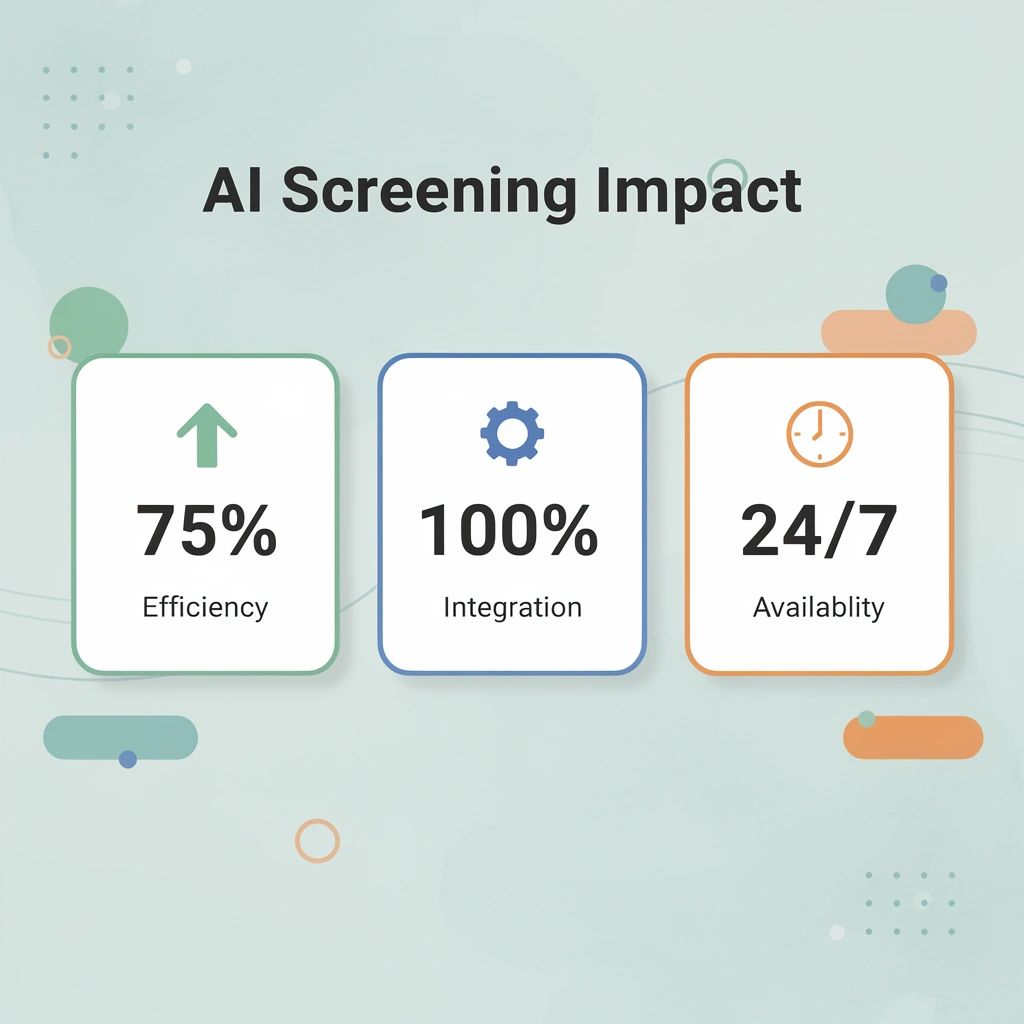
"75% of recruiters say AI screening tools have improved their hiring efficiency." — LinkedIn Talent Solutions

According to LinkedIn Talent Solutions, 75% of recruiters say AI screening tools have improved their hiring efficiency. This improvement matters most when screening connects to downstream hiring processes rather than creating an isolated step. The value comes from end-to-end integration that eliminates manual handoffs and maintains candidate data consistency throughout your recruitment pipeline.
🔑 Takeaway: Efficiency gains from screening tools are maximized when they integrate deeply with your existing hiring workflow rather than operating as standalone solutions.
1. Cercli
Best for
UAE, Saudi Arabia, and MENA organizations seeking candidate screening within an integrated recruitment and workforce management platform.
Cercli combines candidate screening with an ATS that manages applications, maintains visibility across hiring pipelines, standardizes workflows, and improves collaboration between recruiters and hiring managers.
Because Cercli connects recruitment with onboarding, payroll, compliance, contractor management, EOR services, and broader HR operations, organizations manage candidate screening as part of a connected employee lifecycle. Hiring someone in Dubai and onboarding them in Saudi Arabia with compliant contracts and payroll setup becomes one workflow instead of three.
2. Qureos
Best for
Organizations in the Middle East and North Africa are seeking AI-powered candidate matching and shortlisting.
Qureos is a UAE-based hiring platform that uses AI-driven matching to connect candidate profiles with job requirements. It automates screening and helps recruiters prioritize applicants, making it especially useful for organizations hiring across the Middle East.
3. Evalufy
Best for
Organizations that want to focus on testing job candidates before hiring them.
Evalufy offers cognitive, behavioral, and skills-based testing to screen candidates. Employers can customize assessment frameworks to align with specific role requirements, enabling structured evaluation and skills-based hiring practices.
4. OVI
Best for
Recruitment teams seeking automation across sourcing and screening workflows.
OVI automates candidate sourcing, screening, and communication, reducing recruiter workload by finding relevant candidates and managing applicant progression more efficiently.
5. HireZapp
Best for
UAE and GCC employers managing large applicant volumes.
HireZapp combines candidate screening with recruitment automation, including automated shortlisting, applicant evaluation, and interview scheduling. These capabilities reduce manual screening effort and accelerate hiring for organizations with high application volumes.
6. Mokka
Best for
Recruitment teams seeking comprehensive screening and candidate evaluation.
Mokka provides sourcing, candidate screening, AI-assisted pre-interviews, and candidate verification. Its recruitment automation features maintain consistency throughout the evaluation process.
7. HireVue
Best for
High-volume hiring and large-scale candidate assessment.
HireVue offers video interviewing, job simulations, technical assessments, language testing, and structured candidate evaluation. Organizations use it to standardize assessment processes and improve screening consistency at scale.
8. Darwinbox
Best for
Large companies manage hiring and HR work across the Middle East.
Darwinbox combines hiring functionality with broader HR management capabilities, including candidate screening, hiring workflows, hiring visibility, and employee lifecycle processes. It suits companies seeking integrated hiring and workforce management in a single platform.
9. Mercer | Mettl
Best for
Organizations focused on structured pre-employment assessments.
Mettl specializes in psychometric testing, cognitive assessments, and skills evaluations. The platform enables standardized candidate screening and objective evaluation of competencies beyond resume review.
10. TestGorilla
Best for
Skills-based hiring and competency testing.
TestGorilla offers pre-employment assessments that evaluate technical skills, cognitive ability, personality traits, and role-specific competencies, helping organizations rely less on resumes and focus more on demonstrated skills.
11. Manatal
Best for
Recruitment teams seeking AI-powered applicant ranking and shortlisting.
Manatal combines applicant tracking with AI-assisted candidate scoring and screening, helping recruiters identify suitable candidates from large applicant pools, prioritize them efficiently, and track the hiring process.
12. Workable
Best for
Growing organizations seeking integrated recruitment workflows.
Workable brings together sourcing, screening, candidate management, and hiring collaboration on a single platform. Recruiters can manage pipelines, coordinate feedback, and track progress throughout the screening process.
How Platform Architecture Shapes Screening Effectiveness
Most teams evaluate candidate screening tools by comparing feature lists: resume parsing accuracy, AI scoring models, assessment libraries, and integration options. The real difference between platforms emerges after you've shortlisted a qualified candidate.
Why do standalone screening tools create workflow friction?
When screening exists as a standalone tool, you shortlist candidates in one system, then switch to your ATS to schedule interviews, move to email for offer letters, export data to payroll for onboarding, and coordinate with finance on employment contracts. Each handoff introduces delay, data re-entry, and missed details.
How do integrated platforms streamline the hiring process?
Platforms like Cercli connect screening to interview scheduling, offer management, contract generation, onboarding workflows, and payroll setup. Our global HR system handles employment contracts that comply with local labor laws, generates country-specific offer letters, and sets up payroll in the correct entity without re-entering candidate information or coordinating across separate tools. When you shortlist a developer in Egypt and a designer in the UAE, everything works seamlessly across borders.
According to the HR Technology Report, organizations that use AI for candidate screening see a 67% reduction in time-to-hire. This reduction occurs when screening removes friction from the entire hiring process, not when it adds another isolated step.
What Standalone Screening Misses
Standalone screening tools excel at quickly identifying qualified candidates by reading resumes, scoring applicants, and creating shortlists. But that's where they stop.
You still have to manually move candidate data into your ATS, set up interview times via email, create offer letters separately, and send new-hire information to payroll and HR systems. Each system switch causes delays and increases the likelihood that qualified candidates will accept other job offers while you handle logistics.
Screening is only the first step in hiring. When separated from the rest of the process, it automates one part while manual work remains necessary elsewhere.
How does screening complexity multiply for global organizations?
When organizations hire across multiple countries, screening becomes more complicated. You must manage employment contracts that comply with UAE labor law, Saudi Arabian regulations, Egyptian tax requirements, and applicable rules in other jurisdictions where your team operates.
What happens when screening exists separately from workforce management?
When screening exists separately from workforce management, you shortlist candidates in one tool, then manually coordinate contract generation, visa processing, payroll setup, benefits enrollment, and compliance documentation across multiple systems.
How do integrated platforms handle screening and workforce operations?
Platforms that connect screening to workforce operations handle this differently. When you shortlist a candidate in Dubai, the system creates an employment contract that complies with UAE labor law, sets up payroll in the correct entity, handles visa documentation, and initiates onboarding workflows aligned with local compliance requirements, all triggered by the screening decision without manual coordination across tools or re-entering information.
What's the difference between screening tools and screening platforms?
There is no single best candidate screening platform for every organization. Some employers prioritize skills assessments and candidate evaluation, while others focus on AI-assisted screening, workflow automation, or recruitment visibility.
Do you need standalone screening or integrated recruitment workflows?
The key question is whether your organization needs standalone screening capabilities or screening connected to the broader recruitment lifecycle. Standalone screening may suffice if you're hiring within a single country, managing low volumes, or already have established workflows across multiple tools.
But if you're hiring across borders, managing multiple entities, coordinating between recruiters and hiring managers in different locations, or moving candidate information between systems, screening that connects to recruitment workflows, onboarding, compliance, and workforce operations provides greater long-term visibility and operational efficiency than standalone tools.
What makes the best screening tool for your organization?
The best screening tool removes friction from your specific hiring process, not the one with the longest feature list.
What Features Should You Look for in Candidate Screening Tools?
The features that matter most depend on whether you need to handle numerous applications, check for specialized skills, or connect screening information to your hiring and payroll systems. A tool that excels at reading resumes but doesn't integrate with your onboarding and payroll systems creates more work than it saves. The right screening platform should streamline your entire hiring process.
🎯 Key Point: The most powerful screening tool is useless if it doesn't integrate seamlessly with your existing HR infrastructure and workflow requirements.

"Integration capabilities are often the deciding factor between a screening tool that saves time and one that creates additional administrative burden." — HR Technology Research, 2024
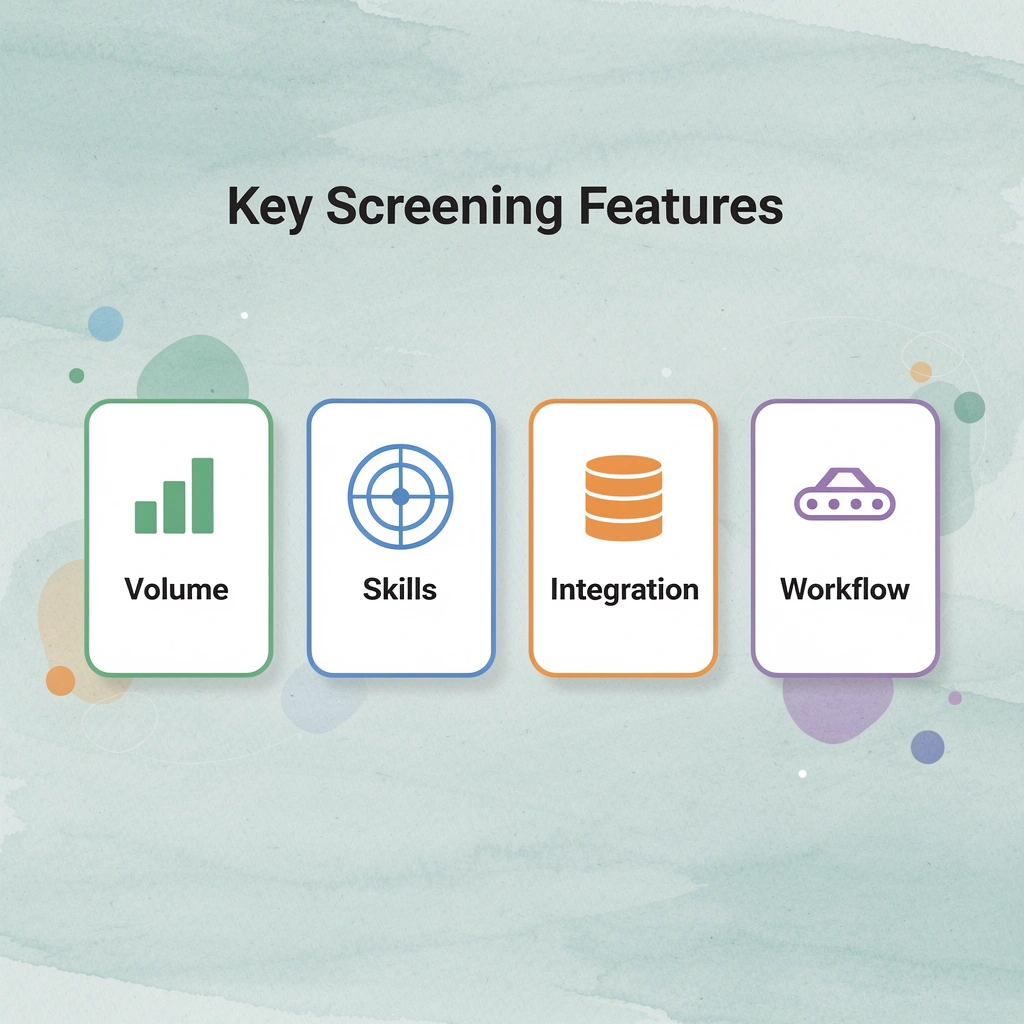
Feature Category
- Application Volume Handling
- Manages high candidate flow
- Reduces manual review time
- Skills Assessment
- Validates specialized competencies
- Improves hiring accuracy
- System Integration
- Connects to existing HR tools
- Eliminates duplicate data entry
💡 Tip: Before evaluating any screening features, map out your current hiring workflow and identify where integration gaps could create bottlenecks in your process.
Resume Parsing and Candidate Matching
Resume parsing converts unstructured application documents into searchable, organized data by extracting work history, education credentials, technical skills, certifications, and contact information. According to the HR Technology Report, this capability can reduce hiring time by 75% when implemented effectively. Strong parsing engines handle multiple resume formats, recognize international qualifications, and identify skills even when candidates use different terminology. Candidate matching then scores applicants against job requirements, surfacing the most relevant profiles first.
Pre-Screening Questionnaires and Automated Filtering
Pre-screening questionnaires determine candidate eligibility before human review. They assess work authorization, location requirements, certifications, language proficiency, salary expectations, and willingness to travel. Automated filtering routes candidates based on responses, declining ineligible applicants immediately and advancing qualified ones to the next stage. This ensures consistency in high-volume hiring while preventing unsuitable applications from consuming recruiter attention. The most effective questionnaire tools use conditional logic, where subsequent questions adapt based on earlier answers, enabling precise screening without overwhelming candidates with irrelevant questions.
Skills Assessment Capabilities
Assessment features are important because hiring is shifting toward competency evaluation. Technical tests, cognitive evaluations, and role-specific simulations provide objective data beyond what resumes reveal. Skills assessments compare candidates across different educational backgrounds and geographic markets: a developer in Lagos and another in São Paulo might have equivalent capabilities despite different credential formats. Assessment reporting should display performance patterns, time-to-completion, and comparative scoring to help recruiters identify where candidates excel or struggle. Platforms that integrate assessment data with application information create a more complete picture of each candidate's potential fit.
Collaboration and Evaluation Workflows
Hiring decisions involve multiple people: recruiters find candidates, hiring managers assess technical skills, department leaders evaluate cultural fit, and interview panels share observations. Screening tools that support shared scorecards, structured feedback forms, and role-based access ensure everyone evaluates candidates using consistent criteria. Visibility into who has reviewed which candidates, what feedback they provided, and where slowdowns occur helps teams make faster, better-informed decisions and prevents conflicts when one interviewer's preference contradicts another's concerns.
How do screening tools connect with existing HR systems?
Screening tools that operate separately from hiring, payroll, compliance tracking, and workforce management force candidate information to be entered manually into multiple systems. Each transfer between systems introduces errors, delays, and administrative overhead. Platforms like Cercli's global HR system connect screening directly to offer generation, onboarding workflows, multi-country payroll setup, and compliance documentation, eliminating gaps where candidate data is typically lost or corrupted.
For teams hiring across borders, this integration matters even more, since employment contracts, tax withholding, and work authorization requirements vary by jurisdiction.
What challenges emerge during actual implementation?
Putting a plan into action often reveals problems that testing missed. The real test happens when screening processes meet the messy reality of actual hiring.
Common Candidate Screening Mistakes
Screening mistakes rarely stem from bad technology—they come from how organizations set up filters, define success, and interact with candidates. These mistakes reduce pipeline quality, slow hiring timelines, and drive qualified candidates away before you speak with them.

🎯 Key Point: The most damaging screening errors happen at the process level, not the technology level—fixing your screening framework delivers better results than upgrading your ATS platform.
"Organizations that implement structured screening processes see 40% better quality-of-hire scores and 25% faster time-to-fill compared to those using ad-hoc methods." — Society for Human Resource Management, 2023
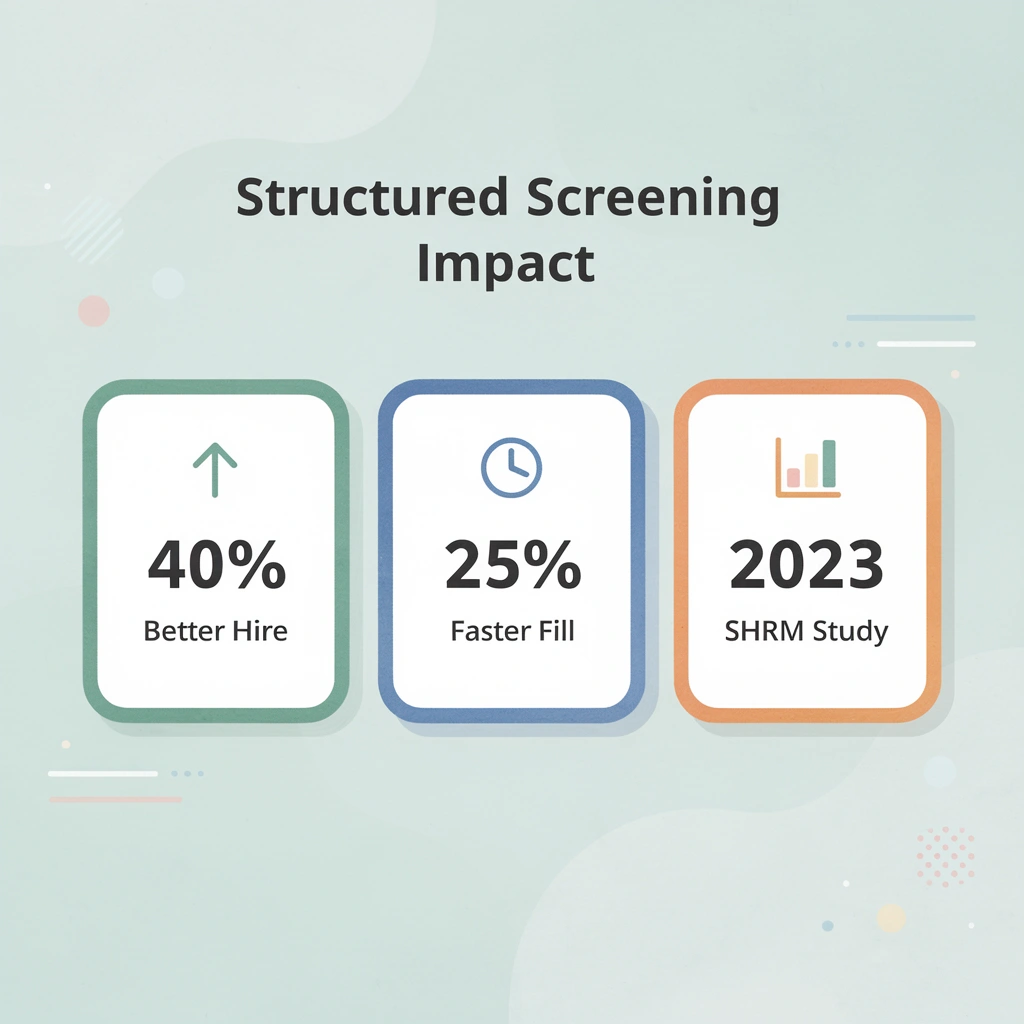
⚠️ Warning: Even the best screening technology becomes counterproductive when paired with poorly defined job requirements, unrealistic qualification thresholds, or inconsistent evaluation criteria.
Relying on keyword matching alone
Keyword filtering manages volume but creates blind spots that emerge only when good candidates disappear from your pipeline. A developer with five years of React experience might not use the exact phrase "React framework" on their resume. A project manager who led cross-functional teams might describe it as "coordinating stakeholders across departments." When your screening tool advances only candidates matching specific words, you filter out people with the skills who describe them differently. This becomes more pronounced when hiring across borders, where terminology varies by region, and candidates translate experience from other languages into English.
Screening without clear evaluation standards
Fast processing doesn't make up for unclear requirements. When recruiters and hiring managers understand "strong communication skills" or "team leadership experience" differently, screening decisions become inconsistent. One reviewer might advance candidates with formal management titles, while another might value candidates who work across teams without direct reports. These inconsistencies compound across high-volume roles, where multiple people review applications using their own mental models. Clear, documented evaluation criteria ensure candidates are assessed against the same standards rather than individual preferences.
Treating automation as the final decision
Automation handles repetitive tasks efficiently, but it shouldn't replace human judgment entirely. Screening tools score candidates based on your criteria, yet they can't evaluate context, potential, or transferable skills outside predefined parameters. According to CareerBuilder, 75% of recruiters admit to making snap judgments about candidates within the first 5 minutes of an interview, suggesting automated systems can reinforce premature conclusions at scale. Treat screening recommendations as input, not a verdict, allowing recruiters to apply professional judgment where it matters most.
How does poor candidate experience impact your screening process?
Screening creates one of the first important moments between your organization and prospective employees. Long application forms, unclear timelines, repeated assessments, and slow communication reveal how you operate before candidates meet your team.
In competitive hiring markets, these friction points directly affect whether qualified people continue through your process. Research from CareerBuilder found that 49% of job seekers have declined a job offer due to a bad interview experience, with candidate drop-off beginning during screening and scheduling stages, when delays and inefficiencies make people question whether the role is worth pursuing.
What happens when screening tools don't integrate with other systems?
Traditional screening tools treat each stage (application review, assessment, interview scheduling, offer management) as a separate workflow, forcing recruiters to manually move data between systems. Cercli connects screening directly to workforce management, so candidate information flows into onboarding, payroll setup, and compliance documentation without gaps or manual transfers.
For teams hiring across multiple countries, this integration eliminates the friction that typically causes qualified candidates to disengage before offers are finalized. The question isn't how you screen, but what happens after a candidate passes through.
Related Reading
- Recruitment Analytics Software
- How Can I Use Ai To Improve My Job Descriptions
- Hr Automation Tools
- Best Job Descriptions
- How To Write A Job Description
- Automate Interview Scheduling
- How To Use Ai In Recruitment
- Best Tools For Remote Recruitment
- Companies Using Ai For Recruitment
- Best Recruitment Crm
How Cercli Helps Companies Improve Candidate Screening
Cercli connects candidate evaluation directly to onboarding, payroll, and compliance workflows, eliminating manual data transfers and administrative gaps. For teams hiring across the UAE, Saudi Arabia, and the wider MENA region, this removes friction that causes candidates to disengage between screening and offer acceptance.

🎯 Key Point: By integrating screening with downstream HR processes, Cercli ensures that qualified candidates experience a seamless transition from evaluation to employment, reducing drop-off rates and improving hiring success.
"Eliminating administrative gaps between screening and offer acceptance is critical for maintaining candidate engagement in competitive markets." — HR Technology Research, 2024
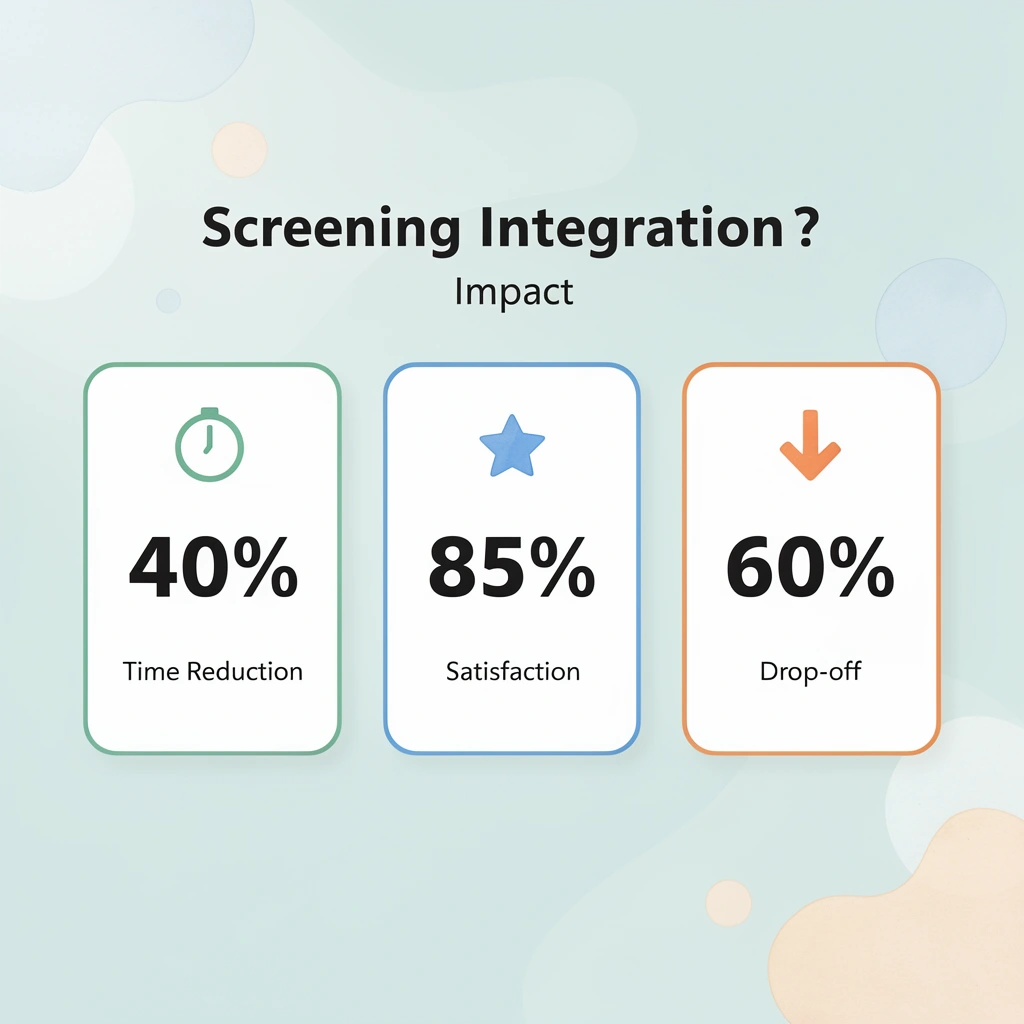
💡 Best Practice: Companies using integrated screening platforms can reduce their time-to-hire by up to 40% while maintaining higher candidate satisfaction scores throughout the recruitment process.
How does centralized management eliminate workflow fragmentation?
The typical screening process is fragmented across email, spreadsheets, and multiple tools. Cercli's ATS consolidates applicant data, evaluation activity, and recruitment progress in one place. When a recruiter in Dubai reviews a developer candidate based in Riyadh, all screening notes, technical assessment results, hiring manager feedback, and interview schedules are available within a single workflow.
According to Cercli, organizations see a 75% reduction in time-to-hire when screening uses connected workflows instead of fragmented tools.
Why is visibility critical for high application volumes?
This visibility becomes critical with numerous applications. Recruiters can prioritize candidates based on progression data, identify bottlenecks (technical assessment completion, hiring manager review delays, reference check gaps), and ensure qualified applicants don't get stuck due to administrative disconnects.
The platform automatically tracks candidate movement, freeing teams from spreadsheet updates so they can focus on evaluation.
How does screening connect to workforce operations?
Most platforms stop at choosing a candidate. The real cost emerges when recruiters manually transfer information into onboarding systems, payroll platforms, and compliance documentation.
What happens when screening extends into employee activation?
Cercli extends screening into employee activation by connecting recruitment data directly to onboarding workflows, payroll setup, and employment compliance requirements across different MENA jurisdictions.
When a candidate accepts an offer, their information flows into employment contracts, payroll configuration, and benefits enrollment without re-entry. For organizations managing employees, contractors, and international hires through EOR arrangements, this prevents administrative gaps that delay start dates and create poor first impressions. Research from Senseloaf indicates that 78% of candidates view their recruitment experience as a direct indicator of how a company values its people.
What performance patterns do recruitment analytics reveal?
Cercli provides recruitment analytics that show where qualified candidates leave the process, which evaluation stages create bottlenecks, and how screening activity connects with time-to-hire and offer acceptance rates. Teams can identify whether delays stem from technical assessment completion times, hiring manager review cycles, or administrative handoffs between recruitment and onboarding.
How does data visibility enable evidence-based improvements?
This visibility enables evidence-based improvements. If qualified candidates consistently drop out after initial phone screens, the data reveal whether the cause is interview-scheduling delays, unclear role expectations, or misaligned compensation discussions.
But improving how you screen candidates creates value only if the rest of your hiring operation can keep pace with better selection decisions.
Related Reading
- Social Media Recruitment Strategies
- Corporate Recruitment Strategies
- Recruitment Process Outsourcing
- Top Recruitment Process Outsourcing Companies
- How To Improve The Recruitment Process
- Workable Alternatives
- Manatal Alternatives
- Braintrust Alternatives
- Workable Vs Greenhouse
Book a Demo to Speak with Our Team about Our Global HR System
Screening processes create value when connected to your broader workforce operations. If your organization struggles with application volume, candidate identification, or hiring visibility, book a Cercli demo. The session identifies screening bottlenecks and demonstrates how our connected recruitment workflows improve candidate evaluation, hiring visibility, and workforce readiness across multiple borders.

🎯 Key Point: A demo session provides immediate visibility into your hiring process breakdowns—whether it's resume overload, inconsistent evaluation standards, or fragmented candidate data across disconnected tools.
"Organizations that implement connected recruitment workflows see significant improvements in candidate evaluation efficiency and hiring visibility across global operations." — Cercli HR Analytics, 2024

The conversation maps where your hiring process breaks down and reveal how teams reduce time-to-hire, eliminate manual data entry, and maintain compliance across multiple countries without adding headcount or complexity.
💡 Tip: Use the demo to identify which screening bottlenecks are actually costing your organization the most in time-to-hire and candidate quality—the results often surprise hiring managers.