15 Pre-Employment Screening Tools for Smarter Hiring
.jpg)
15 Pre-Employment Screening Tools for Smarter Hiring
Hiring the wrong person costs more than money. It drains time, disrupts team morale, and slows momentum at every level of an organization. To reduce that risk, companies are increasingly relying on AI-powered candidate screening tools that combine background checks, skills assessments, and applicant tracking to make faster, more accurate hiring decisions.
Finding the right screening tools is only part of the equation. Managing a global workforce after hiring requires the same level of structure and precision. For HR teams looking to connect candidate evaluation, onboarding, and workforce management in one place, Cercli offers a global HR system built to support every stage of the employee lifecycle.
Table of Contents
- Why Pre-Employment Screening Needs More Than a Background Check
- What Are Pre-Employment Screening Tools?
- 15 Pre-Employment Screening Tools
- Where Pre-Employment Screening Tools Can Go Wrong
- How to Use Pre-Employment Screening Tools Effectively
- How Cercli Supports the Recruitment Process Around Pre-Employment Screening
- Book a Demo to Speak with Our Team about Our Global HR System
Summary
- Hiring the wrong person costs more than recruitment fees. Research cited in the article puts that figure at up to 30% of an employee's first-year earnings, a number that reflects lost productivity, re-hiring costs, and the disruption absorbed by existing team members. The financial case for investing in structured pre-employment screening is straightforward once you understand that baseline.
- Most hiring processes treat screening, verification, and assessment as interchangeable steps, even though they answer entirely different questions. Screening checks whether a candidate appears to meet basic requirements, verification confirms whether a specific claim is accurate, and assessment evaluates whether someone can actually perform the work. Conflating these functions can lead to over-screening candidates who never needed that level of scrutiny or missing critical gaps in candidates who advance too easily.
- Background check data is less reliable than most hiring teams assume. According to Edge Information's 2025 report, up to 40% of background check errors stem from outdated or incomplete database records, and 1 in 3 job applications contain inaccurate information. Screening tools that process flawed inputs efficiently still produce flawed outputs, meaning the shortlists they generate carry embedded risk that recruiters rarely see until a hire goes wrong.
- Automated keyword filters and rigid qualification thresholds are among the most common and least examined failure modes in candidate screening. The U.S. Equal Employment Opportunity Commission has flagged that automated screening based on keywords and qualifications can unintentionally exclude candidates in ways that create legal and ethical exposure. Candidates who describe equivalent experience in plain or unconventional language are systematically disadvantaged by systems designed to reward keyword matching rather than actual capability.
- The sequence in which screening tools are applied matters as much as the tools themselves. Research from Vervoe indicates that structured pre-employment assessments can reduce mis-hires by up to 85%, but that figure depends on applying assessments after basic eligibility is confirmed, not as a first-pass filter on the full applicant pool. Running deep evaluations on candidates who were never qualified produces more data without improving shortlist quality.
- Candidate data generated during screening loses value when it doesn't travel with the hire through onboarding and payroll. Serendi's recruitment research found that 75% of HR managers say background checks surface information that would not have been found otherwise, yet that information is often left behind in standalone screening tools once an offer is extended. A connected system that carries candidate records through to contracts, onboarding, and payroll eliminates the manual re-entry and context loss that create risk at the final stages of hiring.
- Cercli's global HR system addresses this by connecting recruitment, screening workflows, onboarding, and payroll into a single environment so candidate data gathered during pre-employment screening remains accessible and actionable through every stage that follows.
Why Pre-Employment Screening Needs More Than a Background Check
Background checks are a starting point, not a finish line. A criminal record search tells you about the past, but it says nothing about whether someone can actually do the job, whether their claimed degree exists, or whether a previous employer would ever hire them again.
"A criminal record search tells you about the past — but it says nothing about whether someone can actually do the job, whether their claimed degree exists, or whether a previous employer would hire them again."
What a Background Check Covers
- Criminal history
- Identity verification
- Sex offender registry
- Public records
What It Misses
- Job performance ability
- Degree & credential validity
- Reference & rehire status
- Skills & competency gaps
🚨 Warning: Relying solely on a background check creates a dangerous blind spot — you may be screening out risk without ever screening in capability.
💡 Key Point: True pre-employment screening means verifying what a candidate claims — their education, work history, and professional reputation — not just checking for a criminal record.

Why does fragmentation in screening tools slow down hiring?
The failure point is usually fragmentation. Most hiring teams use one tool to post jobs, another to screen applications, a separate service for background checks, and yet another for reference verification. Each handoff between systems creates a gap where candidate context gets lost, and timelines stretch. According to a 2023 report from the Society for Human Resource Management, the average time to fill a position is 44 days, with administrative bottlenecks in the screening process as a significant contributor.
Platforms like Cercli address this by connecting candidate evaluation, background screening coordination, and onboarding into a single system, enabling recruiters to shift from integration layer to decision-makers.
How much screening is the right amount for each role?
How much screening to run matters as much as which tools you use. Running every available check on every applicant adds friction when candidates are evaluating you as much as you are evaluating them. A 2022 Greenhouse candidate experience survey found that 58% of job seekers have abandoned an application process they found unnecessarily slow or complex. Screening should match the role, not be applied uniformly as a defensive reflex.
When hiring at volume, matching becomes a discipline. A recruiter reviewing 300 applications for a customer service role does not need the same depth of credential verification as one hiring a licensed financial advisor. The right screening stack adapts to role type and risk level, using automated candidate scoring and qualification filtering to surface the strongest applicants quickly, while reserving deeper checks for the shortlist.
The goal was never more screening. It was better hiring.
What Are Pre-Employment Screening Tools?
Pre-employment screening tools are software programs that help employers collect, filter, evaluate, or verify candidate information before making a hiring decision. They cover a wide range of functions — from reviewing applications and matching candidates to job requirements, to conducting background checks, verifying credentials, and running skills assessments.
"Pre-employment screening tools span the entire candidate evaluation lifecycle — from initial application review to final credential verification — giving employers a structured, data-driven path to smarter hires." — Industry Overview
🎯 Key Point: Pre-employment screening tools are not a single solution — they are an ecosystem of software functions designed to evaluate candidates at every stage of the hiring process.
💡 Example: A company might use one tool for resume filtering, a separate platform for background checks, and another for skills assessments — or a single all-in-one platform that handles all of the above.
Function
- Application Review
- Filters and ranks incoming candidate submissions
- Job Requirement Matching
- Aligns candidate profiles to specific role criteria
- Background Checks
- Verifies criminal, employment, and identity history
- Credential Verification
- Confirms education, licenses, and certifications
- Skills Assessments
- Tests real-world ability before the interview stage

What is the difference between screening, verification, and assessment?
The failure point in most hiring stacks is treating these three functions as interchangeable, even though they answer entirely different questions. Screening asks whether a candidate meets starting requirements. Verification confirms specific claims, such as degrees, employment history, or professional licenses. Assessment determines whether the candidate can do the job. Confirming that a nurse holds valid registration is verification; evaluating how they respond to a clinical scenario is assessment. Mixing them up leads to either over-screening candidates who don't need that scrutiny or under-screening for roles where the stakes demand it.
Why do disconnected tools create bottlenecks as hiring scales?
Most teams use separate tools: one for applications, another for background checks, a third for references, and a spreadsheet tracking candidate progress. At low volume, this feels manageable. As hiring grows, gaps between tools become bottlenecks where candidates fall through, timelines stretch, and recruiters chase status updates instead of evaluating talent. Platforms like Cercli bring recruitment, HR, and payroll workflows into a single AI-native system, preventing handoffs between screening stages from becoming the constraint.
What These Tools Can Actually Cover
Pre-employment screening tools can match candidates, screen applications, check work eligibility, verify employment and education, confirm identity, validate professional licenses, collect references, and assess skills. Not every platform covers all these functions. An employer hiring a software engineer needs a different screening setup than one hiring a licensed financial adviser or a logistics coordinator. The right combination depends on the role, risk level, and locations involved.
Why does bad hiring happen even with screening in place?
According to Employment Hero, 74% of employers say they have hired the wrong person for a role—a striking number, especially since much of the screening process still relies on unstructured resume reviews and gut-feel interviews. Bad hires create problems through lost productivity, re-hiring expenses, and team disruption. Vervoe's Ultimate Guide to Pre-Employment Testing frames the solution clearly: pre-employment testing replaces subjective screening with objective, job-relevant evidence.
What separates a useful screening stack from an over-engineered one?
The critical difference between a useful screening stack and an over-engineered one is specificity. A tool that scores candidates on skills relevant to a specific role adds signal. A tool that adds three extra steps to verify information a recruiter could confirm in one call adds friction without protection. Knowing what each screening tool does and what question it answers lets you build a stack that speeds up hiring instead of complicating it.
But knowing what these tools are built to do is only half the picture; the other half is where things get complicated.
Related Reading
- Methods For Screening Candidates
- How To Improve The Hiring Process
- How To Reduce Time To Hire
- Reduce Recruitment Costs
- Recruitment Assessment Methods
- How To Assess Cultural Fit
- How To Improve Quality Of Hire
- Automated Reference Checks
- High Volume Recruitment Strategies
- Predictive Hiring Assessments
15 Pre-Employment Screening Tools
The tools below serve different purposes: some focus on background screening and verification, while others provide candidate screening within a broader recruitment platform.
"Choosing the right pre-employment screening tool is one of the most critical decisions in building a reliable, compliant hiring process." — HR Industry Best Practice
💡 Tip: Before selecting a tool, always identify whether your primary need is background verification, skills assessment, or an all-in-one recruitment solution — the distinction will save you significant time and budget.
Tool Category
- Primary Focus: Identity, criminal & employment verification
- Best For: Compliance-heavy industries
Candidate Screening Platforms
- Primary Focus: Skills, fit & application filtering
- Best For: High-volume recruitment
All-in-One Recruitment Platforms
- Primary Focus: End-to-end hiring with built-in screening
- Best For: Growing teams & SMBs
⚠️ Warning: Using a one-size-fits-all approach to screening tools is a common mistake — mismatched tools can lead to compliance gaps, slower hiring, and unnecessary costs.

1. Cercli
Best for: Screening job candidates as part of a connected hiring and HR workflow.
Cercli's AI-native ATS helps recruiters screen applicants against defined job criteria, match candidates to roles, and surface AI-powered candidate insights. Our recruitment platform includes live candidate analytics and feedback management, giving hiring teams visibility across the recruitment pipeline.
Unlike specialist background-screening providers, Cercli manages the entire recruitment process: reviewing applications and moving candidates through the pipeline, collaborating on hiring decisions, and connecting successful candidates with onboarding.
2. Checkr
Best for: Background checks and automated employment screening.
Checkr provides criminal-record screening, employment and education verification, identity verification, professional license verification, drug and health screening, reference checks, and international screening options. Its platform supports customizable screening workflows and adjudication.
It also provides APIs and pre-built integrations with ATS and HRIS platforms, enabling employers to incorporate background screening into existing recruitment or onboarding workflows.
3. First Advantage
Best for: Global background screening at enterprise scale.
First Advantage provides background checks and identity verification across more than 200 countries and territories, including employment and education verification, international checks, regulatory checks, drug and occupational health screening, fingerprinting, and identity-related services.
Its platform includes reporting and analytics, case management, and integrations with more than 100 ATS and HCM partners, making it particularly relevant for organizations managing large or geographically distributed screening programs.
4. HireRight
Best for: Global background screening and regulated hiring.
HireRight provides criminal history checks, employment verification, education and professional license verification, reference checks, and international background screening. The scope of each check varies by employer and role.
This is particularly relevant for regulated industries such as healthcare and transportation, where screening requirements are more extensive. HireRight provides processes for candidates to correct or dispute inaccurate screening information.
5. Accurate Background
Best for: Background screening and credential verification.
Accurate provides employment, education, and professional license verification by contacting previous employers, educational institutions, and licensing authorities. Its services support both domestic and global verification.
6. Veremark
Best for: Checking someone's background and criminal history before hiring them.
Veremark offers criminal checks, identity services, employment history, education and qualification verification, references, right-to-work checks, and other screening options. Employers can select checks based on location, industry, and specific needs.
The platform integrates with existing HR systems and offers customizable reference checks that gather organized feedback on job performance, skills, and professional achievements.
7. Certn
Best for: Global background checks for growing and international teams.
Certn supports screening across all 195 countries with background checks and verification services designed for global hiring. The platform operates via API, integrates with existing ATS or HRIS systems, or functions as a standalone service.
8. Peopletrail
Best for: Customizable background screening and verification.
Peopletrail offers criminal background checks, identity screening, employment and education verification, professional and personal references, drug screening, health screening, professional credential checks, and global screening. It supports screening for extended workforces, including contractors and consultants.
Its services cover more than 200 countries and integrate with ATS systems, offering healthcare-specific screening including credential checks for doctors, nurses, physician assistants, nurse practitioners, and other medical professionals.
9. DISA Global Solutions
Best for: Background screening for regulated and safety-sensitive workforces.
DISA combines background screening with drug and alcohol testing, occupational health services, and other compliance offerings. Its background screening services can be customized to employer requirements, while its broader platform integrates screening and compliance activity.
The company supports healthcare and higher education, providing ATS and HRIS integrations with international availability.
10. IntelliCorp
Best for: Background screening with compliance and international search capabilities.
IntelliCorp, a Cisive company, provides employment and education verification, criminal searches, and background investigations across more than 200 countries and territories. Its Candidate Direct Portal lets applicants safely provide information, while job-specific templates determine which searches run. IntelliCorp also offers adverse-action services to support employers through notification processes following background-screening results.
11. Verified First
Best for: Background verification and professional credential checks.
Verified First offers employment, education, and professional license verification, along with reference verification and background-screening services. Its professional license verification covers regulated professions including nurses, doctors, and pharmacists. The platform integrates with more than 150 cloud-based people and volunteer management platforms, enabling employers to incorporate screening into existing hiring technology stacks.
12. Xref
Best for: Automated reference checking.
Xref focuses on reference checking rather than full background-screening services. Employers can create standard or customized reference questionnaires and collect structured feedback about candidate skills and competencies. The platform automates communication with referees, provides quantified feedback reports, and flags unusual activity during the reference process.
13. Workable
Best for: Screening candidates as part of a larger applicant-tracking system.
Workable combines applicant tracking with candidate evaluation tools, including knockout questions, AI-powered screening, candidate matching, anonymized screening, interview tools, and assessments. Its AI Screening Assistant summarizes candidate profiles, compares candidates against job requirements, and helps create initial shortlists. It can work alongside specialist screening providers, enabling employers to use different tools for different hiring stages.
14. SmartRecruiters
Best for: AI-supported candidate screening within enterprise recruitment.
SmartRecruiters' Winston Screen uses AI to create screening questions, evaluate candidate responses against job-related criteria, and rank candidates into shortlists. Employers can customize criteria weights for must-have and preferred requirements. The screening capability integrates within SmartRecruiters' enterprise recruitment platform, which manages the broader hiring lifecycle.
15. Manatal
Best for: AI-powered candidate matching and application screening.
Manatal's AI reads candidate resumes and extracts skills, education, and experience. Its recommendation engine compares candidates against job requirements, scoring and ranking them using weighted criteria for skills, experience, and education. The platform also provides AI-powered search and candidate-profile enrichment alongside applicant tracking, automating candidate discovery and screening rather than formal background checks.
Where Pre-Employment Screening Tools Can Go Wrong
Screening tools fail quietly. They don't flag when they filter out qualified candidates or when background checks return outdated data that unfairly shapes hiring decisions. The damage accumulates invisibly until a pattern emerges.
When the data itself is the problem
The failure point is often not the tool but the information it uses. According to Edge Information's Background Screening Trends in 2025, up to 40% of background check errors stem from outdated or incomplete database records. A system that processes flawed inputs with perfect efficiency still produces flawed outputs, only faster.
Edge Information also reports that 1 in 3 job applications contain inaccurate information, whether through honest error, selective omission, or deliberate misrepresentation. Screening tools match unverified application data against job criteria, comparing two imperfect sources. The resulting shortlist appears authoritative but rests on assumptions.
What makes wrong screening criteria so hard to catch?
Screening for the wrong criteria is the most common and least examined failure mode. Excessive experience thresholds, degree requirements disconnected from actual job demands, and keyword filters that penalize candidates who describe equivalent work differently all shrink the candidate pool without improving shortlist quality. The U.S. Equal Employment Opportunity Commission has specifically flagged that automated screening based on keywords and qualifications can unintentionally exclude candidates in ways that create legal and ethical exposure.
How does copying old criteria turn a requirement list into an elimination engine?
Most teams copy criteria from previous job postings or build checklists from every item in the job description. This turns a requirement list into a tool that removes candidates who don't match keywords and penalizes those who describe experience in plain language. Platforms like Cercli address this by using AI-powered candidate scoring and flagging rather than rigid keyword elimination, so recruiters see ranked signals instead of binary pass-or-fail outputs that obscure relevant experience before human review.
Treating a screening result as a verdict
Passing a background check or clearing an automated CV screen does not tell you whether someone can do the job—it tells you they cleared a filter. Screening narrows a field; it does not evaluate capability. Skills assessments, structured interviews, and work samples must do that work, and no amount of pre-employment checks replaces them.
Does a longer screening stack actually produce better hiring decisions?
A long screening stack creates the psychological impression of rigor without producing better hiring decisions. When each step answers the same underlying question rather than a new one, the process grows longer without growing smarter. The goal is not a comprehensive-looking process, but one where each check answers a specific question that nothing else already answers.
What should hiring teams actually know about each screening tool they use?
The real question is not whether your screening tools work, but whether users understand what each one is designed to reveal and, more importantly, what it cannot.
Related Reading
- Ai Resume Screening Bias
- How Does Automated Resume Screening Work
- Behavioral Hiring Assessments
- How To Reduce Bias In Hiring Process
- Sales Candidate Screening
- Cultural Fit Assessment Tools
- Blind Resume Screening
- Pre-Hire Assessments For High Volume Hiring
- Candidate Screening Tools for Healthcare
How to Use Pre-Employment Screening Tools Effectively
Sequence screening tools so each stage builds on the last rather than repeating it.
"A well-sequenced screening process ensures every stage adds new insight — eliminating redundancy and keeping top candidates engaged throughout the funnel." — Hiring Best Practices
Screening Stage
- Purpose: Filter basic qualifications
- Builds On: Job requirements
Pre-Employment Assessment
- Purpose: Evaluate skills & fit
- Builds On: Application data
Structured Interview
- Purpose: Deep-dive validation
- Builds On: Assessment results
💡 Tip: Always map your screening sequence before launching a role — each tool should answer questions the previous stage couldn't.
⚠️ Warning: Repeating the same questions or assessments across multiple stages is a critical mistake that wastes candidate time and signals disorganization to top talent.
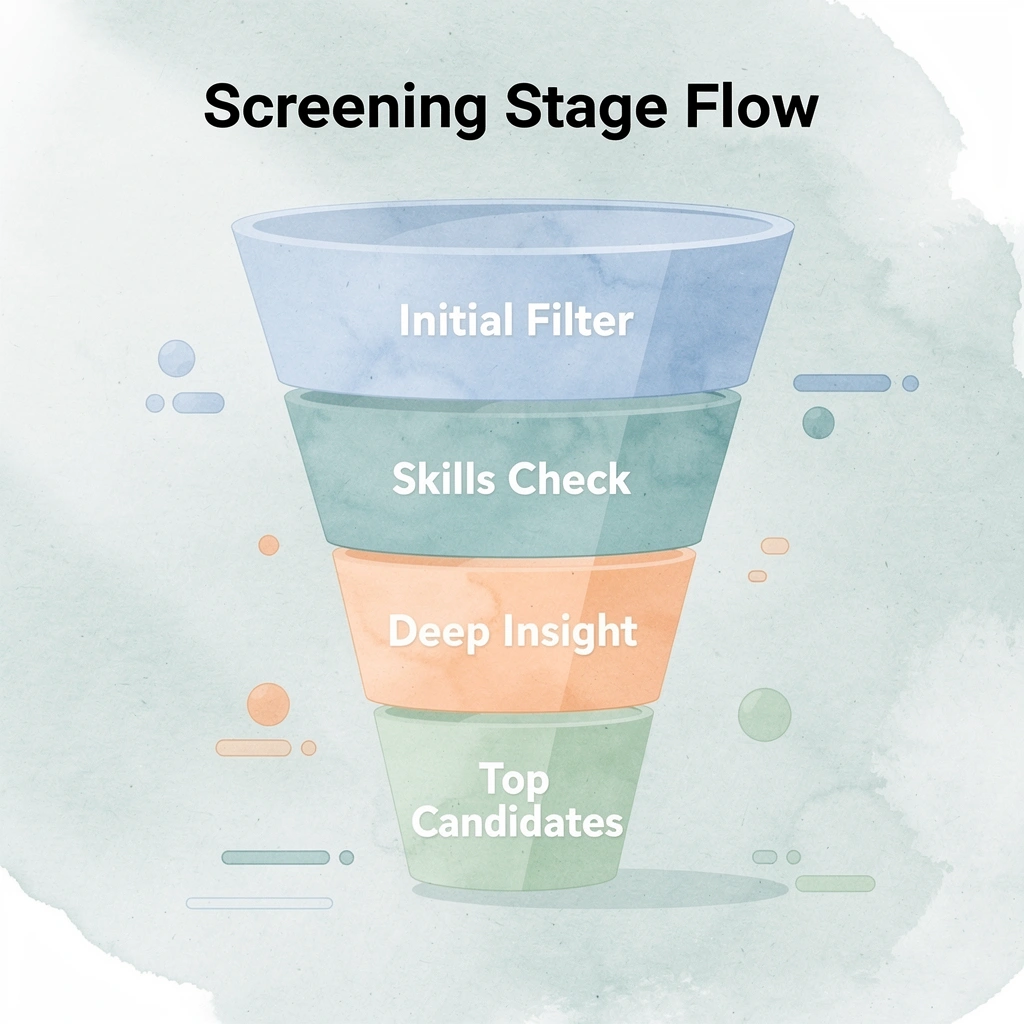
Start with eligibility, not evaluation
The first question in any screening process should be simple: does this candidate meet the non-negotiable requirements for this job? Work authorization, required licenses, and minimum qualifications are binary checks that belong at the front. Everything else—how someone thinks, communicates, or performs under pressure—belongs further along, once basic eligibility is confirmed.
This sequencing matters because the cost of a mis-hire extends beyond finances: onboarding time, team disruption, and repeat searches. Vervoe's 2025 guide to pre-employment testing reports that structured pre-employment assessments can reduce mis-hires by up to 85%, but only when applied to candidates who have cleared the eligibility threshold. Running deep evaluations on unqualified applicants wastes resources on candidates who will not progress.
What happens when screening depth doesn't match the hiring stage?
The failure point is usually a mismatch between screening depth and where a candidate is in the process. Asking someone to complete a two-hour skills assessment before a recruiter has reviewed their CV creates unnecessary friction. Moving a candidate to final interviews without structured capability checks leaves the hiring decision resting entirely on impression.
Does predictive validity depend on when a test is applied?
Criteria Corp's research on pre-employment test validity shows that work sample tests have a validity coefficient of 0.54, among the highest of any screening method. This predictive power depends on using them at the right stage with the right candidates, not as a blanket filter for all applicants.
How do integrated platforms help recruiters sequence screening automatically?
Platforms like Cercli address this directly. When candidate data, screening activity, and hiring workflows live in the same global HR system, recruiters can trigger the next screening stage automatically based on candidate progress, rather than manually tracking who has cleared what across separate tools.
Make human review a design choice, not an afterthought
Automated screening can process hundreds of applications in the time it takes a recruiter to read ten. However, the decision about who moves forward should never belong entirely to an algorithm. Recruiters need to see why a candidate was ranked, flagged, or excluded, and override that outcome when context warrants it.
A candidate with a non-linear career path, equivalent experience described in different terminology, or a gap explained by caregiving responsibilities can look wrong to a scoring system while being exactly right for the role. Human review isn't a check on technology; it is the part of the process technology cannot replace.
Once your screening process runs smoothly, what happens to all that candidate data as hiring moves into onboarding, contracts, and payroll?
How Cercli Supports the Recruitment Process Around Pre-Employment Screening
Candidate data that moves through screening but then disappears into a spreadsheet, email thread, or separate onboarding system is not a workflow — it's a gap with extra steps.
"A disconnected screening process isn't just inefficient — it's a structural risk that compounds at every stage of the hiring funnel."
💡 Tip: If your team is manually reconstructing candidate context after screening, your tools aren't working together — and your hiring decisions are paying the price.
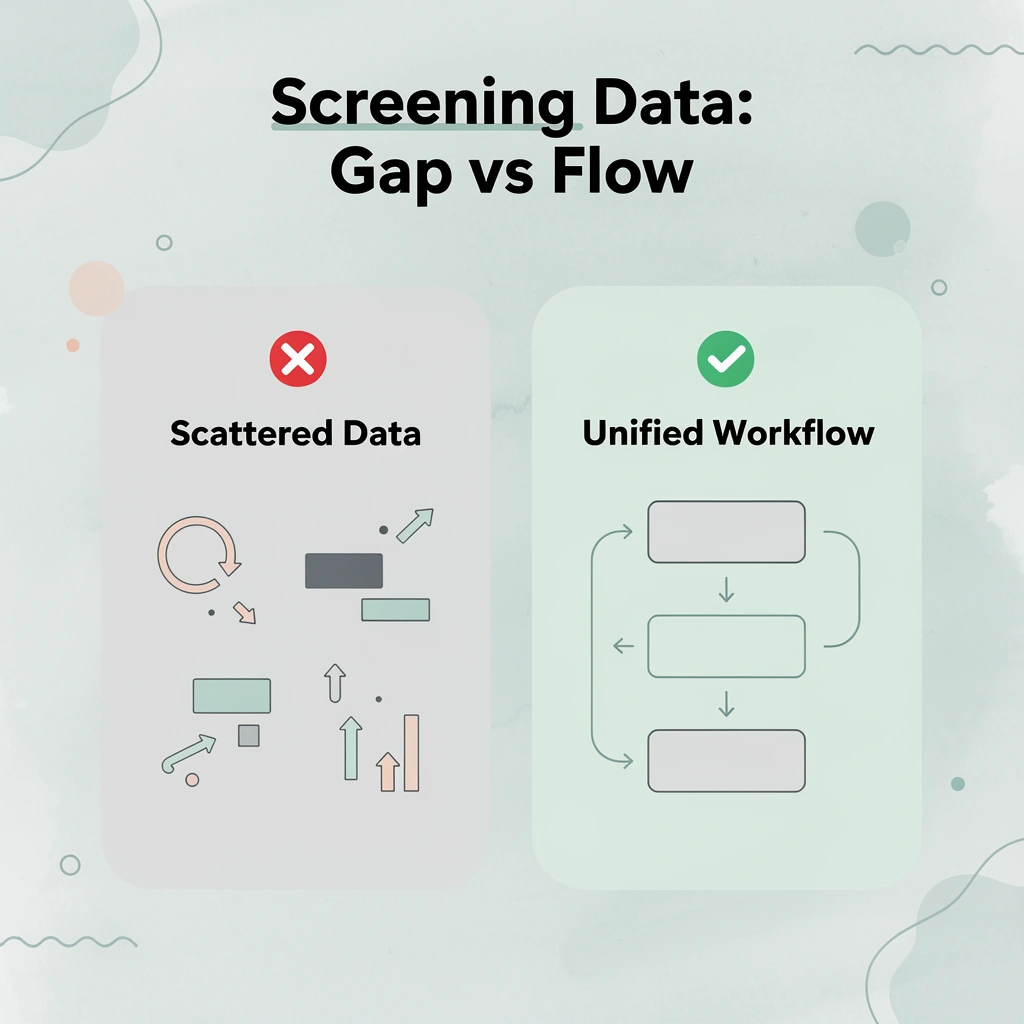
The screening process generates real signal about candidates: who cleared eligibility checks, who scored well on assessments, what feedback hiring managers left after interviews. When that information lives in disconnected tools, recruiters spend time reconstructing context that should already be there. According to PeopleTrail, bad hires cost companies up to 30% of the employee's first-year earnings, and a significant share of that risk traces back to decisions made without complete, connected information.
"Bad hires cost companies up to 30% of the employee's first-year earnings — and a meaningful share of that risk traces back to decisions made without complete, connected information." — PeopleTrail
🔑 Takeaway: The cost of a bad hire isn't just financial; it's a direct consequence of fragmented data and broken information flows across your hiring stack.
⚠️ Warning: Relying on siloed tools during pre-employment screening slows recruiters down and increases the likelihood of costly hiring mistakes that unified candidate data could prevent.
Where most hiring stacks quietly break down
Most teams manage candidate progression through disconnected tools: a background check provider, an assessment platform, a shared inbox for references, a spreadsheet for pipeline tracking. At low volume, this feels manageable. As applications grow, gaps between tools become the bottleneck. Hiring managers lose visibility, recruiters duplicate effort, and candidates experience a disjointed process.
How does an AI-native ATS bring the workflow together?
Cercli addresses this with an AI-native ATS that screens applicants against defined criteria, surfaces candidate insights, and tracks pipeline progression in one place. Recruiters set must-have requirements upfront, let the platform match and score applicants, and monitor live analytics showing candidate quality, drop-off points, and stage progression. Rather than replacing specialist background check or credential verification providers, the global HR system organizes the workflow around them: screening inputs from external tools connect to the same candidate record instead of sitting in separate systems.
Keeping the candidate record intact through to onboarding
The key difference between a hiring platform and a workaround is what happens after someone accepts an offer. If the team must re-enter candidate information into a separate onboarding or payroll system, the process has failed the efficiency test. Cercli connects recruitment directly to onboarding for employees, contractors, and EOR hires, with centralized documents, contract workflows, and new-joiner tasks in a single environment. Serendi's recruitment research found that 75% of HR managers say background checks surface information that would not have been found otherwise—information that needs to travel with the candidate, not remain trapped in a screening tool.
Why does record continuity matter more when hiring across countries?
For teams hiring across multiple countries, that continuity matters even more. Local payroll requirements, contractor classifications, and employer-of-record obligations follow the hiring decision. When recruitment, HR, and payroll function as connected stages, the candidate's journey from application to first payslip requires no record rebuilding at each handoff.
The real question is whether hiring decision-makers can see everything that matters when it matters.
Related Reading
- Eightfold Ai Competitors
- Willo Alternatives
- Harver Alternatives
- Hirevue Alternatives
- Candidate Screening Tools For Healthcare
- Hirevue Vs Smartrecruiters
- Spark Hire Alternatives
- Manatal Vs Hirevue
- Pymetrics Alternatives
Book a Demo to Speak with Our Team about Our Global HR System
Screening works best when candidate information stays connected throughout the hiring process. If your setup requires re-entering data, chasing assessment results, or manually reconciling background checks before extending an offer, the process works against you.
"When hiring workflows are fragmented across tools, teams lose time to data re-entry, manual handoffs, and reconciliation tasks: effort that should be spent on making confident hiring decisions." — Cercli
⚠️ Warning: A disconnected screening process doesn't just slow you down. It introduces errors, delays, and missed candidates that cost your team hiring momentum.
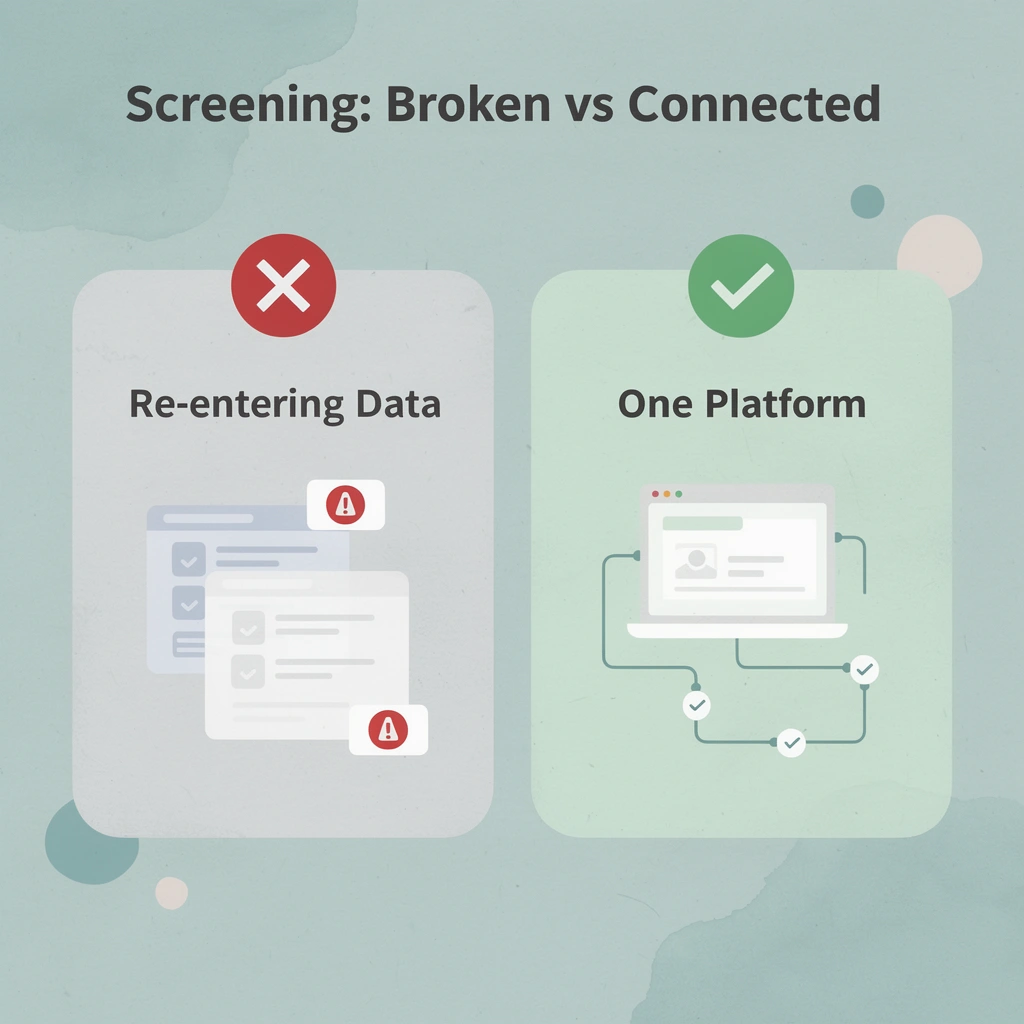
Book a free 30-minute demo with Cercli to see how candidate screening, hiring collaboration, and onboarding run in one connected platform. Teams using a global HR system like Cercli spend less time managing handoffs between tools and more time making confident hiring decisions.
🎯 Key Point: A unified HR platform eliminates the friction between screening, collaboration, and onboarding — so your team moves from first contact to signed offer faster and with greater confidence.
✅ Best Practice: Use a single connected system for every stage of the hiring journey — from initial screening through background checks to day-one onboarding — to reduce errors and keep your entire team aligned.
Fragmented Hiring Setup
- Manual data re-entry between tools
- Chasing assessment results separately
- Manually reconciling background checks
- Slow handoffs between HR tools
- Time lost to tool management
Connected Platform (Cercli)
- Candidate data flows automatically across stages
- Assessments integrated in one dashboard
- Background checks synced before offer stage
- Seamless collaboration across your hiring team
- Time spent on confident hiring decisions


