10 Effective Methods for Screening Candidates Right and Fast
10 Effective Methods for Screening Candidates Right and Fast
Hiring teams today face a familiar problem: too many applications, too little time, and too much room for inconsistency. AI-powered candidate screening tools are reshaping how recruiters filter talent, making it faster to identify qualified candidates without sacrificing accuracy or fairness. Candidate screening methods have evolved well beyond resume reviews, and organizations that adopt structured, technology-driven approaches consistently build stronger shortlists faster.
Cercli is built to support exactly that kind of hiring efficiency. Its global HR system brings applicant tracking, candidate evaluation workflows, and structured screening processes into one platform, helping teams move from job posting to a qualified shortlist without unnecessary back-and-forth.
Table of Contents
- Why Effective Candidate Screening Has Become More Important
- Why Traditional Candidate Screening Methods Often Fall Short
- The Biggest Candidate Screening Challenges for Growing Organizations
- 10 Effective Methods for Screening Candidates
- Candidate Screening Considerations for Employers in MENA
- How Cercli Helps Companies Build a More Connected Candidate Screening Process
- Book a Demo to Speak with Our Team about Our Global HR System
Summary
- Application volumes have reached a scale that fundamentally changes how screening decisions get made. According to the HireD AI App, 95% of recruiters say application volume has increased significantly in recent years. When a recruiter processes hundreds of CVs at once, review quality per candidate drops, qualified people get filtered out for the wrong reasons, and speed pressure starts overriding judgment.
- Traditional screening methods are failing most hiring teams, not just struggling ones. The Institute of Hiring Science reports that 88% of employers believe their own processes reject qualified, high-skilled candidates because of narrow matching criteria. Keyword filtering compounds this further, with 75% of resumes never reaching a human reviewer due to ATS filtering that cannot read context, only characters.
- Poor screening carries consequences that extend well beyond the hiring decision itself. Research from HeroHunt.ai found that 46% of new hires fail within 18 months due to poor screening, a problem that originates before the first interview is ever scheduled. Separately, 88% of employers report that a bad hire hurts team morale, meaning the downstream cost of a flawed shortlist is felt across the entire team, not just by the individual hired.
- Skills-based screening is becoming a practical necessity, not a preference. The World Economic Forum's Future of Jobs Report 2025 found that nearly 40% of the skills required for jobs will change by 2030. Screening methods built around exact job titles and degree requirements are already struggling to keep pace, and candidates who built the right capabilities through non-linear paths are routinely filtered out before anyone reads their application.
- Disconnected tools create a structural mismatch that volume makes worse. High-volume recruiting teams receive an average of 250 applications per corporate job opening according to HiringBranch, and running that volume through fragmented systems, separate ATS platforms, assessment tools, email threads, and scheduling tools means candidate context gets lost at every handoff. Organizations that screen well at scale aren't the ones with the most tools. They are the ones where screening, assessment, and communication happen inside a single coherent process.
- Soft skills assessment is one of the highest-leverage activities in any screening process, yet it remains one of the least structured. The iMocha Blog reports that 86% of bad hires stem from a lack of soft skills. Structured interviews with predefined scoring criteria and consistent question sets give recruiters a defensible, comparable basis for evaluating communication, collaboration, and problem-solving, rather than defaulting to subjective impressions of cultural fit.
- Cercli's global HR system addresses this by connecting recruitment, candidate scoring, onboarding, and payroll in one platform, so the moment a candidate moves from screened to selected, the employment process continues without manual handoffs or re-entry across separate tools.
Why Effective Candidate Screening Has Become More Important
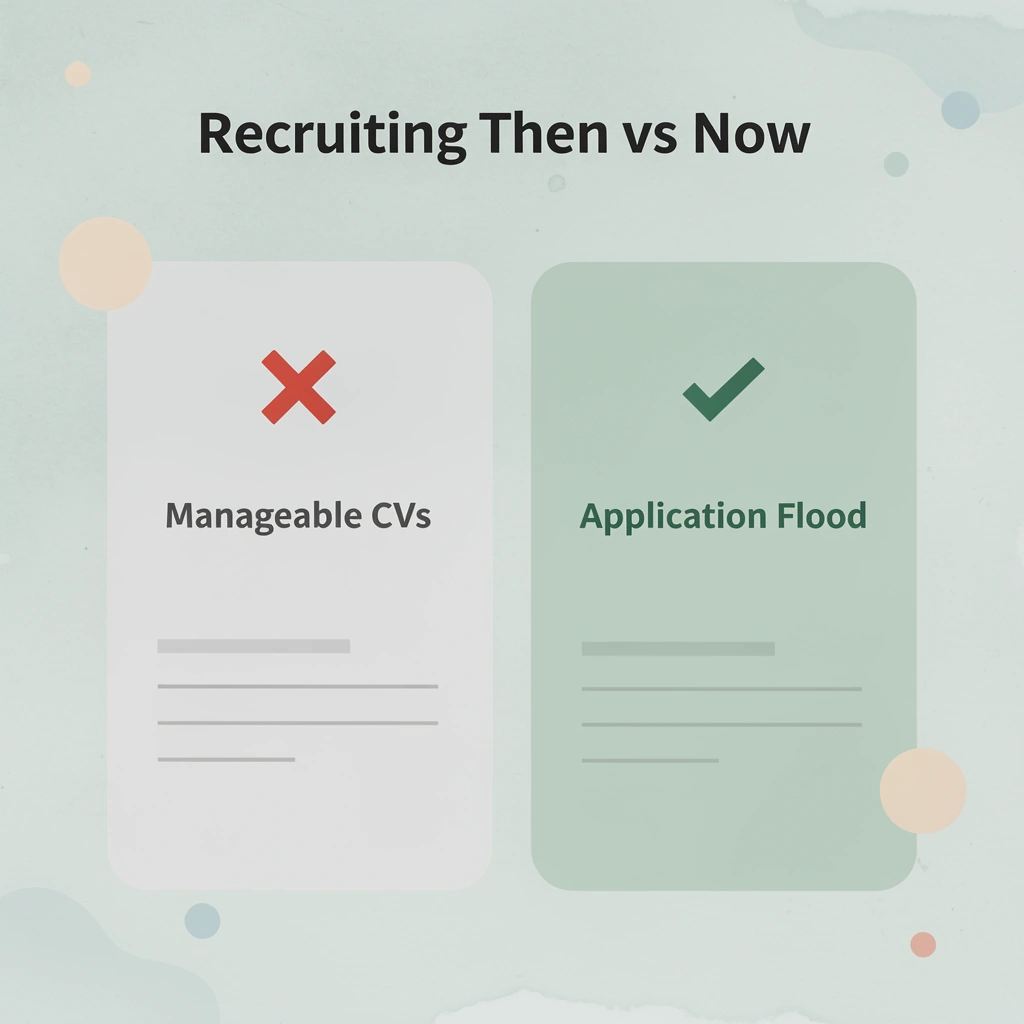
Recruiting used to be easier to handle: a job post generated a reasonable number of CVs, recruiters reviewed them, and a shortlist emerged. That balance is gone. According to HireD AI App, 95% of recruiters report application volume has increased significantly in recent years—a structural shift, not a temporary one. Digital job boards made application costs almost free, flooding inboxes with noise alongside the good information recruiters need.
"95% of recruiters say application volume has increased a lot in recent years—a structural shift, not a temporary one." — HireD AI App
🚨 Warning: This isn't a short-term spike. The flood of applications is a permanent feature of modern recruiting, and teams without a screening strategy will fall behind.
🔑 Takeaway: When applying is free and frictionless, volume explodes, making effective candidate screening not a nice-to-have, but an essential competitive advantage.
What makes volume dangerous
The problem with more applicants isn't the number itself, but what happens to recruiter attention as it grows. When a recruiter has 400 resumes for three open roles, each candidate gets less review time. Qualified people get filtered out because their resume uses different words. Candidates with strong transferable skills from adjacent industries get passed over because their job titles don't match the expected pattern. Speed and quality pressure pull in opposite directions, and something has to give.
Why do familiar fixes make the problem worse?
Most teams respond by adding more screening stages or tightening the keyword filter. Stricter filters eliminate more candidates faster but increase the risk of removing qualified candidates for minor mismatches. More stages slow the process when speed matters most.
The familiar approach of managing screening through spreadsheets, email chains, and disconnected applicant tracking tools exacerbates this problem: each handoff creates a gap where context gets lost, and decisions slow down. Our global HR system consolidates candidate scoring, workflow tracking, and structured evaluation in one place, eliminating those gaps without forcing recruiters to choose between speed and thoroughness.
Why getting it wrong carries real cost
The stakes of a flawed screening process are higher than most hiring managers realize. According to the HeroHunt.ai Blog, 46% of new hires fail within 18 months because of poor screening. This selection problem begins before the first interview. Screening determines hire quality and where the most consequential errors occur quietly and early.
Why do shifting skills make screening harder to get right?
The skills dimension compounds this challenge. The World Economic Forum's Future of Jobs Report 2025 found that nearly 40% of the skills required for jobs will change by 2030. Screening methods built around exact job title matches and degree requirements cannot keep pace with this shift. A candidate who has built the right abilities through non-linear experience may not look right on paper, yet that doesn't disqualify them for the role. Effective screening increasingly requires methods that surface what someone can do, not where they have been.
Why Traditional Candidate Screening Methods Often Fall Short
Traditional screening methods—resumes, recruiter calls, structured interviews, and reference checks—do serve a purpose. The real problem is using the same combination for every job, number of applicants, and hiring market without changing what the situation actually needs.
"Applying the same screening formula to every role—regardless of volume, seniority, or market conditions—is one of the most costly and overlooked inefficiencies in modern hiring." — Hiring Industry Insight
⚠️ Warning: A one-size-fits-all screening approach doesn't just slow down hiring—it actively filters out top candidates who don't fit the traditional mold.
- Screening Method
- Resumes
- Recruiter Calls
- Structured Interviews
- Reference Checks
- Common Limitation
- Favor format over actual ability
- Inconsistent and subjective evaluation
- Time-intensive at high applicant volumes
- Often too late in the process to matter
🎯 Key Point: The issue isn't that traditional methods are broken—it's that applying them rigidly, without adapting to role type, hiring volume, or market conditions, is where the process falls short.

Where the process starts to break down
The failure point is usually specificity applied in the wrong direction. When a job description requires a precise job title, defined years in a named industry, and exact technical terminology, it feels rigorous but functions as a filter designed to exclude. A candidate who built the same capability through a different path or describes their experience in a different language disappears before anyone reviews their application. According to Vervoe, 75% of resumes are never seen by a human recruiter due to ATS filtering, meaning most screening decisions are made by a system that cannot read context, only characters.
Keyword matching compounds this problem. Two candidates with equivalent skills may describe them differently. One writes "customer acquisition," the other writes "growth marketing." One lists "Python scripting," another writes "data automation." The system sees a match and a miss. The recruiter sees only the match.
Why do high-volume pipelines reject qualified candidates?
Most teams respond to high-volume screening by adding more stages or stricter filters, which slows the process and increases recruiter workload. The Institute of Hiring Science reports that 88% of employers believe their screening processes reject qualified, high-skilled candidates because they rely on narrow matching criteria; most hiring teams acknowledge their process works against them.
How do disconnected tools slow hiring decisions?
Most organizations run hiring across disconnected tools: an ATS filtering applications, spreadsheets tracking interview stages, email threads managing recruiter notes, and separate systems handling offers. Each handoff loses candidate context and slows decisions. Platforms like Cercli consolidate hiring, HR, and payroll into a single AI-native system, enabling recruiters to make faster, more accurate decisions without searching across multiple platforms.
What does applying one standard screening process actually cost?
Using the same screening process for every job creates problems. A busy customer service role and a senior engineering position require different evaluation approaches. Identical screening stages either create unnecessary friction for the simpler role or fail to gather sufficient information for the complex one. Neither outcome serves the organization or the candidate.
What happens when AI replaces human judgment in screening?
The same issue arises when AI is treated as a decision-maker rather than decision-support. Automated scoring can reduce initial review time, but accepting outputs without human verification can silently compound errors. An algorithm trained on historical patterns may flag a candidate as low-priority, even if they're the unconventional hire the team needs. Speed matters, but so does the judgment only a human can apply at the right moment.
How fast is the gap between screening methods and hiring demands widening?
For growing organizations, the gap between current screening methods and actual hiring demands widens faster than most teams realize.
Related Reading
- Reduce Recruitment Costs
- Automated Reference Checks
- Recruitment Assessment Methods
- How To Identify Top Talent
- How To Assess Cultural Fit
- How To Improve Quality Of Hire
- High Volume Recruitment Strategies
- How To Reduce Time To Hire
- Predictive Hiring Assessments
- How To Improve The Hiring Process
The Biggest Candidate Screening Challenges for Growing Organizations
The gap between what growing teams need and what their current screening process delivers is structural, not technological. As organizations grow, friction builds at every stage, often in unexpected places.
"The breakdown in candidate screening isn't a technology problem — it's a structural one that compounds as organisations scale."
⚠️ Warning: Many growing teams assume hiring more recruiters solves the problem. In reality, the structural gap widens regardless of headcount if you don't redesign the underlying screening process.

According to LinkedIn Talent Solutions, 52% of talent acquisition leaders say the hardest part of recruitment is identifying the right candidates from a large applicant pool. This reveals the core challenge: not sourcing or attracting candidates, but managing what happens after they arrive. When volume increases, and team capacity stays flat, reviewers make faster, less deliberate decisions — quietly eroding quality at scale.
Screening Challenge
Identifying right candidates
- High applicant volume
- Slower, lower-quality decisions
Flat team capacity
- Organisational growth
- Reviewer fatigue and bias
Structural process gaps
- Scaling without redesign
- Compounding friction at every stage
🔑 Takeaway: When 52% of talent leaders cite candidate identification as their biggest hurdle, it signals that post-application management — not sourcing — is where growing organizations must focus their investment.
💡 Tip: Audit your screening-to-hire ratio regularly. A rising ratio is an early warning sign that your process is breaking down under volume pressure before it becomes a visible quality problem.
Where the process fractures under pressure
The failure point is usually consistency. When multiple recruiters screen independently without shared criteria, shortlists reflect individual preferences rather than role requirements. One recruiter weights tenure heavily, another values industry background, a third focuses on technical keywords. The result is a shortlist built on incompatible foundations, making it nearly impossible for hiring managers to compare candidates fairly or move quickly.
Most teams add more process: alignment meetings, shared rubrics, approval layers. This works with low hiring volume and forgiving timelines. As roles multiply and deadlines compress, each step becomes a delay, and the process designed to improve quality slows the pipeline instead. Cercli addresses this by using AI agents to automatically score and surface candidates against consistent criteria, removing reliance on individual judgment and giving every recruiter the same starting point.
The cost of disconnected tools
An ATS captures applications. A separate platform runs assessments. Video interviews live elsewhere. Feedback travels through email. Scheduling happens in an outdated calendar. Each system solves one narrow problem, but recruiters absorb the overhead of moving between them, reconciling data, and chasing responses. This administrative burden steals time from work that requires human judgment.
Why does a fragmented tool stack fail at scale?
HiringBranch reports that high-volume recruiting teams receive an average of 250 applications per corporate job opening. Processing that volume through fragmented tools creates friction and information loss. Adding another standalone tool only multiplies the problem. Organizations that screen well at scale succeed not because they have the most tools, but because screening, assessment, and communication happen within a single, coherent process.
The right methods can change all of this, but knowing which ones to use and when requires more thought than most hiring guides suggest.
10 Effective Methods for Screening Candidates
Good screening means picking the right way to learn what you need to know at each step—not always using the hardest method or the most familiar one. The most effective hiring teams treat screening as a deliberate sequence of decisions, matching each tool to the specific question it answers best.
💡 Tip: Resist defaulting to the same screening method every time. The right tool at the right stage saves time, reduces bias, and surfaces stronger candidates faster.
"Good screening means picking the right way to learn what you need to know at each step—not always using the hardest method." — Core Principle of Effective Candidate Screening

Different screening tools answer different questions: a CV shows where someone has worked; a skills assessment shows what they can do; a structured interview reveals how they think and communicate; a work sample shows how they perform under realistic conditions. No single method answers all of these, and expecting it to is where most screening processes break down.
Screening Tool
- CV / Resume
- Key Question It Answers: Where has this person worked?
- Best Used For: Early-stage background review
- Skills Assessment
- Key Question It Answers: What can this person actually do?
- Best Used For: Technical or role-specific validation
- Structured Interview
- Key Question It Answers: How do they think and communicate?
- Best Used For: Behavioral and cognitive evaluation
- Work Sample
- Key Question It Answers: How do they perform under real conditions?
- Best Used For: Final-stage practical validation
⚠️ Warning: Relying on a single screening method — especially the CV alone — is one of the most common and costly mistakes in hiring. Each tool has a specific purpose, and none is a complete picture on its own.
🎯 Key Point: A well-sequenced screening process layers these tools strategically — using each one only when it answers a question the previous step could not.
1. Start with criteria, not candidates
Before reviewing applications, decide what you want. Separate requirements into: qualifications, relevant experience, technical skills, transferable skills, and location or work authorization factors. This determines whether your screening produces consistent shortlists or depends on which recruiter reviews each application.
A screening checklist built before the vacancy goes live gives every reviewer the same starting point and reveals where criteria may be too narrow, a common reason qualified candidates get filtered out unread.
2. Screen for skills, not just titles
Recruiters often screen for exact job titles or industry backgrounds when they need specific skills that candidates may have developed differently. A skills taxonomy—separating must-have skills from nice-to-have ones and covering both technical and transferable skills—opens the shortlist to otherwise invisible candidates.
Candidates who have changed industries, taken non-linear career paths, or built expertise through project work are frequently screened out by rigid keyword matching. Skills-based screening more accurately identifies who can do the job.
3. Use assessments to replace assumptions
Pre-employment assessments shift the conversation from "what does this person claim to be able to do" to "what can they actually demonstrate." Technical tests, writing exercises, numerical reasoning tasks, and job simulations each provide different evidence. Design them around genuine role responsibilities, not proxy tasks that feel rigorous but measure the wrong things.
Keep assessments proportionate. A two-hour test for an entry-level role signals poor judgment about candidate time and will cost you applicants. A ten-minute task for a senior technical hire signals the opposite. Match assessment depth to the stakes of the decision.
4. Structured screening conversations before full interviews
A short phone or video screening with consistent questions gives recruiters real-time evidence of communication skills, clarity of thought, and genuine motivation, plus practical factors like availability, salary expectations, and location fit before assembling a full interview panel.
Structure ensures candidates can be compared fairly. When every recruiter asks the same questions and scores against the same criteria, you can compare results directly. Without it, two recruiters screening the same candidates produce different shortlists not because they judge differently, but because they measure different things.
5. Why structured interviews outperform gut feel
Using specific skills to test, setting scoring rules ahead of time, and asking the same questions to all candidates makes hiring fair. Without this structure, interviewers make decisions based on feelings, and hiring choices reflect who seemed like a good fit rather than who demonstrated the strongest skills.
According to the iMocha Blog, 86% of bad hires result from weak soft skills. Testing communication, teamwork, and problem-solving during structured interviews is essential to the screening process.
6. Where AI changes the equation
Processing hundreds of applications is a capacity problem, not a screening one. Adding more reviewers or tighter filters doesn't solve it. AI-assisted screening changes what's possible at volume by analyzing applications, identifying relevant skills, and prioritizing candidates who warrant closer evaluation in a fraction of the time manual review requires.
How does AI handle volume without creating new bottlenecks?
Most teams assign junior recruiters to conduct first-pass CV reviews, which consumes time, lacks consistency, and disconnects from the broader hiring workflow. As applications grow, this creates bottlenecks that slow the entire process. Platforms like Cercli use AI to handle initial candidate scoring and flagging within the same system where interviews are scheduled and offers are managed, eliminating handoff gaps where information gets lost. Critically, AI should surface and prioritize, not decide—recruiters must review recommendations and retain control over which candidates advance.
7. Work samples as direct evidence
When practical ability matters more than credentials, work samples are the most direct form of evidence available. A marketing candidate developing a campaign concept, a developer completing a technical exercise, a salesperson running a mock discovery call—each produces observable output that a CV or interview cannot replicate.
Task design determines its value. Work samples should reflect realistic work, include clear instructions, and have reasonable time limits. Poorly scoped tasks signal disorganization and produce outputs that are difficult to evaluate consistently.
8. Reference checks belong later than most teams place them
Many teams conduct reference checks early, before candidates demonstrate fit. This wastes time on candidates unlikely to advance and unnecessarily burdens reference providers. Reference and background checks work best as a final step, after a candidate has passed earlier stages and the hiring decision is nearly made.
Checks should match the job. Employment history verification, qualification checks, and professional references serve different purposes. Decide which ones you need before making them standard for every hire.
9. Reactivate candidates already in your pipeline
Organizations consistently underuse existing candidate data. A previous applicant rejected for one role may fit a different position months later. A recruitment CRM with recorded interview outcomes and notes enables candidate rediscovery without restarting the sourcing process.
Toggl's research shows 88% of employers say a bad hire negatively impacts team morale. Reactivating known candidates reduces sourcing time and hiring risk, as you already have signal on their fit.
10. Build a workflow, not a checklist
The best screening processes combine methods strategically, using each to gather different information at the right stage. An application review checks basic eligibility. A skills assessment tests practical ability. A structured screening call adds context. A formal interview explores competencies and motivation. Reference checks validate the final decision.
Why does a one-size-fits-all approach fall short?
Using the same method for every role, regardless of seniority, volume, or risk, doesn't work. A high-volume customer service hire and a senior engineering hire require different screening processes.
Screening quality is determined by how well each stage produces evidence that the next stage can use, not by the number of stages you add.
How does geography add complexity to consistent screening?
These methods become harder to apply when job candidates are in different countries, each with its own employment rules and workforce expectations.
Candidate Screening Considerations for Employers in MENA
Screening in MENA is the first step in a chain that runs through employment authorization, workforce localization, data privacy, and payroll—every link carries legal weight.
"Every stage of the MENA hiring chain — from candidate screening to payroll compliance — is interconnected, and a misstep at the start can trigger cascading legal and operational consequences."
🚨 Warning: Skipping or rushing candidate screening in MENA doesn't just risk a bad hire — it can expose your organization to employment authorization violations, data privacy breaches, and workforce localization penalties across multiple jurisdictions.
✅ Best Practice: Treat MENA candidate screening as a strategic compliance checkpoint, not a formality. Aligning your process with localization mandates, data protection laws, and payroll regulations from the outset protects every subsequent step in the hiring chain.
Screening Touchpoint
- Employment Authorization
Validates right-to-work status across MENA jurisdictions - Workforce Localization
Ensures compliance with Saudization, Emiratization, and similar mandates - Data Privacy
Governs how candidate information is collected, stored, and processed - Payroll Compliance
Screening outcomes directly inform lawful compensation and contract structures

What makes MENA hiring structurally different
The UAE and Saudi Arabia require work permits and approved employment documentation before a hired candidate can legally begin work. Information collected during screening—qualifications, employment history, and role details—must flow directly into onboarding and employment records, not be re-entered manually. When recruitment and workforce administration operate in disconnected tools, that handoff becomes a source of errors, delays, and duplicated effort.
How do localization programs shape hiring obligations?
Workforce localization adds another layer of planning that screening technology alone cannot handle. The UAE's Emiratisation program requires eligible private-sector companies with 50 or more employees to increase Emirati representation in skilled roles by two percentage points annually, reaching 10% by 2026, with financial contributions for non-compliance. Saudi Arabia's Nitaqat program ties localization requirements to company size and industry sector. These obligations require visibility into hiring pipelines and workforce composition over time, not screening filters that automatically exclude candidates.
What happens when candidate data moves across disconnected systems?
Most teams export candidate data into separate HR, payroll, and onboarding systems. As hiring grows across multiple MENA markets, this fragmentation causes candidate information to be entered multiple times, classification decisions to be made separately, and compliance gaps to emerge undetected. Cercli solves this by connecting recruitment, employee and contractor management, and payroll in one AI-native platform, enabling candidates to move from screened to selected without manual handoffs.
Why candidate data privacy cannot be an afterthought
AI-powered screening collects personal information: CVs, assessment responses, employment histories, and interview recordings. Both the UAE Personal Data Protection Law and Saudi Arabia's Personal Data Protection Law establish legal rules for collecting, storing, processing, and retaining data. Employers must understand the legal basis for processing candidate data, whether they need permission at certain stages, how long they retain records, and what obligations apply when automated systems affect candidate ranking or rejection. According to Ken Research's Middle East Employment Screening Services Market Report, the regional market for employment screening services is worth USD 325 million in 2025 and is expected to reach USD 600 million by 2031, reflecting significant organizational investment in formal, compliant screening systems.
What happens when a screened candidate isn't a conventional employee?
Not every candidate who passes screening becomes a regular employee. Depending on the role, country, and organization's legal structure, a successful candidate might be brought on as an employee, hired as a contractor, or employed through an Employer of Record arrangement. Organizations must make this classification decision before onboarding begins, not discover it halfway through. The Ken Research report notes the market is growing at a CAGR of 11.80%, signaling that more organizations are formalizing these processes. However, growth in screening volume creates downstream complexity if the post-screening workflow remains disconnected from the recruitment decision.
Why does human oversight still matter after AI screening?
Human oversight is essential. AI can score candidates and find relevant applications faster than manual review, but the final assessment of context, fit, and classification requires a recruiter or hiring manager who understands what the role demands and what the employment arrangement will entail. Organizations that get this right aren't those with the most screening stages, but those where the entire employment process moves with a candidate once selected.
The question most hiring teams never ask until too late determines whether any of this works.
Related Reading
- Blind Resume Screening
- Pre-Hire Assessments For High Volume Hiring
- Candidate Screening Tools For Healthcare
- Cultural Fit Assessment Tools
- How To Reduce Bias In Hiring Process
- How Does Automated Resume Screening Work
- Sales Candidate Screening
- Ai Resume Screening Bias
- Behavioral Hiring Assessments
How Cercli Helps Companies Build a More Connected Candidate Screening Process
Good candidate screening is about more than just finding qualified people. Those candidates still need to go through interviews, offers, onboarding, payroll, compliance, and ongoing workforce management. A connected recruitment process reduces manual handoffs while keeping recruiter and hiring manager oversight—this is far more valuable than a standalone screening tool.
"A connected recruitment process reduces manual handoffs while keeping recruiter and hiring manager oversight—this is more valuable than a standalone screening tool."
Standalone Screening Tool
- Isolated candidate data
Connected Recruitment Process: Unified candidate journey - Manual handoffs between stages
Connected Recruitment Process: Automated stage transitions - Limited hiring manager visibility
Connected Recruitment Process: Full recruiter & manager oversight - Screening ends at qualification
Connected Recruitment Process: Extends through onboarding & payroll - Compliance managed separately
Connected Recruitment Process: Compliance built into the workflow
🔑 Takeaway: Screening is only the beginning—true hiring efficiency comes from connecting every stage, from the first application to payroll and compliance.
💡 Tip: When evaluating recruitment tools, look beyond screening capabilities. Ask how the platform handles onboarding, workforce management, and compliance integration to avoid costly manual handoffs down the line.

How does Cercli reduce the time recruiters spend screening candidates?
Large applicant pools make manual screening one of the most time-consuming parts of recruitment. Cercli's AI-supported workflows help recruiters screen and prioritize candidates more efficiently, so they can focus on applicants who deserve closer review. Technology handles repetitive work while recruiters focus on evaluating candidates and making hiring decisions, increasing screening capacity without adding manual workload.
How does keeping screening and candidate management in one workflow help?
Screening loses value when candidate information moves between separate systems. Cercli combines candidate screening with its ATS and pipeline, letting recruiters manage candidate information and progression in one workflow. Candidates advance from screening through interviews and feedback without recruiters having to recreate or transfer information, giving teams clearer visibility into candidate status and next steps.
How does Cercli give recruiters and hiring managers shared visibility?
Hiring managers need to see which candidates are being considered and why they advance. Cercli lets recruiters and hiring managers collaborate in a shared recruitment process, managing candidate information, feedback, interviews, and hiring decisions in one workflow instead of scattering them across email and separate documents. This reduces delays from fragmented communication.
What happens after a candidate is selected?
Once a candidate accepts an offer, organizations must complete onboarding, create HR records, collect required information, and prepare for employment. If recruitment and HR operate in separate systems, teams enter the same information multiple times. Cercli connects successful candidates with onboarding and HR records, maintaining continuity between recruitment and the employee lifecycle.
How does Cercli reduce administrative complexity in international hiring?
Hiring across the UAE, Saudi Arabia, and the wider MENA region requires managing different employment arrangements, payroll processes, compliance requirements, and worker types. Cercli connects recruitment with payroll, compliance, contractor management, and Employer of Record services, extending the recruitment process into workforce operations without relying on disconnected systems.
How does the connected process work from candidate screening to workforce management?
The connected process begins when a candidate applies, or the company identifies them. The recruitment team uses AI-supported screening, skills evaluation, assessments, and interviews to determine candidate progression. Recruiters and hiring managers collaborate on evaluation and hiring decisions. Once an offer is accepted, the candidate enters onboarding and HR records, where the organization manages payroll, compliance, contractor, and Employer of Record requirements. Cercli's value lies in connecting candidate screening with subsequent recruitment and workforce operations, providing growing organizations a unified platform for recruitment, onboarding, payroll, compliance, contractor management, and Employer of Record services.
Book a Demo to Speak with Our Team about Our Global HR System
Determine whether your systems can move with your hiring decisions before your next role opens, not after it stalls.
"The distance between selecting a candidate and starting one gets much smaller when screening connects directly to employment." — Cercli
🎯 Key Point: Don't wait for a hiring bottleneck to expose gaps in your HR infrastructure. Audit your systems before the next role opens.

If your recruitment team is putting together candidate scoring, applicant tracking, and onboarding across separate tools, book a free 30-minute demo with Cercli. The team can walk through your current screening workflow, find where handoffs break down, and show how our unified, AI-native platform connects the full hiring lifecycle — from initial candidate evaluation through payroll, compliance, and contractor management across the UAE, Saudi Arabia, and the wider MENA region. When screening connects directly to employment, the distance between selecting a candidate and starting one gets much smaller.
💡 Tip: A single 30-minute conversation can reveal exactly where your current tools are creating costly delays between candidate selection and Day 1 readiness.
✅ Best Practice: Look for a platform that handles the end-to-end hiring lifecycle — from candidate scoring to payroll and compliance — so nothing falls through the cracks during handoff.
- Capability
- Candidate Scoring
- Fragmented Tools: Siloed, manual
- Cercli Unified Platform: Integrated, AI-native
- Applicant Tracking
- Fragmented Tools: Separate system
- Cercli Unified Platform: Connected to full lifecycle
- Onboarding
- Fragmented Tools: Disconnected handoff
- Cercli Unified Platform: Seamless from hire to start
- Payroll & Compliance
- Fragmented Tools: Manual reconciliation
- Cercli Unified Platform: Automated across MENA
- Contractor Management
- Fragmented Tools: Ad hoc
- Cercli Unified Platform: UAE, KSA & MENA-ready
- Candidate Scoring
Related Reading
- Pre-Employment Screening Tools
- Willo Alternatives
- Harver Alternatives
- HireVue Alternatives
- HireVue vs Smartrecruiters
- Eightfold Ai Competitors
- Pymetrics Alternatives
- Spark Hire Alternatives
- Manatal vs HireVue


