Using Candidate Screening Tools for Healthcare to Screen Talent
.jpg)
Using Candidate Screening Tools for Healthcare to Screen Talent
Hiring in healthcare means more than filling open positions. Recruiters must identify candidates who can handle patient care responsibilities, meet strict compliance standards, and perform reliably under pressure. AI-powered candidate screening tools for healthcare help organizations meet that challenge by accelerating the review process without compromising hire quality.
For teams managing high applicant volumes across clinical and non-clinical roles, structured recruitment makes a measurable difference. Smarter screening means less time sorting through unqualified applications and more time evaluating candidates who are genuinely ready for the role. Teams looking to streamline that process end to end can explore Cercli's global HR system.
Table of Contents
- Why Healthcare Candidate Screening Requires More Than CV Review
- What Are Candidate Screening Tools for Healthcare?
- Where Healthcare Candidate Screening Can Go Wrong
- 7 Ways to Use Candidate Screening Tools for Healthcare Effectively
- Candidate Screening Considerations for Healthcare Hiring Across MENA
- How Cercli Helps Healthcare Companies Manage Candidate Screening
- Book a Demo to Speak with Our Team about Our Global HR System
Summary
- Background checks in healthcare reveal more than most recruiters expect. According to the HireRight 2025 Benchmark Report, 76% of healthcare organizations reported finding a discrepancy on a background check in 2024. This figure reflects a structural gap in CV-only review, where incomplete or contextually misleading information slips through without active verification of licenses, credentials, and jurisdictional eligibility.
- Professional license verification has become a baseline expectation in healthcare hiring, with 88% of healthcare organizations screening for it according to the same HireRight report. The challenge is not whether teams know this step is required. It is whether the tools they use apply it consistently across every application or leave it dependent on whoever happens to be reviewing a given file on a given day.
- Candidate drop-off during screening is a measurable and often overlooked hiring cost. The Jobtrain Candidate Insights Report 2025 found that over 50% of healthcare candidates abandoned an application due to a lengthy or complicated screening process, and only 34% said they were satisfied with the screening experience during their last job search. Friction-heavy processes do not filter neutrally. They tend to filter out candidates with the most options, which is rarely the intended outcome.
- Keyword-based screening tools create a specific failure pattern in healthcare recruitment. Candidates with equivalent clinical experience but different terminology, internationally trained professionals whose credentials use unfamiliar naming conventions, and practitioners with non-linear career histories are routinely excluded before a recruiter reviews their application. The filter cannot distinguish between a terminology gap and a qualification gap, so it treats both the same way.
- Hiring across MENA adds regulatory complexity that generic screening tools are not designed to handle. The UAE and Saudi Arabia run parallel but distinct credentialing frameworks, with separate steps for professional classification, qualification verification, and active registration. Workforce localization policies in both markets, including the UAE's Emiratisation mandate and Saudi Arabia's expanded Nitaqat program, shape candidate pool composition but are workforce strategy decisions, not substitutes for role-specific competency assessment.
- Automated screening decisions have downstream consequences that human review cannot always correct. As SHRM's guidance on AI-enabled hiring notes, a recruiter making the final decision can only evaluate candidates the system allowed through. If the filter is miscalibrated, the damage is done before any human is involved, which is why ongoing auditing of who advances through the funnel matters more than one-time configuration.
- Cercli's global HR system addresses this fragmentation by connecting candidate screening, credentialing tracking, and onboarding into one platform, so healthcare hiring teams don't manually reconstruct candidate records across disconnected tools as roles progress toward an offer.
Why Healthcare Candidate Screening Requires More Than CV Review
A CV tells you where someone has been and what they claim to have done. It cannot tell you whether that information still holds true today.
"A CV tells you where someone has been — it cannot tell you whether that information still holds true today." — Core Principle of Healthcare Candidate Screening
🚨 Warning: Relying solely on a CV during healthcare candidate screening is one of the most critical mistakes a hiring team can make. Credentials expire, registrations lapse, and conduct records go unverified.
✅ Best Practice: Always pair CV review with real-time verification of licenses, registrations, and professional standing to ensure your candidate's claimed qualifications are current and valid.

What a CV Shows
- Past employers and roles
- Claimed qualifications and certifications
- Self-reported experience
- Career history timeline
What a CV Cannot Confirm
- Whether registration is still active
- If credentials have lapsed or been revoked
- Any conduct investigations or sanctions
- Real-time fitness to practice
What does a CV consistently fail to reveal in healthcare hiring?
In healthcare, this gap is critical. A nurse practitioner whose license lapsed six months ago, a radiologist whose credentials apply in one jurisdiction but not another, a care coordinator whose listed experience is technically accurate but contextually misleading—none of these problems appear on a resume. According to the HireRight 2025 Benchmark Report, 76% of healthcare organizations reported finding a discrepancy on a background check in 2024. CV-only review consistently misses critical verification steps.
The failure point is usually incompleteness, not dishonesty. Professional license verification, clinical competency assessment, and jurisdiction-specific eligibility checks require active confirmation, not passive review. Healthcare hiring carries consequences other industries do not: a wrong hire in a clinical setting poses a patient safety risk that screening should have caught.
How do manual screening processes create gaps that let unqualified candidates advance?
Most teams manage this with manual checklists that track credentials, license status, references, and role-specific skills across disconnected tools and email threads. This inconsistency allows unqualified candidates to advance too far. A global HR system like Cercli consolidates applicant tracking, skills assessment, and candidate shortlisting into one platform, ensuring screening criteria apply consistently across every role without extra coordination.
What does effective screening actually require?
Good healthcare candidate screening works across several areas simultaneously: professional qualifications, active license registration, role-specific skills assessment, and recent work history. A gap of several years in a fast-moving clinical specialty differs significantly from one in an administrative support role. According to the HireRight 2025 Benchmark Report, 88% of healthcare organizations screen for professional license verification. The question is whether the tools used make that verification consistent and scalable, or whether it depends on whoever reviews that particular application.
Why do availability and location filters matter as much as qualifications?
Availability, location, and language requirements add another layer that CV review rarely captures. A candidate who is technically qualified but unavailable for required shift patterns, unable to practice in the relevant jurisdiction, or not fluent in the patient-facing language the role demands cannot fill the position, no matter how strong the resume. Screening tools that apply these filters early protect recruiters from investing time in unsuitable candidates and protect candidates from advancing through a process that cannot result in an offer.
The real question is whether your tools are built for the complexity healthcare hiring demands.
What Are Candidate Screening Tools for Healthcare?
Candidate screening tools for healthcare are specialized recruitment technologies that collect, filter, and prioritize applicants based on predefined role requirements. They bring structure to an otherwise unmanageable volume of applications, giving recruiters faster access to qualified candidates.
"Screening tools don't just save time: they bring critical structure to high-stakes hiring decisions where the wrong hire can directly impact patient safety and care quality." — Recruitment Operations Best Practices
💡 What This Means: These tools act as a first-pass filter, ensuring only the most relevant applicants reach a recruiter's desk, reducing noise and accelerating time-to-hire across every healthcare role.

The criteria these tools evaluate go far beyond resume review. A hospital recruiting nurses must confirm qualifications, active registrations, clinical experience, and shift availability — while a healthcare organization hiring for IT or administrative roles will weight technical competencies and systems familiarity instead. Critically, screening criteria should follow the job, not a generic template.
Role Type
- Clinical (Nurses, Physicians)
- Active licenses, certifications, clinical hours, shift flexibility
- Administrative
- Systems familiarity, organizational skills, compliance knowledge
- Healthcare IT
- Technical competencies, EHR experience, security clearances
⚠️ Common Mistake: Applying a one-size-fits-all screening template across all healthcare roles leads to missed qualifications and overlooked top candidates.
🔑 Takeaway: The most effective screening tools are those configured to match role-specific requirements — making customization, not convenience, the defining feature of a high-performing healthcare recruitment process.
What clinical and compliance factors do these tools actually assess?
Healthcare applicant screening tools evaluate professional licenses and jurisdictional eligibility, clinical or technical skills, experience with electronic health records or medical equipment, language proficiency, and work eligibility and location requirements. Knockout questions handle binary filters early: can this candidate work nights, do they hold the required registration, are they authorized to work in this region? These eliminate obvious mismatches before a recruiter opens an application. Phenom notes that conversational chatbots enable 24/7 candidate engagement, screening for licenses, certifications, and shift preferences without recruiter involvement.
What happens when screening tools don't talk to each other?
Most teams combine an applicant tracking system with a separate credentialing checklist, a spreadsheet to track progress, and manual follow-up for missing documents. This approach breaks down at scale: recruiters spend time chasing documents instead of evaluating candidates, and gaps between tools cause qualified applicants to slip through. Cercli solves this by bringing recruitment, HR, and payroll into a single AI-native platform, eliminating the need to rebuild candidate records across three separate systems.
The line screening cannot cross
The most important difference in healthcare recruitment screening is between eligibility and capability. Screening confirms that a candidate meets starting requirements but does not reveal how a nurse performs under pressure, how a lab technician handles equipment failure, or how an administrator manages difficult patient interactions. Those answers require interviews, structured assessments, or clinical simulations. Screening tools decide who moves forward; deeper evaluation provides the evidence hiring decisions need.
Why does a complete credentialing file feel like enough?
Many recruitment processes go too far here. Collecting documents becomes a proxy for clinical quality, and a complete credentialing file feels like proof of the right hire. Confirming that a candidate has the required qualifications is where you start, not where you finish.
What happens when screening tools are configured incorrectly?
The revealing question is what happens when screening tools are configured incorrectly or when the process doesn't match the job's actual needs.
Related Reading
- Methods For Screening Candidates
- How To Improve The Hiring Process
- How To Reduce Time To Hire
- Reduce Recruitment Costs
- Recruitment Assessment Methods
- How To Assess Cultural Fit
- How To Improve Quality Of Hire
- Automated Reference Checks
- High Volume Recruitment Strategies
- Predictive Hiring Assessments
Where Healthcare Candidate Screening Can Go Wrong
Screening processes fail quietly: qualified candidates slip through the cracks one filter at a time, often unnoticed until the vacancy has been open for weeks longer than necessary.
"Screening processes fail quietly: qualified candidates slip through the cracks one filter at a time, often unnoticed until the vacancy has been open for weeks longer than necessary." — A costly reality for healthcare hiring teams everywhere
⚠️ Warning: The most dangerous screening failures aren't loud or obvious. They're silent, systematic, and compound over time, turning a manageable hiring gap into a critical staffing crisis.
🎯 Key Point: Every flawed filter in your screening process is a potential exit door for your best candidates. The longer a role stays vacant, the higher the cost to your organization, your team, and ultimately your patients.

Screening Failure Type: Over-filtering on credentials
- What Goes Wrong: Qualified candidates eliminated too early
- Impact: Missed talent, longer vacancies
Screening Failure Type: Slow response times
- What Goes Wrong: Top candidates accept competing offers
- Impact: Vacancy extends by weeks
Screening Failure Type: Inconsistent evaluation criteria
- What Goes Wrong: Subjective decisions replace structured review
- Impact: Bias risk, poor hire quality
Screening Failure Type: Ignoring passive candidates
- What Goes Wrong: Only active applicants are considered
- Impact: Talent pool shrinks significantly
When keyword logic becomes a liability
The failure point is usually specificity without context. A screening system built around exact job titles and precise terminology will miss candidates with equivalent experience described differently. A nurse trained in one healthcare system may list responsibilities using terminology unfamiliar to a filter calibrated for another. An internationally qualified pharmacist may hold credentials that map directly to local requirements but use different naming conventions. The system flags them as incomplete, and recruiters never see them.
This is a structural problem with how keyword-based screening tools process clinical and professional language. The solution is not to abandon automated filtering but to build screening criteria around the underlying competency being assessed, not the specific phrase used to describe it. When the filter cannot distinguish between a terminology gap and a qualification gap, it will keep making the wrong call.
The hidden cost of rigid career path assumptions
Career histories in healthcare are rarely straight paths. Screening models that expect linear paths punish professionals returning from parental leave, clinicians who moved between countries, or practitioners who switched into education or administration before returning to clinical roles. Rigid applicant tracking systems interpret gaps or pivots as missing experience rather than context requiring human judgment, filtering candidates out before anyone reads their application.
Cercli consolidates screening, HR, and hiring workflows into one global HR system, eliminating the need for recruiters to switch between disconnected systems and manually rescue candidates that automation should never have excluded. The problem isn't the people reviewing applications—it's the architecture that forces them to compensate for a broken filter.
What friction costs you before the interview even starts
According to the Jobtrain Candidate Insights Report 2025, over 50% of healthcare candidates stopped applying because the screening process was too long or too complicated. When screening requires candidates to retype resume information, answer qualifying questions, or navigate multiple steps before speaking with a recruiter, strong candidates drop off. They have other opportunities and move on.
The same report found that only 34% of healthcare candidates were happy with the screening process during their last job application. Hiring teams should pay attention, especially if they view early-stage screening as a routine administrative task. It is the candidate's first impression of how the organization operates. A cumbersome process attracts candidates willing to navigate excessive red tape, which is likely not the talent you want to hire.
Automation without accountability
SHRM's guidance on AI-enabled hiring highlights a critical flaw: a human making the final decision cannot undo damage from an automated system that already excluded candidates. If the filter is miscalibrated, the recruiter sees only the candidates the system allowed through and cannot evaluate what it cannot see. Validation must be ongoing, not a one-time configuration exercise. Healthcare employers should regularly audit who progresses through the funnel and ask whether screening criteria predict good hires or simply predict who can navigate the application process.
This question looks different depending on where in the world you are hiring.
Related Reading
- Ai Resume Screening Bias
- How Does Automated Resume Screening Work
- Behavioral Hiring Assessments
- How To Reduce Bias In Hiring Process
- Sales Candidate Screening
- Cultural Fit Assessment Tools
- Blind Resume Screening
- Pre-Hire Assessments For High Volume Hiring
7 Ways to Use Candidate Screening Tools for Healthcare Effectively
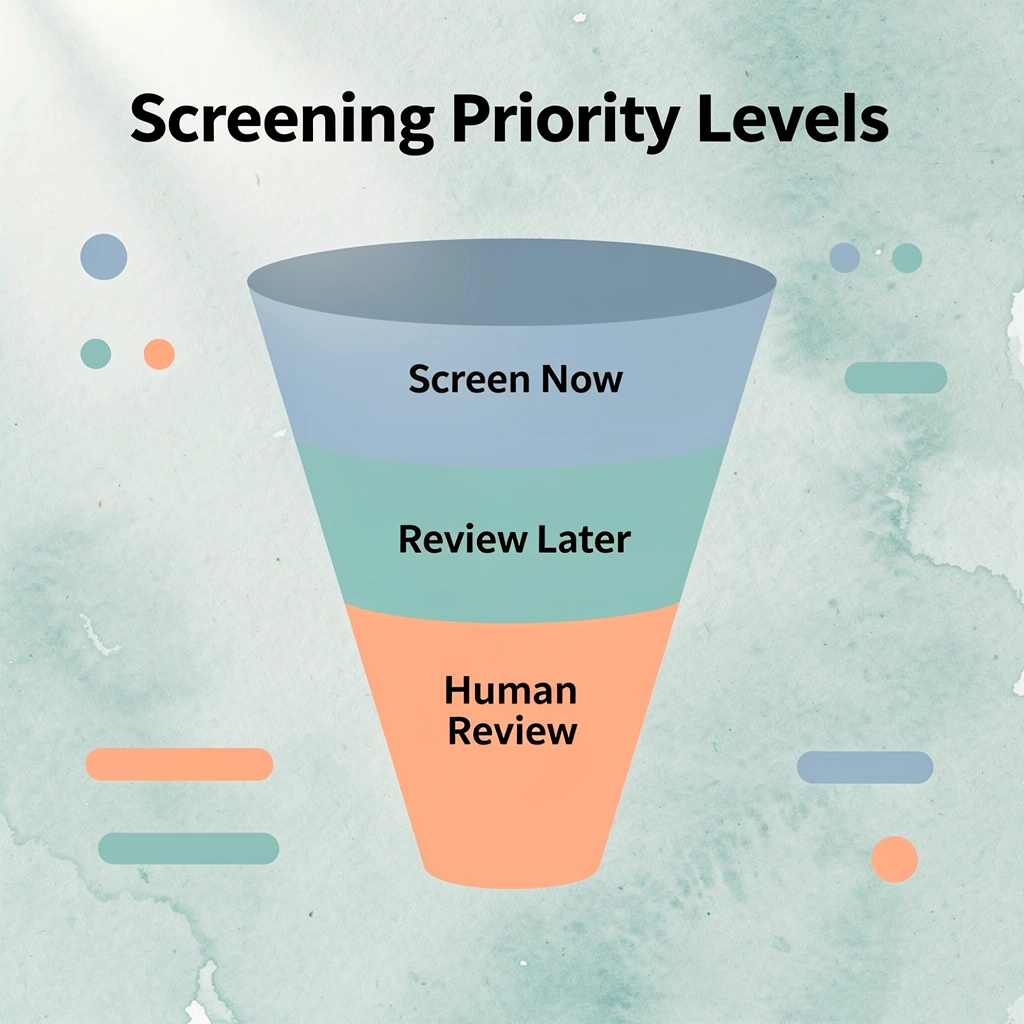
Healthcare candidate screening tools work best when they strategically reduce repetitive recruitment work without lowering evaluation quality. Decide what needs to be checked at screening, what can be looked at later, and where human judgment is still absolutely necessary.
"The most effective screening processes separate must-have checks from nice-to-have reviews — protecting recruiter time while ensuring no critical step is skipped." — Healthcare Recruitment Best Practices
Screening Stage
- What to Automate
- License verification, credential checks
- Where Human Judgment Is Needed
- Cultural fit assessment
Mid-Stage Review
- What to Automate
- Skills matching, compliance flags
- Where Human Judgment Is Needed
- Behavioral evaluation
Final Evaluation
- What to Automate
- Background check processing
- Where Human Judgment Is Needed
- Clinical judgment & references
💡 Tip: Map out your full hiring funnel before deploying any screening tool — knowing exactly which steps are repetitive vs. judgment-driven will maximize your time savings without sacrificing candidate quality.
⚠️ Warning: Over-automating the screening process is a critical mistake in healthcare hiring. Always preserve human oversight for roles that require nuanced clinical competency assessment — no tool can fully replace that judgment.
🎯 Key Point: The real power of healthcare screening tools lies in balance—letting automation handle high-volume, rule-based checks so your team can focus on the decisions that truly matter.
1. Define the Non-Negotiable Requirements
Keep mandatory qualifications separate from preferred ones. Mandatory qualifications—professional licenses, registrations, work eligibility, and specific certifications—form the basis of initial eligibility screening. Preferred experience, additional skills, or system familiarity should prioritize candidates but not automatically disqualify them. This distinction prevents screening tools from treating every preference as a knockout criterion.
2. Build Screening Criteria Around the Actual Role
Screening criteria should reflect what the person will need to do in the job. A clinical role may require specific experience, registrations, and patient-care competencies, while a healthcare administration role may focus on scheduling, records management, and healthcare systems. A healthcare IT position may require technical expertise rather than clinical credentials.
Starting with the position's responsibilities helps recruiters decide what to screen automatically and what skills require closer evaluation.
3. Screen for Skills as Well as Credentials
Credentials set basic requirements but don't show the whole story. Screening should also assess relevant experience, technical or clinical skills, job-specific competencies, and proof of working in similar environments. Evaluate candidates on abilities directly connected to the position rather than relying solely on keywords or qualifications. This is especially important for candidates with international experience or different terminology for similar work.
4. Use Progressive Screening
Start with basic eligibility screening for required qualifications, registration, or location, then move stronger candidates into detailed evaluation based on experience and skills, followed by interviews and role-specific assessments. This progressive approach reserves time-intensive evaluation for a smaller pool while gathering stronger evidence before hiring.
5. Automate Repetitive Screening Tasks
Automation is especially helpful when managing numerous job applications. Tools can help read resumes, filter applications, match qualifications, rank candidates, and extract key information across large applicant pools, reducing manual sorting.
However, automation should assist with screening rather than serve as the final decision-maker. For important decisions, recruiters should review candidate information and consider context that automated systems might miss.
6. Review Candidates Who Are Automatically Rejected
Check automated screening for false negatives by regularly reviewing rejected candidates. Some may meet requirements but were filtered out because of terminology differences, variations in career history, or how experience was presented. If strong candidates are frequently rejected at the same stage, the problem may be the screening criteria rather than the candidates.
7. Track Screening Performance
Employers should measure whether the screening process improves recruitment outcomes, not merely how fast it processes applications.
Key metrics include application volume (demand on the process), screening time (recruiter capacity used), candidate drop-off (friction in the application experience), and screen-to-interview conversion (relevance of advanced candidates). Time to hire indicates whether screening accelerates the path from application to appointment. Post-hire measures like quality of hire and early turnover reveal whether screened candidates ultimately succeed.
The goal is a screening process that handles volume efficiently while identifying candidates who deserve further evaluation.
Candidate Screening Considerations for Healthcare Hiring Across MENA
Healthcare recruitment across MENA is not a single market. The Antal International MENA Hiring Report 2025 analyzed UAE, Saudi Arabia, and Egypt, and found big differences in salary and hiring movements. Screening criteria that work in Dubai can fail in Riyadh because licensing infrastructure, workforce rules, and documentation requirements operate on completely separate systems.
"Screening criteria that work in Dubai can fail in Riyadh — licensing infrastructure, workforce rules, and documentation requirements work on completely separate systems." — Antal International MENA Hiring Report, 2025
🚨 Warning: Applying a one-size-fits-all screening framework across MENA markets is one of the most common — and most costly — mistakes in regional healthcare hiring.
Market
- UAE (Dubai)
Key Screening Consideration: DHA / HAAD licensing, Emiratisation compliance - Saudi Arabia
Key Screening Consideration: SCFHS credentialing, Vision 2030 workforce quotas - Egypt
Key Screening Consideration: Egyptian Medical Syndicate registration, local documentation norms
✅ Best Practice: Always tailor your candidate screening criteria to the specific country's regulatory and licensing framework — never assume regional alignment where none exists.

When "Qualified" Means Different Things in Different Countries
The failure point is usually a generic qualification filter applied across jurisdictions as if they share the same credentialing logic. In the UAE, the Unified Healthcare Professional Qualification Requirements assess candidates against the awarding institution's country, program content, clinical training hours, and active professional licensing. Saudi Arabia's SCFHS treats professional classification and registration as separate steps, requiring independent verification of foreign qualifications before confirming classification. A screening system that treats "licensed healthcare professional" as a single checkbox will misread candidates who are fully qualified under one system but haven't completed the administrative steps required by another.
Why do international candidates get filtered out before review?
The same issue arises when MENA employers hire workers trained abroad. A nurse trained in the Philippines, a pharmacist with UK credentials, or a specialist with clinical experience in multiple countries may have qualifications using unfamiliar words, grading systems, or school names that automated filters do not recognise. The UAE's PQR evaluates the issuing country and school, along with program content and clinical training. Screening tools that reject candidates for unfamiliar qualification names will eliminate people who meet every substantive requirement.
How does a consolidated review process keep strong candidates from walking away?
Most teams send international candidates to a manual review queue, which becomes problematic as applications grow and strong candidates accept other offers while waiting in a process not designed for their pace. AI-native platforms like Cercli solve this by consolidating candidate information, credentialing details, and hiring workflows into one system, so the review process moves with the candidate rather than stalling across disconnected tools.
Language Requirements Deserve More Precision
Constraint-based thinking applies directly here. If a role requires Arabic-language patient communication, that is a genuine job requirement and should be screened for directly. If a role requires English proficiency for clinical documentation or cross-functional collaboration, that is equally specific. What does not work is using language as a broad quality proxy: filtering out candidates whose CVs are written in a third language or whose qualifications were issued by a non-English institution, when neither fact bears on their clinical competence.
Localization Policy Is Not a Screening Criterion
The Antal International MENA Hiring Report 2025 shows that workforce localization is reshaping hiring pipelines across the region. UAE's Emiratisation mandate requires private-sector employers with 50+ staff to grow local hiring in skilled roles by 2 percentage points annually through 2026. Saudi Arabia's expanded Nitaqat program targets more than 340,000 additional localized private-sector jobs in its next three-year phase. These policies shape workforce planning and candidate pool composition, but they are workforce strategy decisions, not substitutes for profession-specific qualification and competency assessment. Mixing localization targets with screening criteria risks filtering out candidates for reasons unrelated to their ability to perform the role safely and effectively.
Once you understand how fragmented the screening process becomes when accounting for localization across multiple markets simultaneously, the real question becomes which criteria to apply.
How Cercli Helps Healthcare Companies Manage Candidate Screening
The harder question isn't which screening criteria to apply, but whether your tools can keep the process together once those criteria multiply across roles, markets, and employment types. When credential requirements, licensure checks, and compliance thresholds stack across a growing workforce, screening logic breaks down without a unified system to hold it all in place.
💡 Tip: Before adding another screening layer, audit whether your current tools can surface, track, and enforce those criteria consistently across every role and market.
"The real challenge in healthcare candidate screening isn't defining the criteria—it's maintaining process integrity as those criteria scale across multiple roles, markets, and employment types." — Cercli

Most healthcare recruiting teams stack systems on top of each other: an ATS for tracking, a spreadsheet for credential status, email threads for interview feedback, and a separate HR tool for onboarding. Each works by itself. Information lives in four places and accountability lives in none.
⚠️ Warning: A fragmented tech stack doesn't just slow down hiring—it creates compliance blind spots where critical credential or licensure data falls through the cracks between tools.
🔑 Takeaway: Healthcare organizations need a platform that consolidates screening, credentialing, feedback, and onboarding into a single workflow—so nothing gets lost between systems.
Tool
- ATS
- What It Tracks
- Candidate pipeline
- The Gap
- No credential visibility
- What It Tracks
- Spreadsheet
- What It Tracks
- Credential status
- The Gap
- No real-time updates
- What It Tracks
- Email threads
- What It Tracks
- Interview feedback
- The Gap
- No structured accountability
- What It Tracks
- HR onboarding tool
- What It Tracks
- New hire setup
- The Gap
- No screening context
- What It Tracks
Where does the screening process typically break down?
The failure point is usually invisible until it costs you a hire. A strong candidate clears initial filters, then stalls because nobody has a complete picture of where they stand. Feedback is scattered, document status is unclear, and the recruiter toggles between tools trying to reconstruct a timeline. According to Cercli's AI candidate screening resource, teams can save hours by automating manual CV reviews, but the deeper gain is clarity: having one system that knows what every other part of the process knows.
How does Cercli connect screening to the full hiring workflow?
Cercli addresses this directly. Our AI-native ATS screens applicants against defined role criteria, surfaces candidate insights, and tracks progression through a structured workflow connected to onboarding, contracts, and document collection. For healthcare employers managing multiple roles across MENA, this integration matters because a successful hire extends beyond the offer into employment arrangements, payroll, and workforce management.
When recruiters define must-have requirements in Cercli, the platform screens incoming applications against those standards consistently, eliminating the drift that occurs when criteria exist only in someone's head or an outdated document. Live recruitment analytics give hiring managers visibility into candidate progress without status meetings. According to Phenom's 2025 healthcare recruiter resource, 24/7 candidate engagement via conversational chatbot has become a defining capability separating modern healthcare recruitment tools from legacy approaches. Cercli's AI-powered screening fits within that shift: less manual sorting and more time spent evaluating candidates who warrant deeper consideration.
What does this mean for healthcare teams day-to-day?
For healthcare teams, screening, tracking, feedback, and onboarding become stages in a single workflow rather than separate problems requiring separate tools. Credential verification, clinical assessments, and role-specific evaluations still require human judgment. Cercli organizes everything around those evaluations so judgment isn't wasted on administration.
Related Reading
- Pre-Employment Screening Tools
- Hirevue Vs Smartrecruiters
- Manatal vs. HireVue
- Willo Alternatives
- Hirevue Alternatives
- Harver Alternatives
- Eightfold Ai Competitors
- Pymetrics Alternatives
- Spark Hire Alternatives
Book a Demo to Speak with Our Team about Our Global HR System
Healthcare hiring teams managing screening, credentialing, and onboarding across multiple disconnected tools need a unified platform.
"Teams juggling fragmented hiring tools don't just lose time — they lose candidates, compliance, and control." — Cercli
💡 Tip: If your team toggles between 3 or more separate tools to manage a single hire, consolidate onto one purpose-built HR platform.
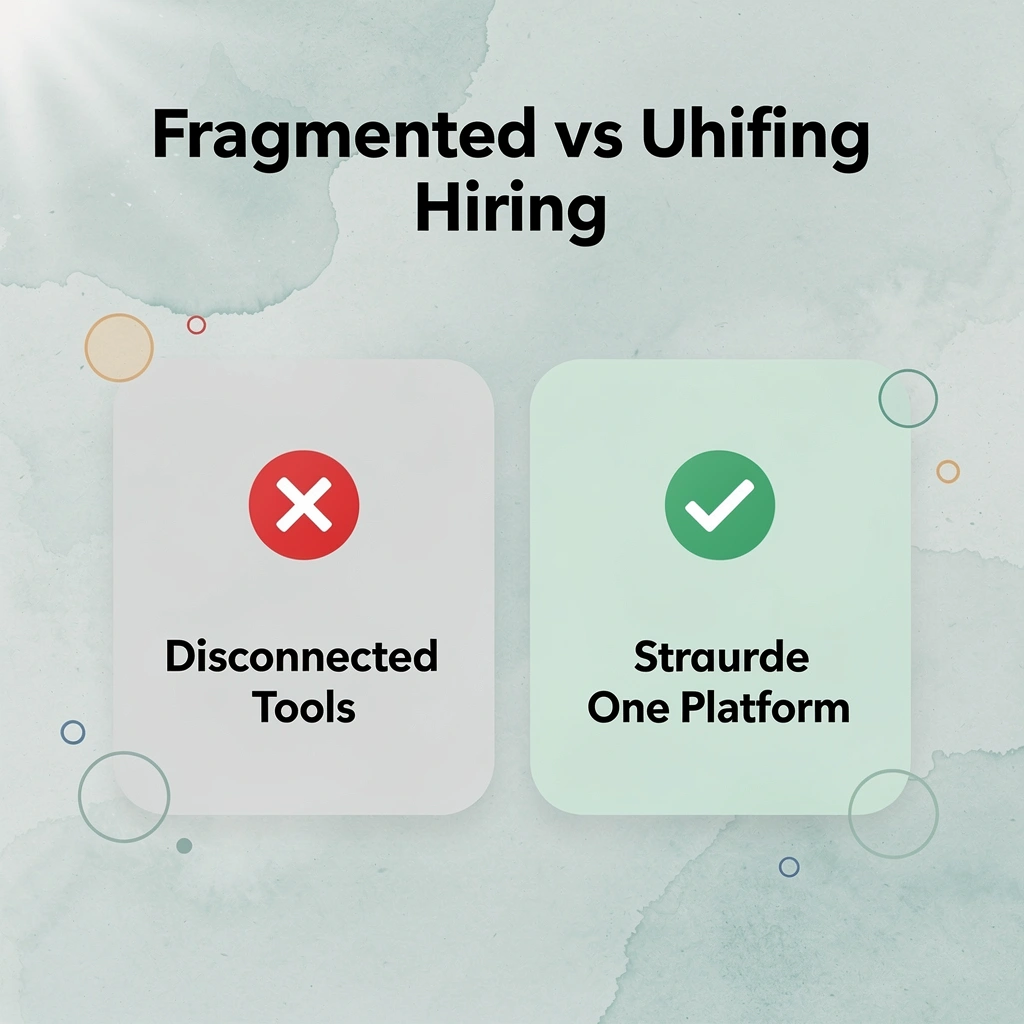
Book a free 30-minute demo with Cercli to see how our global HR system brings candidate screening, hiring activity, compliance tracking, and onboarding together in one platform built for teams hiring across MENA and beyond. Visit the global HR system to get started.
🎯 Key Point: One 30-minute conversation with our team is all it takes to see how Cercli eliminates the chaos of disconnected tools and replaces it with a single, streamlined workflow.
What You'll See in the Demo
- Candidate Screening
- Faster shortlisting with zero manual back-and-forth
- Compliance Tracking
- Stay audit-ready across MENA and global jurisdictions
- Onboarding Workflows
- Get new hires productive from day one
- Unified Dashboard
- Everything your hiring team needs in one place
✅ Best Practice: Come to the demo with your biggest hiring bottleneck in mind — our team will show you exactly how Cercli solves it.


