What's an Enterprise Recruitment System? Top 12 Platforms Compared
What is an Enterprise Recruitment System? Comparing Leading Platforms
Managing job postings, screening CVs, and scheduling interviews can become overwhelming, often leading to the loss of top candidates due to slow follow-up. A structured system allows you to track every hire, from sourcing through onboarding, and measure which channels deliver the best talent. This article examines the core functions of an enterprise recruitment system to help you refine your talent pipeline and improve candidate pipeline management. The UAE’s business landscape is known for its high standards and efficiency. By adopting a unified system, your organization can align with the region's digital goals while ensuring a professional experience for every applicant.
To support this transition, Cercli’s global HR system integrates applicant tracking, candidate sourcing, and hiring analytics into a unified interface. You can book a demo to see how Cercli brings hiring and workforce operations together by providing the tools needed to optimise recruitment and enhance the candidate experience.
Summary
- Many teams assume an Enterprise Recruitment System is simply a larger applicant tracking system (ATS), often narrowing their requirements to basic throughput and approvals. Consequently, 85% of enterprise recruitment teams believe their current systems are sufficient.
- Optimising for applicant volume rather than the handover process can lead to significant operational disruptions. For instance, one organisation’s quarterly goal of 2,000 hires was delayed because offer data arrived in three different formats, requiring payroll teams to spend weeks on manual reconciliation.
- Recruitment KPIs that focus solely on speed often mask real costs, as they rarely track the rework or provisioning errors that occur during the transition. Reports suggest that 75% of Enterprise Recruitment Systems are not fully utilised.
- Practical data insights tied to service-level agreements (SLAs) and assigned responsibilities are essential; 80% of enterprises report improved hiring efficiency when using dedicated recruitment analytics.
- The quality of system integration determines whether faster hiring actually reduces exceptions. Companies using these systems report a 50% reduction in time-to-hire when integrations are robust.
- Market adoption is high—with over 60% of companies adopting a system—yet operational use lags, with only 40% of teams leveraging the full capabilities. Procurement should therefore prioritise organisational fit and pilot programmes over technical specifications.
Cercli’s global HR system addresses these challenges by centralising validated candidate records, enforcing regional validation rules, and automating the handover into onboarding and payroll.
The Common Misconception Regarding Enterprise Recruitment Systems
.avif)
Most teams assume an enterprise recruitment system is simply:
- A larger applicant tracking system (ATS)
- Optimised for a higher volume of roles
- They set their requirements accordingly
This framing narrows the focus to applicant flow, approvals, and recruiter productivity, which often leaves the employee lifecycle beyond the initial hire unaddressed.
Why Focusing On Hiring Volume Can Be Misleading
Scaling candidate flow is fundamentally different from scaling the handover process. When requirements focus primarily on throughput, teams prioritise screening speed and interview capacity rather than how candidate data will be utilised once an offer is accepted.
This approach produces organised dashboards up to the offer stage, but can lead to operational difficulties thereafter, as downstream success depends on data structure and continuity rather than raw volume.
What Occurs After The Offer Is Accepted?
Handoffs to onboarding, payroll, and compliance often encounter issues due to:
- Inconsistent candidate records
- Missing fields
- Regional variations in formats
For example, a high-volume hiring quarter can experience setbacks if offer data arrives in multiple formats, requiring payroll teams to spend weeks reconciling entries. This results in delayed start dates and increased compliance risks. The immediate cost is duplicated effort, while the hidden cost is reduced visibility across multi-entity payroll and regulatory checkpoints.
The Persistence Of Traditional Assumptions
Many organisations maintain their current setup because they believe it meets their immediate needs. Recent industry data suggests that 85% of enterprise recruitment teams consider their existing systems sufficient.
Simultaneously, automation designed to facilitate smoother handovers remains underutilised, with only 40% of teams integrating intelligent automation into their recruitment processes. These figures indicate broad confidence in the status quo, despite limited investment in the automation needed to map hiring data directly into payroll and compliance frameworks.
Integrating Recruitment And Operations
The standard approach often involves keeping recruitment and operations as separate functions, with onboarding handled by HR or finance. While this may work for smaller teams, increasing hiring complexity across countries creates friction due to manual exports and spreadsheet management.
Cercli’s global HR and payroll system addresses this challenge by centralising hire-to-pay data and ensuring compliance with regional standards in the MENA region. By using intelligent automation, downstream teams receive consistent, audit-ready records instead of fragmented spreadsheets. To see how these processes can be unified for your business, you may wish to book a demo of Cercli’s platform.
The Actual Cost Hidden By Recruitment Metrics
Recruitment KPIs often celebrate speed and offer-to-acceptance ratios, but they rarely account for downstream delays or the hours spent on manual rework. When the focus is solely on the number of hires, organisations may overlook whether those individuals were provisioned correctly or categorised accurately for statutory reporting.
This mismatch means that recruitment efficiency is often achieved at the expense of slower onboarding and a higher compliance burden.
Prioritising The Handover Process
Teams should design for the handover stage when requirements are first drafted. This involves defining the specific fields, formats, and validation rules required by payroll and legal departments across different entities. By setting clear service level agreements (SLAs) for data transfer and requiring robust audit trails, recruitment becomes the first stage of a connected process rather than a standalone transaction.
Proactive adjustments, such as regional compliance checks, ensure that recruiter productivity translates into long-term operational reliability.
The real driver of hiring success lies in bridging the gap between talent acquisition and long-term workforce management. If you are ready to align your recruitment with the UAE’s high standards for digital excellence, explore how Cercli automates recruitment workflows to support your growth.
Related Reading
- Candidate Pipeline Management
- How Applicant Tracking Systems Work
- Applicant Tracking System Benefits
- How to Improve Candidate Experience
- HRIS vs ATS
- How to Choose an Applicant Tracking System
- Applicant Tracking System Pricing
- How to Track Open Positions
- Saas Applicant Tracking System
What an Enterprise Recruitment System Actually Is

An enterprise recruitment system serves as the technical foundation for hiring as a core operational function.
Rather than just a tool for moving applications, it coordinates multiple:
- Teams
- Entities
- Countries
By aligning data structures, approvals, and handovers, the system ensures compliant onboarding, payroll, and legal adherence without creating manual work.
How It Manages Scale And Complexity
At scale, the priority shifts from simply advertising vacancies to how a person is represented in the data. Robust systems rely on a centralised candidate record, audit logs, and secure integrations.
This ensures that a single change, such as a salary update, updates these simultaneously:
- The payroll
- Background checks
- Benefits providers
In regions such as the UAE, this structure allows teams to comply with local labour laws without disrupting global reporting.
Using Analytics And Automation Effectively
Data is only helpful if it leads to action. Instead of surface-level counts, analytics should identify where offers stall or where approval paths cause delays. For organisations in the Middle East, these tools are most effective when they monitor local compliance timelines and automate routine tasks such as routing exceptions and sending reminders to approvers.
The UAE’s Ministry of Human Resources and Emiratisation (MOHRE) has clear guidelines on job offers and contracts. An enterprise system ensures your data matches these official records from day one. Curious how this works in practice? Book a demo with Cercli to see our automated compliance features.
Governance And Security Patterns
Governance succeeds when access control is built into the foundation. Practical governance combines role-based permissions, data residency rules for each legal entity, and audit trails that record every change.
By encrypting data and limiting exports through strict policy, companies can ensure their multi-entity reporting remains reliable and their data protection is defensible.
Moving Beyond Familiar But Disconnected Tools
A common mistake is to integrate disparate tools simply because they are familiar. This often leads to reconciliation issues and compliance risks as an organisation grows into new countries.
Cercli’s platform centralises the record from the initial hire through to the monthly pay slip. By building local regulations for MENA jurisdictions directly into the software, the system reduces manual checks and provides clear audit evidence.
Reliable Integrations And Handovers
If integrations rely on manual data transfers, errors are inevitable, especially when local tax fields or ID formats change. A reliable pattern uses secure API connectors with built-in validation.
This allows teams to catch errors early, before they affect the monthly payroll. In a fast-moving market like Dubai, this level of technical accuracy is essential for maintaining trust with a diverse, international workforce.
Ensuring Adoption Across The Team
Moving from spreadsheets to a structured system only works if the transition is easy for the users. Success depends on simplifying the daily workflow, for example, reducing an approval process from several clicks to two.
A short pilot program can demo measurable improvements, such as reducing the time spent reconciling offer data. When technology is built around the human experience, adoption follows naturally.
A Simple Way To Visualise The System
Imagine an airport where every airline uses a different baggage system. While individual flights might depart, the risk of lost luggage is high. An enterprise recruitment system acts as a universal conveyor; it standardises how data is tagged and tracked, ensuring that any issues are spotted before they affect the “passenger” or lead to a compliance error.
Related Reading
- Types of ATS Systems
- ATS Features
- Applicant Tracking System Integration
- Recruiters Use AI-based applicant Tracking Systems tools
- Recruitment Management System UAE
- Best Applicant Tracking System UK
- Best ATS for Small Recruitment Agencies
- Healthcare Applicant Tracking Systems
- Best Candidate Assessment Tools
- Applicant Tracking System Functional Requirements
Twelve Enterprise Recruitment Platforms (Revised with CTAs)
Selecting the right platform depends on where your hiring process ends and where your payroll requirements begin. The goal is to choose a system that aligns with your organisation’s approval processes and your specific regional compliance needs.
Below are twelve primary platforms and the practical trade-offs to consider when connecting recruitment to your wider operations.
1. Cercli
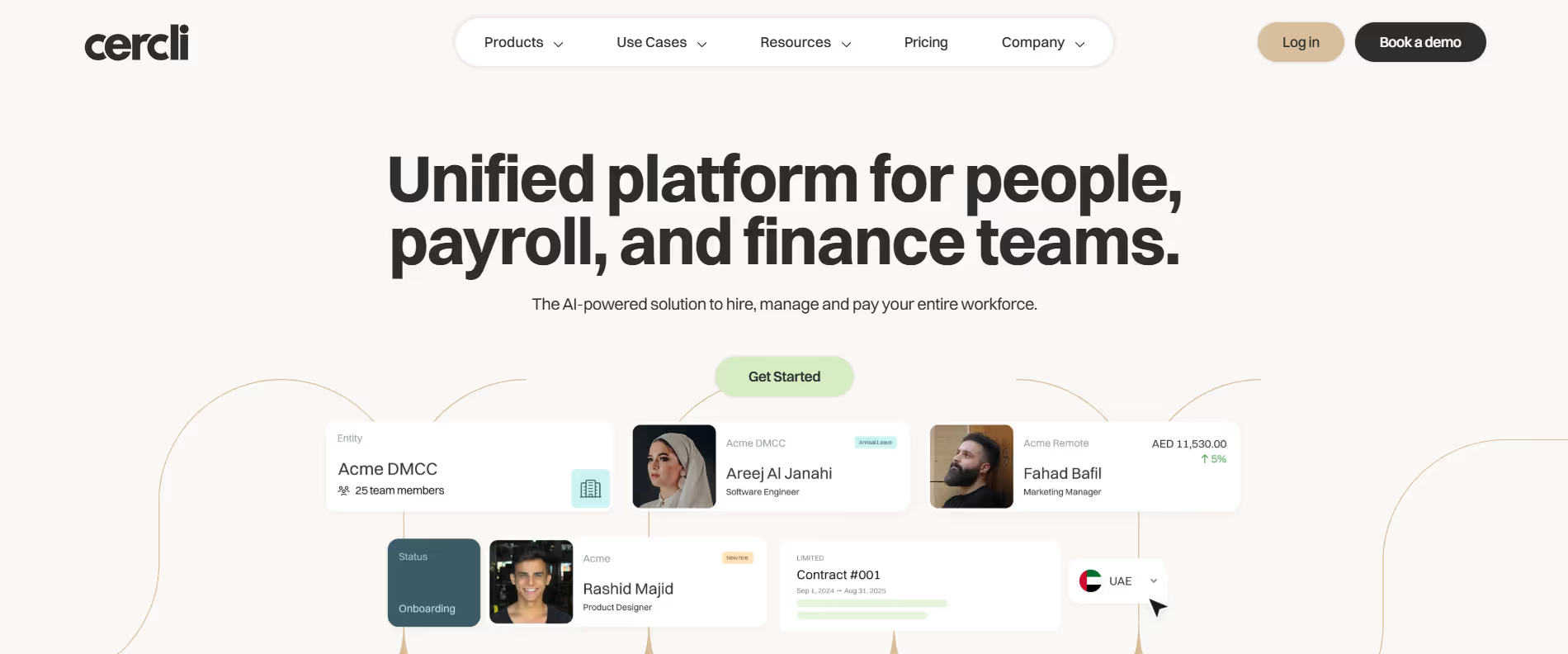
Choose Cercli for cross-border hiring across MENA, where recruitment and payroll must be perfectly aligned. Cercli combines localised payroll for the UAE, Saudi Arabia, and the broader region with an AI-integrated recruitment tool.
This allows teams to create structured vacancies and carry that same validated data through to onboarding and multi-currency payments. In the UAE, where Wage Protection System (WPS) compliance is mandatory, this reduces the risk of manual errors during the transition from candidate to employee. Reliable reporting starts with validated data.
See how Cercli automates your hire-to-pay workflow and removes the need for constant manual reconciliation.
2. Oracle Recruiting (Taleo)
Large global enterprises often select Taleo when high-volume hiring and deep ERP integration are the priority. It offers robust lifecycle tracking and strict approval controls, making it suitable for organisations already using Oracle for finance and payroll.
3. iCIMS
For teams needing adaptable workflows without extensive custom coding, iCIMS is a strong choice. It provides configurable pipelines and detailed reporting, which is useful when business units have varying approval chains.
4. SAP SuccessFactors
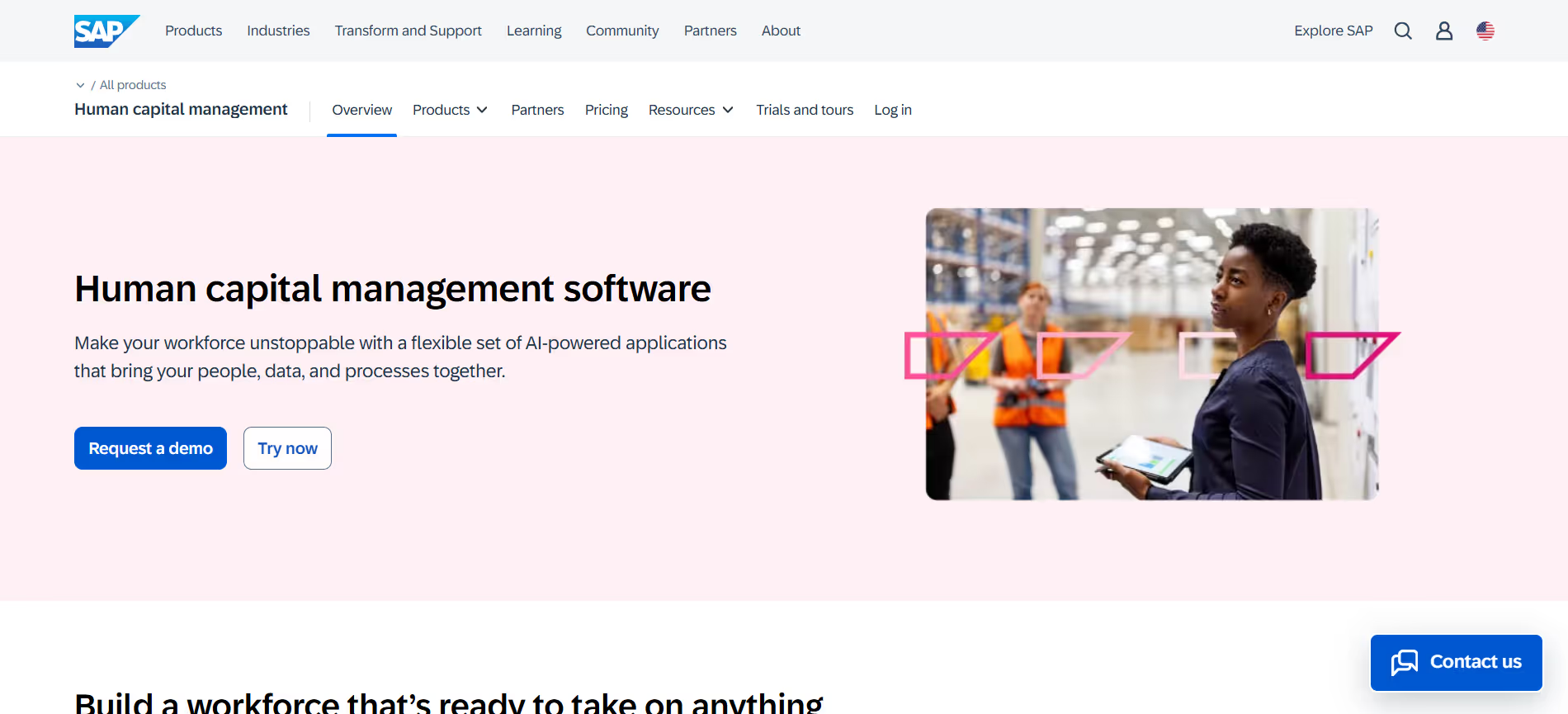
Pick SuccessFactors if you view recruitment as part of a long-term talent strategy. It links candidate matching to:
- Internal performance
- Learning
- Succession planning
It offers a unified view for organisations that measure success by employee development.
5. Workday Recruiting
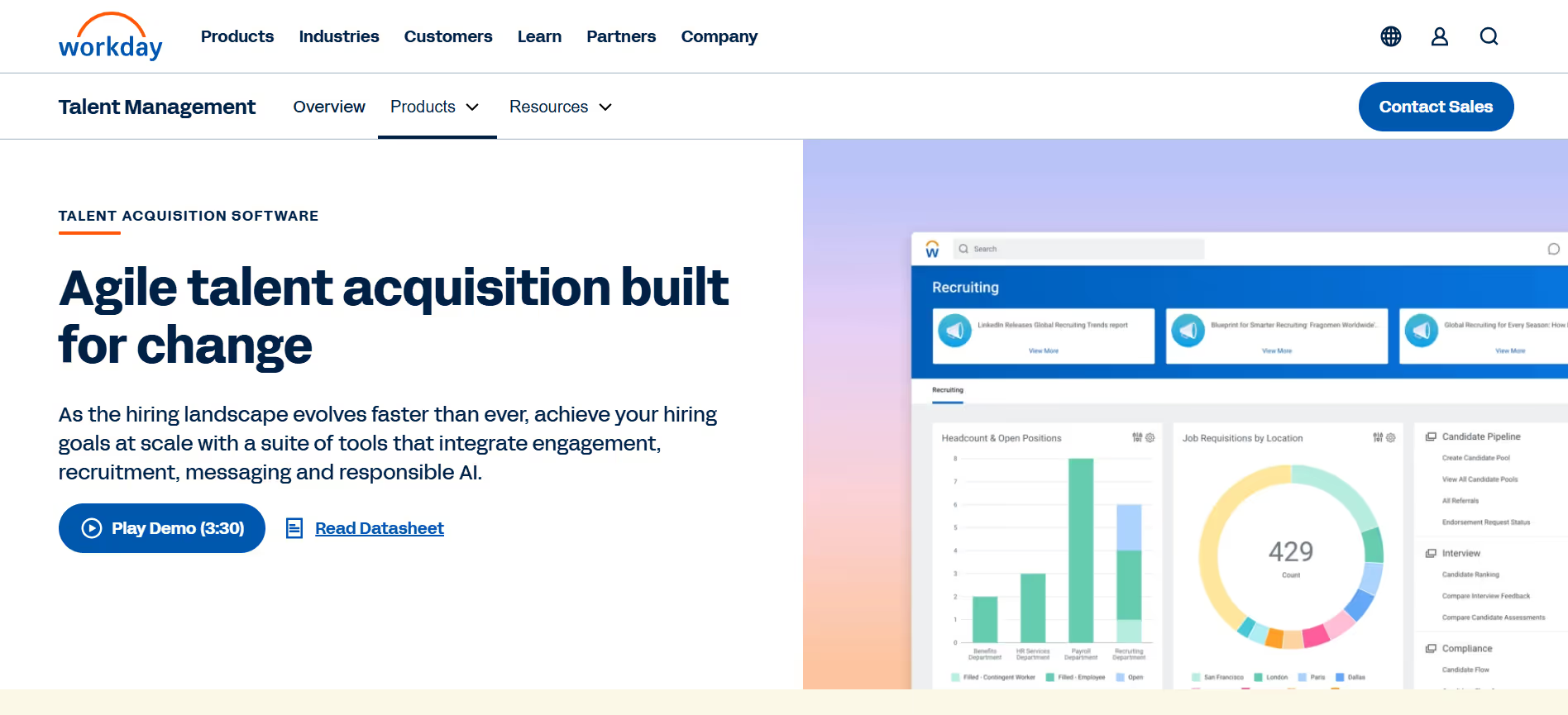
Workday is preferred by organisations seeking a unified cloud HR stack. Its focus on skills-driven matching and global payroll localisation makes it a practical choice for workforce planning, though it requires disciplined governance to manage access effectively.
6. Greenhouse
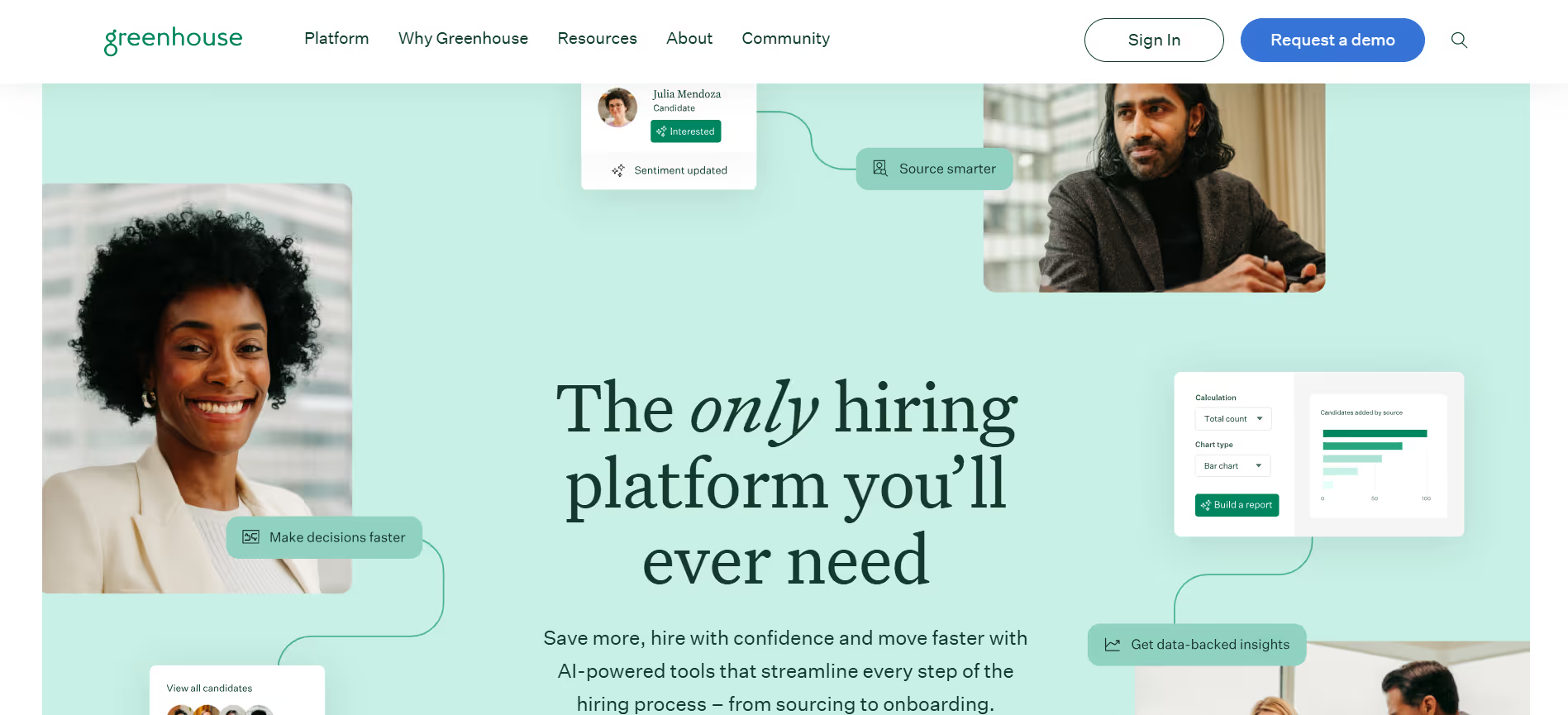
Greenhouse is designed for teams that prioritise structured, equitable interviewing. Its scorecard system and evaluation tools ensure consistency across different departments, which is ideal if interview quality is your primary metric.
7. Bullhorn
Often used by recruitment agencies, Bullhorn treats candidate relationships as a CRM problem. It includes invoicing and billing capabilities, making it a pragmatic choice for high-volume placements where financial tracking is essential.
8. SmartRecruiters
This platform suits enterprises that require scale while frequently changing their processes. It offers configurable workflows and predictive analytics without requiring advanced technical expertise to adjust.
9. Lever
Lever is built for organisations that treat recruitment as a continuous relationship.
Combining recruitment and CRM views helps teams keep passive talent engaged, which can shorten time-to-offer for specialised roles.
10. Beamery
Beamery focuses on talent communities rather than just immediate vacancies. It uses automated rediscovery to turn previous applicants into a long-term pipeline, which is valuable for recurring or expanding roles.
11. Eightfold.ai
Eightfold.ai is typically used alongside an existing recruitment system to improve skills-based matching. It uses machine learning for talent rediscovery and diversity analytics, enabling you to enhance internal placements without replacing your core HRIS.
12. BambooHR
A practical option for mid-size organisations that prioritise a smooth candidate experience. It focuses on reducing friction in the hiring process and is best suited for teams that do not require complex enterprise-level integrations.
Managing payroll across different jurisdictions doesn't have to be a manual burden. Download our guide to MENA Labour Law compliance to see how structured data simplifies the process.
Bridging the Operational Gap
Many teams still handle hiring and payroll as separate administrative tasks because that pattern is familiar. As an organisation grows, this separation leads to manual data reconciliation and delayed start dates.
Recent trends suggest that a significant number of enterprise recruitment systems remain underutilised. This often occurs because daily workflows remain stuck in spreadsheets even after a new tool is implemented. The mismatch between the software’s capabilities and actual practice means that expensive modules often remain unused, while manual reconciliation work shifts to the finance and legal teams.
Seamless Transitions: Moving from Pipeline to Payroll
Platforms like Cercli address this by enforcing regional validation at the source. By carrying a structured candidate record directly into the payroll system, the entire process is audited and automated. This shifts hours of manual work back into hiring and ensures compliance with regional standards.
Selecting a recruitment system is not just about the “engine” for finding talent; it is about the “transmission” that smoothly carries that talent into the organisation. Choosing the right system is about more than features; it’s about how the system supports your team's daily habits. If you’re ready to move beyond spreadsheets, book a brief introductory call with our specialists to discuss your requirements.
How to Choose the Right Enterprise Recruitment System

Selecting a system should prioritise reliable handovers over a lengthy list of features. Focus on API-driven integrations, enforce field-level validation, and set clear Service Level Agreements (SLAs) for every data transfer.
A successful pilot programme should demonstrate that data moves accurately from the candidate record to your payroll and compliance systems.
Operational Outcomes To Expect From Vendors
Start by specifying your required outcomes. You should require measurable SLAs for data delivery, reconciliation time, and error rates, and insist on clear audit trails for every change. Monitor practical metrics daily, such as the time between an offer being accepted and the record being “payroll-ready,” the percentage of records requiring manual correction, and the average time to resolve mapping errors.
These metrics ensure you can measure adoption and ongoing vendor performance against a clear baseline. With the UAE’s focus on digital transformation and project-led growth, local businesses now prioritise precision over mere volume. Explore how Cercli aligns with UAE workforce trends.
Assessing Integration Quality
Treat integration assessments with the same rigour as a legal contract.
Require an API agreement that includes:
- Versioning
- Retry queues
- Schema validation
Alongside a staging environment that reflects your active payroll regulations. Run tests for complex scenarios, such as multi-entity hires with different national ID formats or conditional fields that vary by jurisdiction. Ensure the vendor provides automated anomaly alerts to prevent errors from going undetected.
Buying Criteria In A Mature Market
As of 2026, most companies have already adopted some form of recruitment system. This shifts the focus from simple adoption to how well these systems work together. Your decision should centre on integration quality and operational fit. While many vendors claim they can scale, it is essential to test them against your busiest workflows and most complex regional use cases.
Is your current system keeping up? Book a brief introductory call to see how our platform handles multi-entity complexity.
Why Procurement Language Matters
Formalise integration, ownership, and exit rights within your contract. Specify who is responsible for field mapping and who manages technical fixes. Include rollback clauses and insist on data portability in machine-readable formats.
These terms are not negotiable add-ons; they are core risk controls that prevent you from being locked into undocumented systems.
Moving Away From Manual Handovers
Many teams still handle data transfers using CSV files and emails because it is familiar. As your organisation grows, these ad hoc methods lead to reconciliation errors, payroll delays, and audit gaps.
Platforms such as Cercli centralise validated candidate records and enforce regional validation rules. This automates the handover into onboarding and payroll, providing a single source of truth and significantly reducing manual work.
Ownership After Implementation
System ownership should be a cross-functional oversight role with clear accountability. Talent operations should manage the candidate data, payroll teams should define verification rules, and legal teams should oversee data residency and consent policies.
Regular reviews are necessary to ensure the vendor is meeting integration metrics before new features are activated across all entities.
What A Pilot Should Demo
A pilot programme should verify the entire “hire-to-pay” path. Test diverse hires, offers with conditional tax requirements, and the specific reports your finance team needs for statutory filings. Measure the results against your SLAs for payroll readiness and reconciliation hours. View the pilot as a practical verification of the system's ability to handle your daily operations.
Ready to simplify your regional payroll? Download our guide to MENA compliance to learn how integrated data reduces risk.
Related Reading
- Bamboohr Alternatives
- Top Recruiting Tools
- Top Applicant Tracking Systems
- Workday Alternatives
- Greenhouse vs Lever
- Bamboohr vs Rippling
- BambooHR vs Workday
- BambooHR vs Paylocity
- Greenhouse Competitors
Book a Demo to See How Cercli Unifies Hiring and Workforce Operations
Many teams continue to manually integrate recruitment tools, spreadsheets, and payroll exports because it feels familiar during periods of rapid expansion.
This convenience often leads to a backlog of administrative tasks, resulting in last-minute:
- Verifications
- Extended reconciliation
- Compliance
These factors challenge the talent operations.
If this is a challenge your organisation faces, book a demo with Cercli. We will walk you through a complete recruitment-to-payroll workflow to show how Cercli transforms recruitment data into verified, auditable records. These records feed directly into your HRIS, onboarding, and payroll systems, improving hiring efficiency and reducing operational risk across the UAE and the wider region.


